




There is a moment on the Dzükou Valley trek — usually somewhere between the treeline and the first ridge — when the path crests and the valley opens below you in its entirety: an impossibly wide, impossibly green bowl of rolling hills at 2,452 metres, ringed by higher ridges, bisected by a stream, and in season carpeted with the extraordinary Dzükou lily. It is one of those landscapes that produces involuntary stillness. Experienced trekkers who have walked Himalayan routes far more technically demanding will tell you that Dzükou stays with them.
Dzükou Valley straddles the border between Nagaland and Manipur — it can be reached from both sides, and the two routes offer quite different experiences. The Nagaland approach (via Viswema or Zakhama village near Kohima) is the more popular and involves a steeper, forest-dense ascent. The Manipur approach (via Mao, near the Kohima–Imphal highway) is gentler and passes through different flora. Both lead to the same valley — a high-altitude paradise that rewards every kilometre of effort.
Quick Facts About Dzükou Valley
| Location | Nagaland–Manipur border (accessible from both states) |
| Altitude | 2,452 metres (8,044 feet) |
| Trek Duration | Day trek possible; 2–3 day overnight trek recommended |
| Trail Difficulty | Moderate to Challenging (steep ascent sections; manageable for fit beginners) |
| Nagaland Entry Point | Viswema Village or Zakhama Village (near Kohima) |
| Manipur Entry Point | Mao town (on NH2 between Kohima and Imphal) |
| ILP Required | Yes — Nagaland ILP for Indian nationals; separate Manipur ILP if entering from that side |
| Best Time | June–September for Dzükou lily; October–May for trekking comfort |
| Famous For | Dzükou lily (Lilium mackliniae var.), rolling green hills, camping, seasonal wildflowers |
What Makes Dzükou Valley Special
Dzükou Valley is not the highest trek in Northeast India, nor the most technically demanding. What makes it exceptional is the combination of landscape, flora, and accessibility that few other high-altitude valleys in the region can match.
The Dzükou Lily: The valley’s most celebrated resident — Lilium mackliniae, a rare pink-white lily that blooms exclusively in the Dzükou Valley and a few adjacent highland areas. The lily blooms from late June through August, carpeting the valley floor in pink and white during the monsoon season. This is the only place in the world where this species grows in the wild.
Year-round appeal: Unlike many trekking destinations that have a single optimal window, Dzükou offers genuinely different experiences across the seasons — green and flower-filled in monsoon; gold-and-russet in autumn; stark and dramatic in the cold months; rhododendron-blooming in spring.
The crossing experience: Because the valley sits on the Nagaland–Manipur state boundary, trekkers who traverse it fully — entering from one state and exiting from the other — have one of the genuinely unusual multi-state trekking experiences in India. This requires ILPs for both states.
The Two Trekking Routes
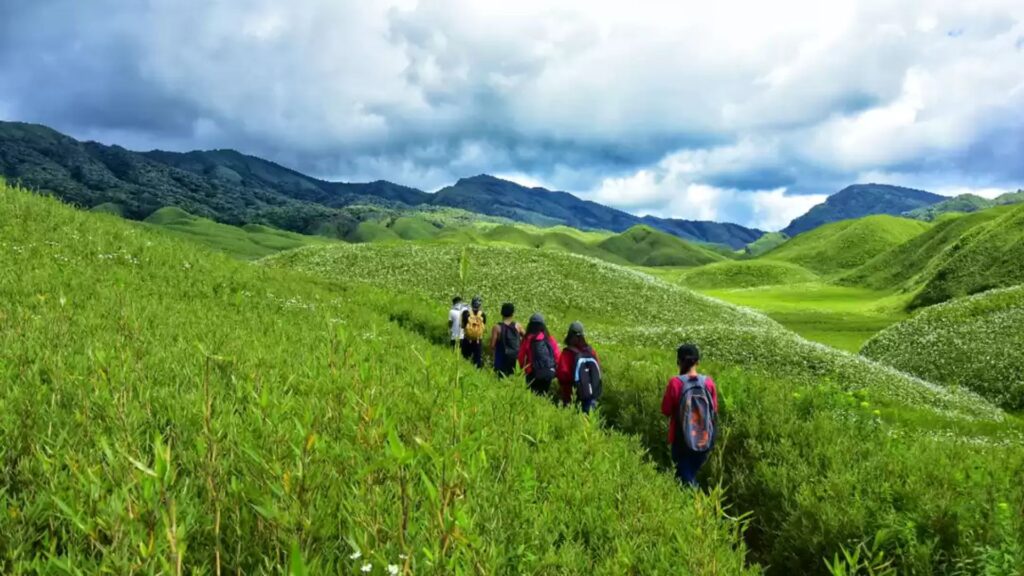
Route 1: Viswema Trailhead (Nagaland Side — Most Popular)
The Viswema route begins at Viswema village, approximately 20 km south of Kohima on NH29. From the village, a trail climbs steeply through mixed forest for approximately 7 km before reaching the valley rim and descending into Dzükou.
- Distance: 7 km from Viswema to valley; 14 km return
- Ascent: Approximately 700 metres over 7 km — steep in sections, well-defined trail
- Time: 3–4 hours ascent; 2.5–3 hours descent
- Difficulty: Moderate — suitable for fit beginners with proper footwear; strenuous for those unaccustomed to hill walking
- Facilities: Basecamp at valley floor with basic shelters and camping ground
Route 2: Zakhama Trailhead (Nagaland Side — Alternative)
The Zakhama route begins at Zakhama village, also near Kohima, and offers a slightly different forest approach to the valley. The trail is less trafficked than the Viswema route and passes through areas of exceptional bird diversity.
- Distance: Approximately 8 km to the valley
- Difficulty: Moderate — similar to Viswema but with different forest character
- Best for: Birdwatchers and those seeking a less-trafficked route
Route 3: Mao Trailhead (Manipur Side)
The Mao approach begins at Mao town on the Kohima–Imphal highway, in the Senapati district of Manipur. The trail from Mao is generally considered less steep than the Nagaland approaches and passes through a rhododendron forest of exceptional richness. A Manipur ILP is required in addition to the Nagaland ILP.
- Distance: Approximately 8–10 km from Mao to the valley
- Difficulty: Moderate — gentler gradient than Viswema
- Best for: Rhododendron season (March–April) and those entering from Imphal direction
- Note: Requires both Nagaland and Manipur ILPs for a full traverse
| For a first visit, the Viswema (Nagaland) route is recommended — it is the best-marked, most serviced, and most straightforward. For a second visit or for those wanting a traverse experience, enter from Viswema and exit via Mao (or vice versa) for a genuinely memorable cross-border mountain experience. |
Dzükou Valley Through the Seasons
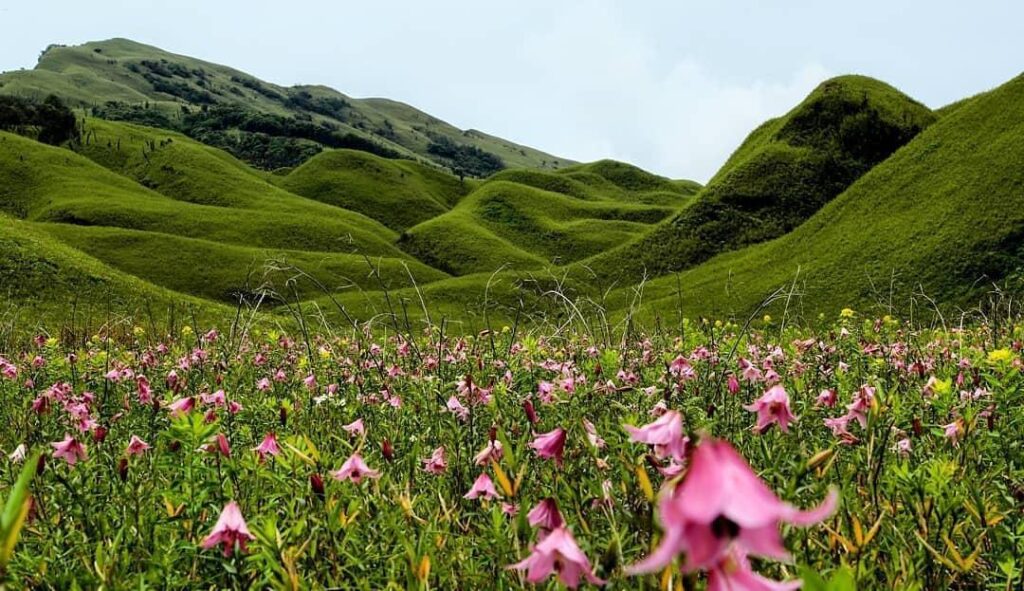
June to August — The Lily Season
The monsoon months are when Dzükou Valley reaches its most famous incarnation — carpeted in Dzükou lilies, intensely green, and wrapped in shifting mist. The trail is wet and the ascent can be muddy, but the valley at full bloom is one of the great natural spectacles of Northeast India. This is the season for the iconic lily photographs.
- Dzükou lily in full bloom: Late June through August; peak usually mid-July to early August
- Conditions: Wet, muddy, misty — carry full waterproofs and waterproof boots
- Other wildflowers: Multiple orchid species, primulas, and fritillaries also in bloom
- Wildlife: Monsoon season is excellent for birds; the wet conditions bring out more animal activity
October to December — Autumn Colours
The post-monsoon months bring a different beauty to Dzükou — the hills turn gold and rust, the skies clear dramatically, and the views from the valley rim extend across multiple ridgelines. This is the best season for photography of the landscape itself rather than the flowers.
- October: Golden grasslands; clearest skies of the year; best landscape photography
- November: Cold nights; sharp visibility; possible frost at higher points
- December: Cold; possible light snow at the valley rim; very few other trekkers
March to May — Rhododendron Season
Spring transforms the forests on the approach to Dzükou into corridors of flowering rhododendron — crimson, pink, and white blooms against bright green new growth. The valley itself is not as dramatically flowered as in monsoon, but the approach forests are exceptional.
- March–April: Rhododendron forests in bloom on Viswema and Mao approaches
- May: Warming up; some early lilies beginning to sprout; pleasant trekking temperatures
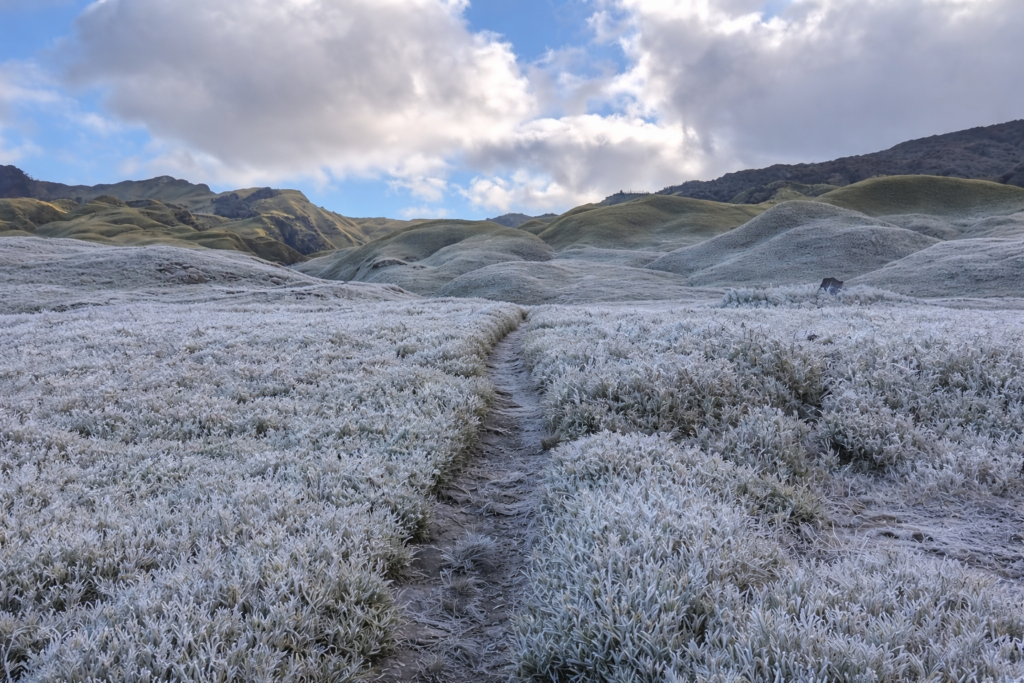
January to February — Cold and Clear
The coldest months bring clear skies, minimal other trekkers, and the possibility of frost and light snow on the valley rim. For experienced campers with appropriate gear, this is one of the most solitary and beautiful times to visit.
- Temperature: Daytime 5–12°C in the valley; sub-zero at night
- Gear: High-quality sleeping bag (rated to -5°C minimum) essential
Camping in Dzükou Valley
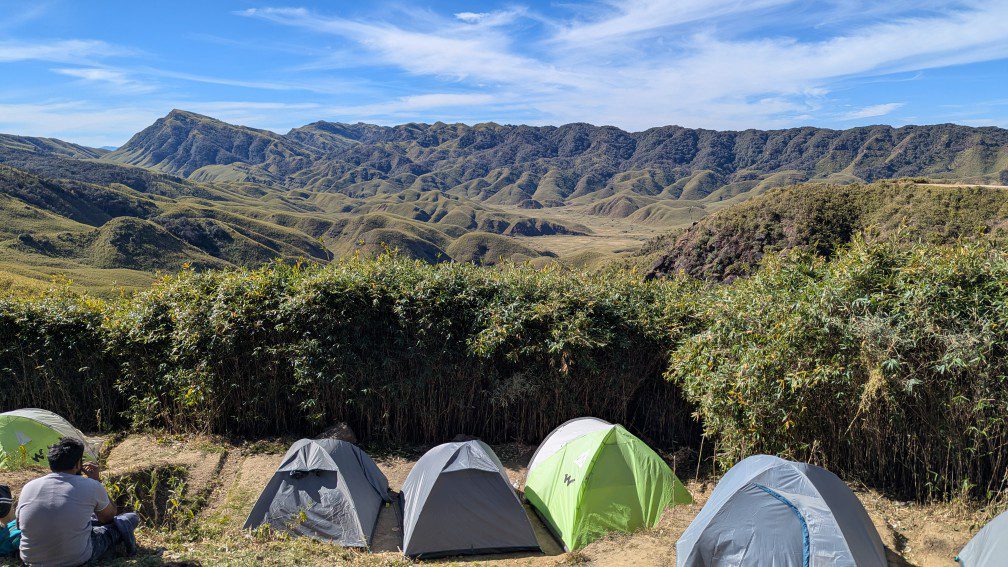
Overnight camping is the definitive Dzükou Valley experience. The valley base camp area has a basic shelter, a water source (stream), and space for multiple tents. Camping under a sky full of stars at 2,452 metres, with only the sound of the stream and the distant call of nocturnal birds, is one of the finest outdoor experiences in Northeast India.
- Camping permission: Obtain from the Forest Department in Kohima or through a registered trekking operator
- Equipment: Carry tent, sleeping bag, cooking equipment, and all food — no facilities in the valley
- Water: Stream water is generally clean but boil or treat before drinking
- Waste: Carry out all rubbish — the valley’s pristine condition is a community responsibility
- Campfire: Not permitted in the valley — use a portable stove
| The most recommended Dzükou itinerary: Day 1 — drive from Kohima to Viswema; trek to valley; set up camp. Day 2 — explore the valley floor, upper ridges, and lily fields; afternoon photography; overnight again. Day 3 — morning light photography; descend to Viswema; return to Kohima. Two nights in the valley is significantly better than one. |
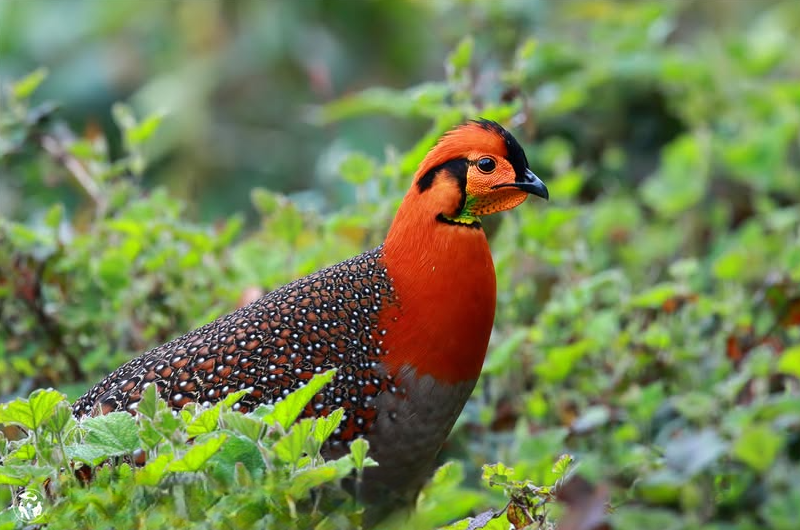
Wildlife of Dzükou Valley
- Blyth’s Tragopan — Nagaland’s state bird; a spectacular pheasant found in the rhododendron forests on the approach and valley edges
- Blood Pheasant — High-altitude pheasant occasionally seen in winter
- Hoolock Gibbon — Present in the lower forest zones of the approach
- Barking Deer (Muntjac) — Commonly heard at dawn and dusk in the valley
- Multiple warbler, laughingthrush, and nuthatch species — Best observed on the forested approach sections
Practical Trekking Information
What to Carry
- Waterproof jacket and trousers — essential year-round
- Sturdy trekking boots with ankle support — wet and rocky terrain
- Trekking poles — strongly recommended for the steep descent
- 3 litres of water minimum — refill at the valley stream
- High-energy snacks and packed meals for overnight trips
- Headtorch with spare batteries
- Basic first aid kit, including blister treatment and pain relief
- Warm layers — temperature drops significantly after sunset
Guides & Porters
Local guides from Viswema or Zakhama village are available and recommended for first-time trekkers. Guides know the trail intimately, can identify flora and fauna, and provide essential safety cover on the steeper sections. Porter services are also available for those carrying heavy camping equipment.
How to Reach the Trailheads
- Viswema Trailhead from Kohima: 20 km south on NH29; taxi or shared sumo from Kohima town; approximately 45 minutes. Arrange in advance as early departure (6–7 AM) is recommended.
- Zakhama Trailhead from Kohima: 15 km from Kohima; accessible by taxi.
- Mao Trailhead from Kohima: 60 km south on NH29 toward Imphal; Mao is on the Nagaland–Manipur border.
Travel Essentials for Dzükou Valley
- Nagaland ILP required — apply at nagalandilp.in before travel
- Manipur ILP additionally required if entering or exiting via the Mao side
- Register at the Forest Department checkpost at the trailhead before ascending
- No mobile signal in the valley — inform someone of your itinerary before departing
- Cash only — no facilities in or near the valley beyond Viswema village
Also Read: How to Apply For Travel Permits for Traveling to Northeast India
Best Time to Visit Dzükou Valley
- June to August: Dzükou lily season; monsoon; wet but extraordinary floral display
- October to November: Best trekking weather; clear skies; autumn colours; highly recommended
- March to May: Rhododendron season on approach; pleasant temperatures
- December to February: Cold and clear; minimal crowds; requires proper cold-weather gear
Also Read: Best Time to Visit Northeast India — Month-by-Month Guide

[…] for all required states. Kaziranga jeep safari slots (Central Range books fastest). Goecha La or Dzükou Valley trek operators if trekking is in the […]