




There is a connection between the Gunabati Temples at Udaipur and Rabindranath Tagore that most visitors do not know about. Tagore’s novel Rajarshi (1887) and his drama Visarjan (1890) — both set in the court of a fictional Tripura king — draw on the cultural and historical atmosphere of Udaipur’s royal period, including the religious environment of the Bhuvaneshwari Temple and the royal temple complexes built by the Manikya dynasty. Rabindranath Tagore’s Rajarshi novel settings trace directly back to this landscape. The Gunabati temples are part of the historical fabric that supplied the imaginative material for two of Tagore’s early works.
The Gunabati Temples — located near Udaipur in the Gomati district of Tripura, just southwest of the massive Amar Sagar lake — were built in 1668 CE during the reign of Maharaja Govinda Manikya, dedicated to his queen, Maharani Gunabati. The complex stands within the old fortified core of Radha Kishorpur (historical Udaipur), making its layout an integral part of the kingdom’s early hydraulic urban design. Today, the four ancient brick temples in Udaipur, Tripura, are preserved by the Archaeological Survey of India and represent some of the finest surviving examples of 17th-century Bengali temple architecture in Northeast India.
Gunabati Temples: The 17th-Century Royal Legacy of Udaipur
| State | Tripura |
| District | Gomati |
| Location | Near Udaipur (Gomati district HQ); southwest of Amar Sagar lake; ~55 km from Agartala |
| Built | 1668 CE — verified by a stone foundation inscription on the principal temple |
| Named After | Maharani Gunabati — queen consort of Maharaja Govinda Manikya |
| Architecture | Aat-chala style with Buddhist stupa-finial fusion — a distinctly Tripuri royal variant |
| Number of Temples | Four main temples; the Mahadeb Bari is a related fifth structure |
| ASI Status | Protected by the Archaeological Survey of India — Archaeological Survey of India-protected sites, Agartala region |
| Tagore Connection | Inspiration for Rajarshi (1887) and Visarjan (1890) |
| Combined Visit | Old Rajbari Palace (500 m); Bhuvaneshwari Temple; Matabari; Jagannath Dighi |
| No ILP Required | Tripura is open to all Indian nationals; drive freely on NH44 from Agartala |
| The 1668 CE Foundation Inscription. The exact construction date is not a matter of inference — it is verified by a stone foundation inscription plaque found on the principal temple. Written in old Bengali script, the inscription explicitly states that the complex was consecrated by Maharani Gunabati herself in the Saka era equivalent of 1668 CE. This places Gunabati among the relatively small number of Tripura’s historic temples whose foundation date rests on primary epigraphic evidence rather than oral tradition or later textual reference. |
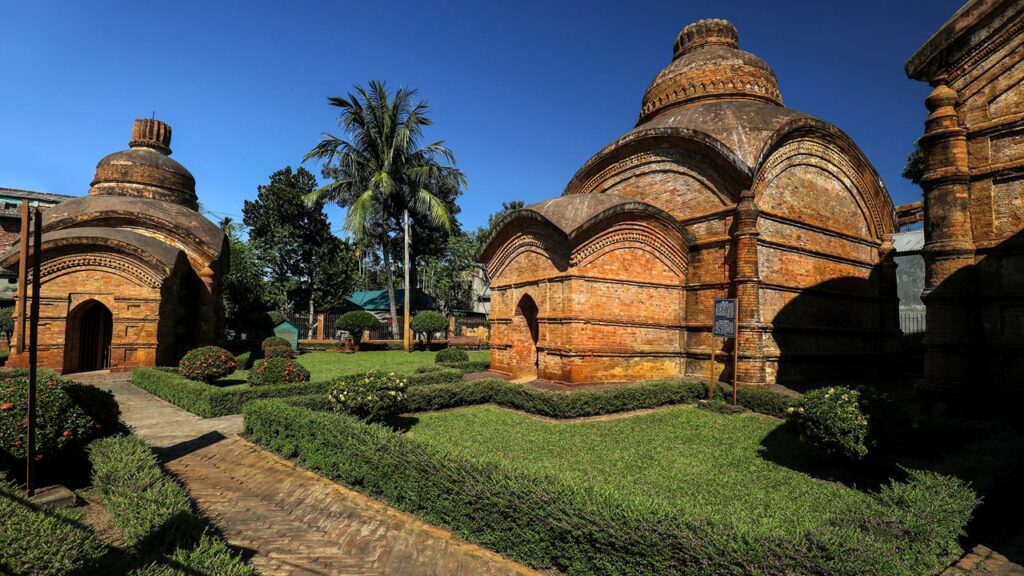
The Aat-Chala Architectural Code: Decoding Bengal’s Eight-Roofed Style
The aat-chala temple architecture features that define the Gunabati group represent a specific structural evolution within Bengali temple design. The style is best understood as a progression from the simpler char-chala (four-roofed) form: a basic char-chala temple has a single pyramidal roof divided into four sloping sections (‘chala’), converging at a central ridge. The aat-chala (eight-roofed) form adds a second tier — a miniature, secondary four-roofed cap built symmetrically on top of the primary four-roofed base structure, doubling the roof count to eight. The resulting double-pyramidal profile is the style’s most immediately recognisable feature.
This layered roof form is not an abstract architectural exercise — it is a direct masonry translation of the traditional straw-thatched village huts of Bengal, in which a similar tiered thatch profile arose from practical roofing needs. Bengali temple builders of the 16th and 17th centuries replicated this vernacular silhouette in permanent brick and lime-mortar construction, elevating a rural building tradition into a royal architectural idiom. The Gunabati temples, built by craftspeople trained in or imported from the Bengal tradition, are a Tripuri royal expression of this same translation.
The Fusion of Islamic Arches and Buddhist Stupa Finials in Tripuri Art
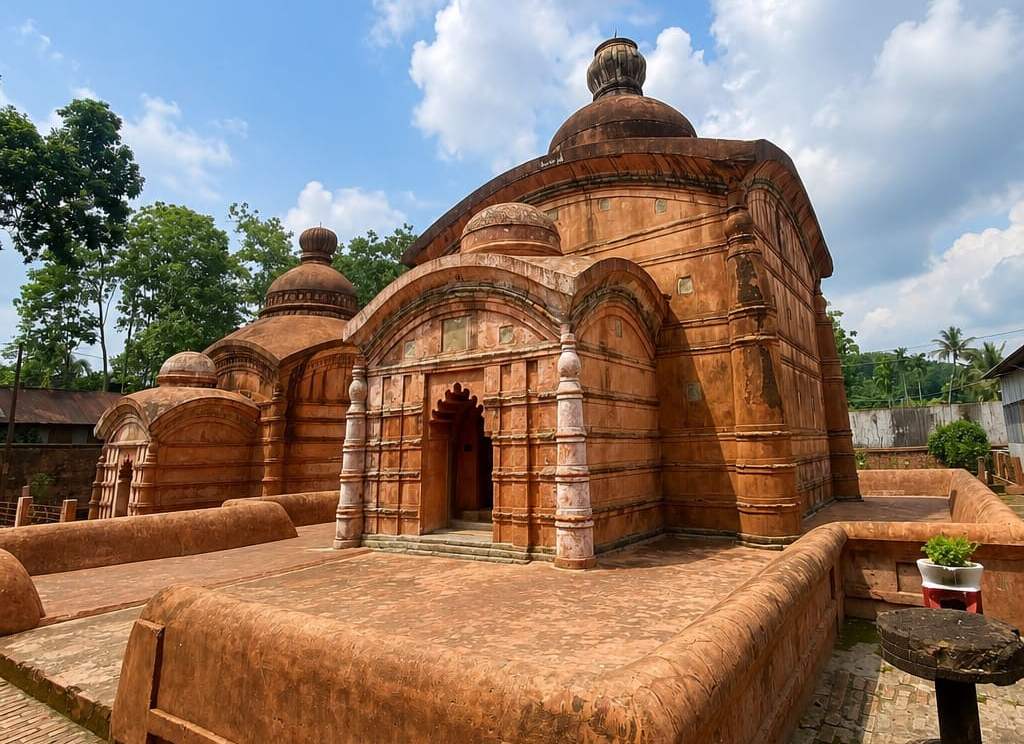
Tripuri temples feature an architectural quirk that distinguishes them sharply from mainland Bengal examples. While West Bengal aat-chala roofs typically terminate at a sharp, straight, pitched ridge line, the royal builders at Gunabati crowned the apex with elements borrowed from Buddhist art — specifically a curved crown or circular stupa-style finial supporting the kalasa (the sacred pot that traditionally tops Hindu temple spires). This fusion of a Buddhist stupa silhouette with a Hindu temple’s sacred vessel, combined with the pointed arch openings characteristic of Indo-Islamic masonry traditions present across Bengal at the time, reflects the genuinely multi-religious cultural history of the Manikya kingdom — a court that absorbed Buddhist, Islamic, and Bengali Vaishnavite influences into a single architectural vocabulary.
Architectural Evolution & Style Comparison
The table below sets the standard West Bengal aat-chala form against the distinct Tripuri royal variant realised at Gunabati:
| Architectural Element | Standard West Bengal Aat-Chala | Tripuri Royal Variant (Gunabati) |
| Roof Apex Termination | Straight horizontal ridge line | Domed stupa-like circular pinnacle |
| Primary Wall Cladding | Dense, total-surface terracotta narrative panels | Plain plastered brickwork with isolated terracotta accents |
| Entrance Layout | Triple-arched multi-columned porch | Single arched opening with thick, defensive fort-style walls |
Maharaja Govinda Manikya: The True History Behind Tagore’s Visarjan
Understanding Maharaja Govinda Manikya’s history in Tripura is essential to understanding why Gunabati exists. Govinda Manikya (reigned 1660–1661 and 1663–1673 CE) was one of the most complex and culturally significant rulers in the Manikya dynasty’s history. His court supported scholarship and religious culture, and the temples he built — including the Gunabati group, dedicated to his queen — were expressions of royal piety and cultural ambition realised in brick and terracotta.
It is the specific character of Govinda Manikya’s reign — its religious complexity, its conflicts between royal power and Brahminical authority, and a famous episode involving the sacrifice of a favoured devotee — that Tagore used as the basis for Rajarshi and Visarjan. The Bhuvaneshwari Temple in Udaipur, beside the Old Rajbari Palace, is directly connected to this episode.
The Gunabati temples belong to the same royal religious building programme that defines Govinda Manikya’s contribution to Udaipur’s heritage landscape. He was known in his time for an act of personal piety that passed into oral tradition: he reportedly renounced his kingdom voluntarily out of religious conviction, then returned to rule it twice — a life with the quality of moral drama that drew Tagore to the material.
Inside the Complex: Terracotta Motifs, Shiva Shrines, and Foundation Inscriptions
- The primary temple: Dedicated to Shiva; the largest of the four; the most elaborately decorated in surviving terracotta
- The Mahadeb Bari: A related fifth temple structure, associated with the same royal building programme, mentioned separately in some sources alongside the main Gunabati group
- The terracotta panels: Mythological scenes and decorative elements rewarding close examination — bring binoculars for the higher sections
- The hillside setting: The temples are arranged on a slope; views from the upper temple across the Udaipur area are pleasant
| Gunabati Temple Heritage & Photography Field Guide. Because this protected complex is an active archaeological conservation site, keep these parameters in mind for an optimal visit: Angle for light optimisation: The facades face east. Arrive between 08:00 AM and 10:30 AM to catch the morning sun on the surviving terracotta panels along the front cornicesSpot the floral medallions: Look closely at the arch spandrels of the central temple for deeply carved, stylised lotus medallions — a signature motif used by 17th-century royal artisans to denote state-sponsored constructionCombine with the Royal Palace ruins: Walk just 500 metres northeast to the Old Rajbari Palace ruins, seamlessly extending your half-day itineraryTripura travel compliance: Unlike other Northeast Indian states, domestic Indian tourists do not require an Inner Line Permit (ILP) for Tripura — drive freely along NH44 from Agartala directly to Udaipur |
| Archaeological note: The Gunabati temples are under ASI protection, meaning entry is regulated and conservation is actively managed. The current condition reflects both 350+ years of age and the ASI’s ongoing maintenance. Some terracotta decoration has deteriorated; other sections remain remarkably intact. |
Navigating the Udaipur Heritage Circuit: Matabari, Amar Sagar, and Rajbari Ruins
The Gunabati Group of Temples is most effectively visited as part of a comprehensive Udaipur heritage circuit — the town and its surroundings contain more significant historical and religious sites per square kilometre than any other area in Tripura outside Agartala.
- Tripura Sundari Temple (Matabari) — 2 km from Udaipur; one of India’s 51 Shakti Peethas; the most sacred pilgrimage site in Tripura
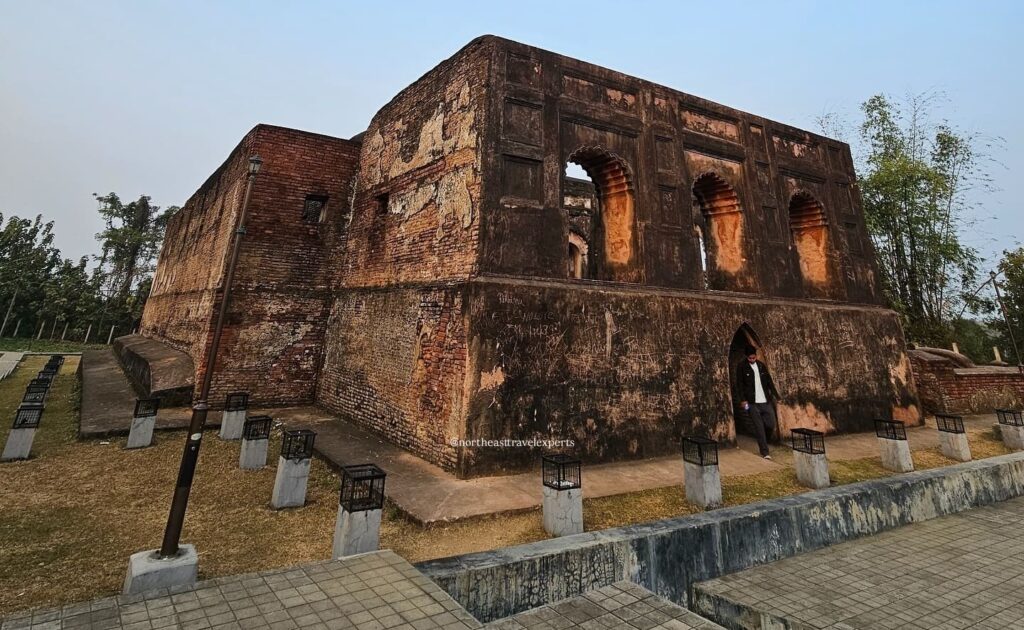
- Old Rajbari Palace — 0.5 km from Udaipur town and 500 m from Gunabati; ruins of the Manikya royal palace that preceded Agartala as the state capital
- Bhuvaneshwari Temple — Beside the Old Rajbari; the temple that inspired Tagore’s Visarjan; still an active worship site
- Amar Sagar and Jagannath Dighi — The large lakes beside which the Udaipur palace complex was built; pleasant evening walks and the geographic anchor for the Gunabati complex’s southwest position
Logistics Guide: How to Reach Udaipur from Agartala Efficiently
- From Agartala: 55 km south toward Udaipur on NH44; approximately 1.5 hours. All Agartala–Sabroom road travel passes through Udaipur
- From Udaipur town centre: 15–20 minutes by auto-rickshaw or taxi to the temple complex
- Combined day trip: Most efficiently visited as part of the Agartala → Udaipur → Neermahal Water Palace day circuit
Best Time to Visit
- October to March: Best weather; pleasant for outdoor temple exploration; Tripura Sundari Temple festivals nearby
- Any time of year: The temples are accessible throughout; the ASI maintains regular access
