




There is a temple in Old Agartala where, once a year, the heads of fourteen gods are carried out from their sanctum, bathed in a sacred river, and brought back through streets lined with thousands of devotees. No full bodies, no elaborate idols in the conventional sense — just the heads, decorated with flowers and vermillion, in a ritual that has been performed since the days of the Tripuri kings. This is the Kharchi Festival, and it remains one of the most distinctive and least-known major festivals anywhere in India.
The Kharchi Festival, also called Kharchi Puja, is celebrated annually at the Chaturdasha Temple in Agartala, Tripura, on the eighth day of the new moon (Ashtami) in the Hindu month of Ashar — typically falling in late June or July. Dates for the 2026 edition have not yet been officially announced by the Tripura government; we will update this guide as soon as they are confirmed. In the meantime, here is everything you need to know about a festival that has functioned, for centuries, as Tripura’s most powerful symbol of unity between its tribal and non-tribal communities.
Quick Facts: Kharchi Festival
| Detail | Information |
| Festival | Kharchi Festival (Kharchi Puja) |
| 2026 Dates | Not yet announced — check back for updates |
| Typical Timing | Ashtami (8th day of new moon), Ashar month — late June to July |
| Location | Chaturdasha Temple, Old Agartala (Khayerpur), Tripura |
| Duration | 7 days |
| Deities Worshipped | Chaturdasha Devata (Fourteen Gods) |
| Sacred River | Haora/Saidra River |
| Officiating Priests | Chantai (tribal priest) and Brahmins, jointly |
| Temple Built By | King Krishna Manikya, 1761 |
| Significance | Symbol of unity between tribal and non-tribal communities of Tripura |
What Is the Kharchi Festival? Meaning and Origins
The name itself carries layered meaning, and sources differ slightly on its exact etymology — which is itself revealing of how the festival straddles tribal and Sanskritic traditions. Some accounts trace “Kharchi” to the Kokborok words “khya” (earth) and “chi” (water), framing the festival as the worship of the earth and its cleansing by water. Other interpretations point to “khar” (sin) and “chi” (cleaning) — positioning Kharchi Puja as a ritual of purification. Both readings converge on the same idea: this is a festival about renewal, about washing away what needs to be washed away ahead of the year to come.
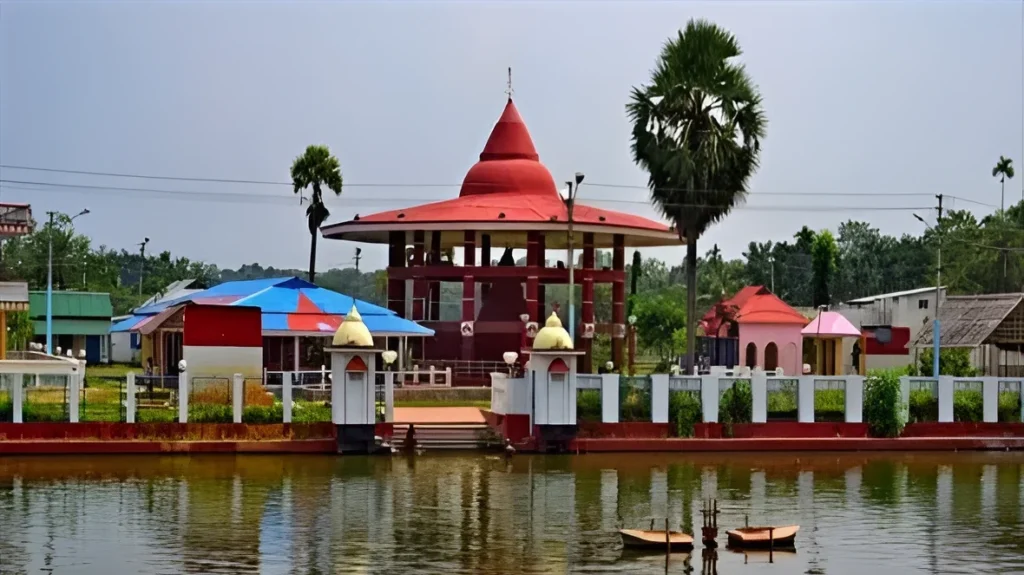
According to legend in Tripura’s royal chronicles, worship of the Fourteen Gods dates back to the era of the Mahabharata, when King Trilochana — a contemporary of Yudhisthira — worshipped these deities as Tripura’s royal gods. The tradition was carried forward by every subsequent Tripuri king, eventually finding its permanent home in the Chaturdasha Temple built by King Krishna Manikya in 1761 in Old Agartala. The temple’s distinctive dome, patterned after traditional Tripuri village huts and showing traces of Buddhist architectural influence, remains one of the most visually unique religious structures in Northeast India.
What was once a strictly royal ritual, accessible only to the king and his court, gradually opened to the wider population. Today Kharchi Puja is celebrated by Tripura’s tribal and non-tribal communities alike, with both participating with equal devotion — a transformation that explains the festival’s significant social weight in the state.
The Chaturdasha Devata: Understanding the Fourteen Gods
At the heart of the Kharchi Festival is the worship of the Chaturdasha Devata — the fourteen gods who form the dynastic deity of the Tripuri people. Unlike most Hindu temple deities, the images inside the Chaturdasha Temple are unusual: only the heads of the fourteen gods are represented, without full bodies. This iconographic choice is one of the festival’s most striking and least-explained features, setting the temple apart from virtually every other major Hindu shrine in the country.
The fourteen deities are widely understood to include figures recognisable from the broader Hindu pantheon, though their specific Tripuri identities have been shaped by centuries of regional tradition blending Hindu, Buddhist, and indigenous belief. Long-time devotees often describe this as the only festival in India where fourteen deities are worshipped together as a single collective at one site — a claim that has become part of the festival’s identity even if it resists easy verification.
The Chaturdasha Mandapa, the structure housing the deities, is designed to symbolise the royal palace of the Tripuri kings — a deliberate reminder that this festival, more than almost any other in the region, is inseparable from Tripura’s monarchical history even as it has become a fully public celebration.
The Seven Days of Kharchi Puja: Rituals and Procession
The Opening Ceremony
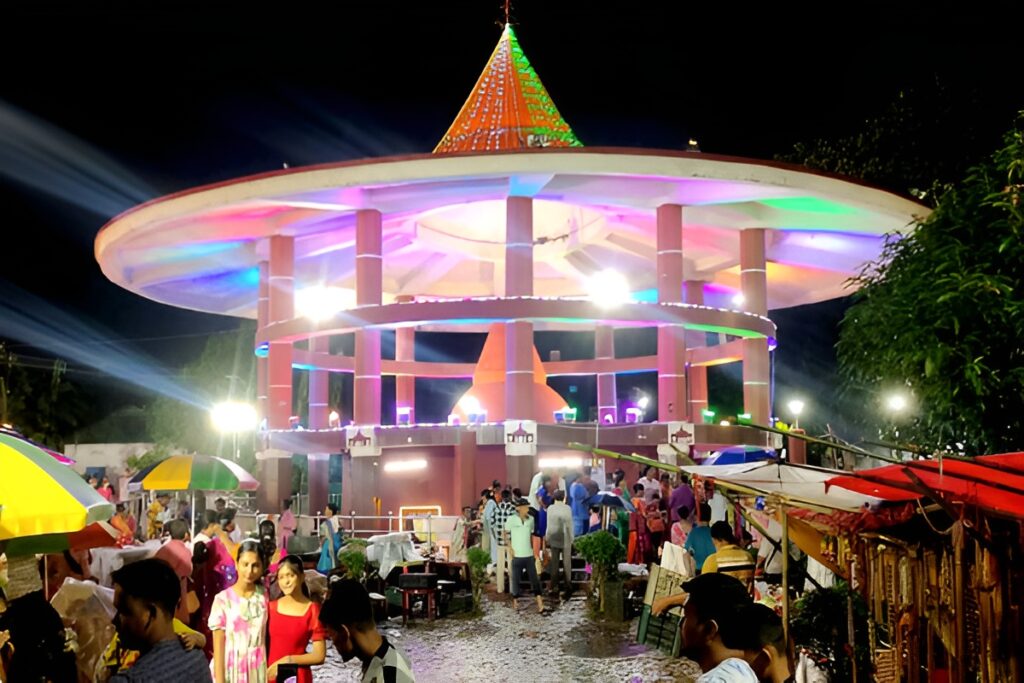
The festival traditionally opens with an inaugural ceremony at the Chaturdasha Temple, often attended by the Chief Minister of Tripura and senior state officials, who offer prayers to the fourteen deities for the well-being and welfare of the state. In recent years, the opening has doubled as the launch of the Kharchi Festival and Exhibition, a parallel cultural and commercial fair that runs alongside the religious observances.
The Sacred River Procession
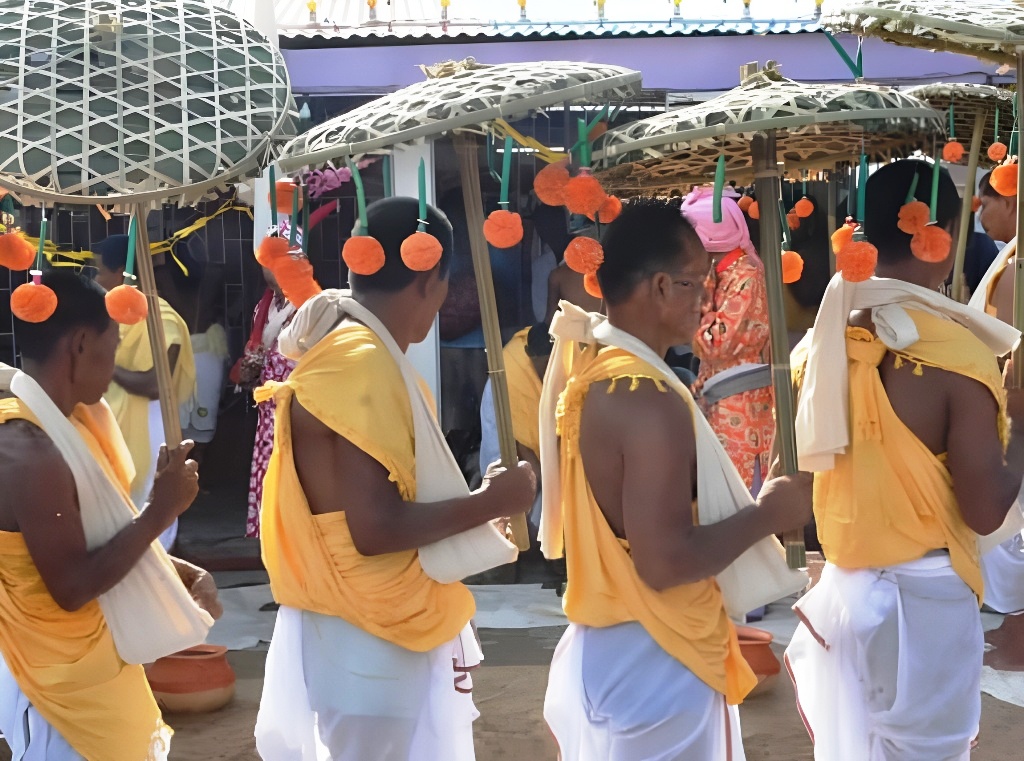
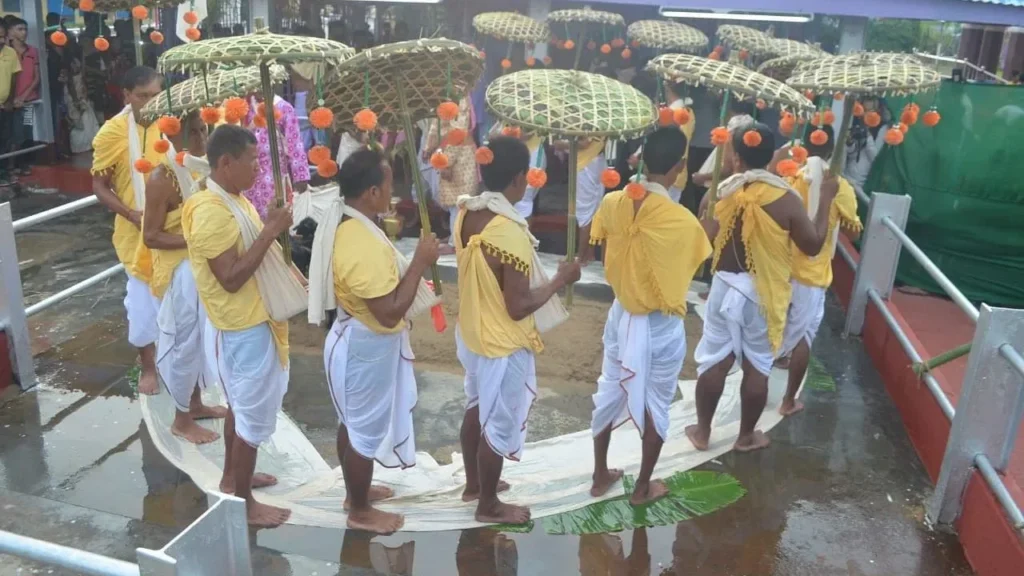
The defining ritual of Kharchi Puja takes place when the heads of the Chaturdasha Devata are carried out of the temple in a formal procession, starting from the historic Ujjayanta Palace grounds and proceeding to the Haora River (also recorded as the Saidra River in some sources) for a ceremonial bath. The procession is led by the Chantai, the traditional tribal priest responsible for officiating Kharchi rituals, working alongside Brahmin priests — a rare and enduring example of joint tribal-Hindu religious practice.
Thousands of devotees join the procession, and many take a customary holy dip themselves alongside the deities. After the ritual bath, the gods are decorated afresh with flowers, traditional attire, and vermillion paste before being carried back to the temple. Devotees following the procession receive prasad — typically traditional sweets — as a blessing.
Animal Sacrifice and Traditional Offerings
Animal sacrifice has historically been an integral part of Kharchi Puja, with devotees offering he-goats, chickens, and pigeons as part of their devotion to the Chaturdasha Devata. This practice reflects the festival’s deep roots in indigenous Tripuri ritual tradition, distinct from the largely vegetarian offering customs found in many other regional Hindu festivals. Visitors attending the festival should be prepared for this aspect of the celebration, which remains an authentic and unmodified part of the rites for many devotee families.
The Kharchi Mela: Exhibition and Festivity
Running parallel to the religious observances is the Kharchi Mela, a week-long fair held on the temple grounds and surrounding areas, featuring stalls selling local handicrafts and food alongside folk performances that draw visitors well beyond the immediate devotee community. The state government often ties the mela’s theme to broader civic priorities — the 2025 festival carried the theme “Green is the Future,” linking the ancient festival of nature worship to a contemporary tree-planting initiative across the state.
The final day of the festival is frequently declared a public holiday in Tripura, allowing residents and visitors to participate fully in the closing celebrations.
Kharchi Festival as a Symbol of Tripura’s Social Harmony
What makes the Kharchi Festival genuinely significant beyond its religious dimension is its role as a unifying social institution in Tripura.
The fourteen deities worshipped during Kharchi Puja are recognisably Hindu in name and form, yet the festival is widely regarded — by both outside observers and Tripura’s own communities — as fundamentally a tribal festival. The joint officiating role of the Chantai and Brahmin priests is not a ceremonial nicety; it is the structural embodiment of a centuries-old working relationship between Tripura’s indigenous and non-tribal populations. In a state whose modern history has included periods of communal tension, Kharchi Puja stands as a continuously renewed demonstration that shared ritual can outlast political and social division.
This is why successive state governments, regardless of political affiliation, have consistently invested in the upkeep of the Chaturdasha Temple and the scale of the annual celebration — including significant infrastructural development funding directed toward the temple complex in recent years.
Where to Experience Kharchi Puja: Agartala and Beyond
The Chaturdasha Temple in Old Agartala (Khayerpur) is the undisputed centre of Kharchi Festival celebrations and the only place to witness the core rituals — the procession, the river bath, and the temple ceremonies. The temple is easily accessible within Agartala, Tripura’s capital, and the surrounding Khayerpur neighbourhood becomes the focal point of the city during festival week.
Beyond the temple itself, the Ujjayanta Palace — the starting point of the river procession and now a museum showcasing Tripura’s royal and cultural history — is worth visiting both during the festival and as a standalone attraction. The Jampui Hills, in the far north of the state, offer a different but complementary cultural experience, with tribal villages that celebrate their own regional variations of harvest and nature-worship traditions around the same season.
Practical Travel Tips for Visitors
Agartala is well connected by air, with Maharaja Bir Bikram Airport offering direct flights from Kolkata, Guwahati, Delhi, and other major Indian cities. The city is also accessible by rail and road from Guwahati, with onward connections through Assam.
Book accommodation in Agartala in advance if visiting during the festival week, as hotel demand rises with the influx of devotees and visitors attending the Kharchi Mela. Modest dress is appropriate for temple visits, and visitors should be prepared for both the devotional and the explicitly traditional, non-vegetarian-offering aspects of the rituals described above. Photography is generally permitted at the mela and procession route, though it is courteous to ask before photographing devotees during the more intimate moments of worship at the riverside.
No special permit is required for Indian or foreign nationals to visit Tripura, unlike several other Northeast Indian states — a logistical advantage that makes this one of the more straightforward festival destinations in the region to plan for.
Final Thoughts: Why Kharchi Puja Deserves Wider Recognition
The Kharchi Festival occupies a curious position in India’s cultural landscape: a centuries-old royal tradition, now a fully public festival, that quietly accomplishes something many larger, better-known celebrations only claim to do — bringing genuinely different communities together around a shared ritual without erasing what makes either community distinct.
For travellers interested in the cultural complexity of Northeast India, Kharchi Puja offers a window into Tripura that few other events provide: the layering of Hindu, Buddhist, and indigenous Tripuri traditions in a single architectural and ritual space, the continued relevance of a 260-year-old temple to contemporary state identity, and a festival that has managed to remain both deeply traditional and genuinely inclusive across generations.
Watch this space for confirmed 2026 dates as soon as the Tripura government and the Kharchi Puja Mela Committee announce them. In the meantime, use the NE India Trip Planner to start mapping a visit to Tripura, and browse the NorthEast India Connect Festivals & Events category for more celebrations across the region.
