




There is a sound that defines the Garo Hills every November — the deep, rolling thunder of a hundred drums beaten in perfect unison, echoing across terraced fields and pine ridges until it feels like the hills themselves are pulsing. This is the Wangala Festival, one of the most spectacular harvest celebrations anywhere in Northeast India, and 2026 marks its most significant edition yet.
Wangala is the post-harvest thanksgiving festival of the Garo people of Meghalaya, celebrated to honour Misi Saljong, the Sun God of fertility, for a season’s bounty. The 49th Hundred Drums Wangala Festival concluded at Asanang on November 8, 2025, with state officials explicitly looking ahead to 2026 as the festival’s Golden Jubilee — its 50th anniversary since the modern format began in 1976. Exact dates for the 2026 Golden Jubilee edition had not been finalised at the time of writing; based on the festival’s consistent pattern, expect it in the first or second week of November. We will update this guide the moment the Meghalaya Tourism Department confirms the schedule.
Quick Facts: Wangala Festival
| Detail | Information |
| Festival | Wangala (the Hundred Drums Festival) |
| 2026 Significance | Golden Jubilee — 50th anniversary of the modern Asanang format |
| Typical Timing | First to second week of November (village level: September–December) |
| Main Venue | Asanang (Asananggre), near Tura, West Garo Hills, Meghalaya |
| Celebrated By | Garo tribe of Meghalaya |
| Modern Format Began | 1976, at Asanang, under CM Captain Williamson A. Sangma |
| Deity Honoured | Misi Saljong (also called Pattigipa Ra’rongipa, “The Great Giver”) |
| Key Rituals | Rugala (Day 1), Kakkat (Day 2) |
| Signature Dance | Wangala Dance / Hundred Drums Dance |
| Instruments | Dama, Adil, Chigring, buffalo-horn flute |
| Traditional Attire | Dakmanda, Daksari, chroko ganna, Kotip with Do’kru feathers |
| ILP Required | No — Meghalaya requires no Inner Line Permit |
What Is the Wangala Festival? Sowing the Roots of the Garo Harvest
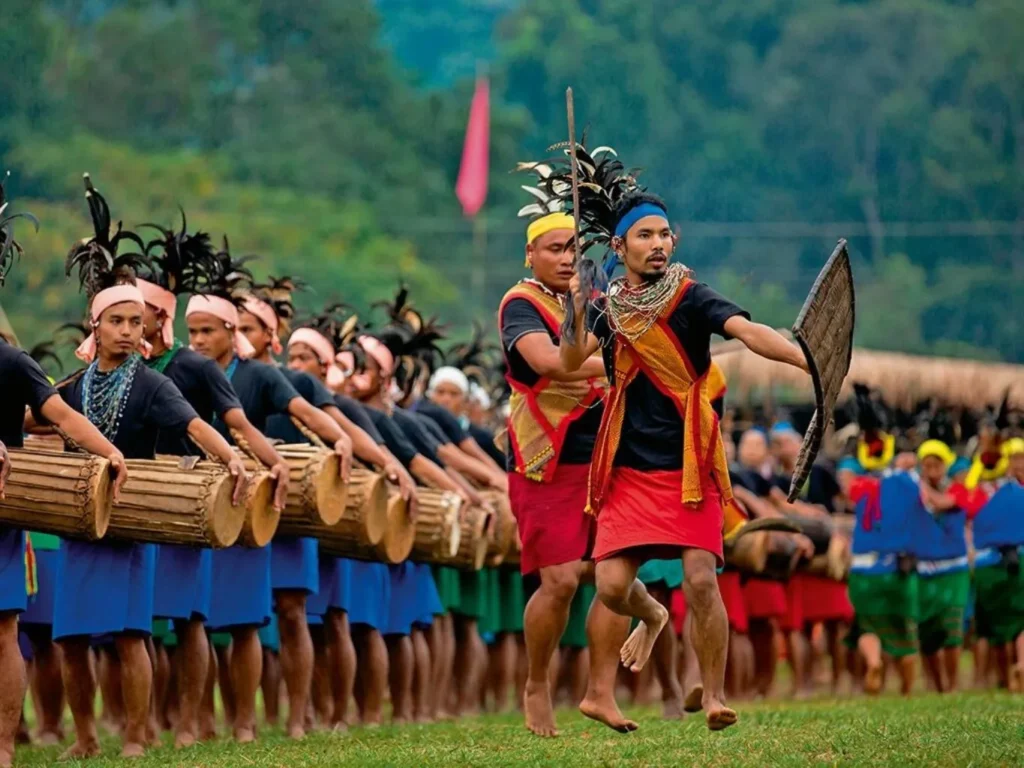
Wangala is one of the oldest harvest festivals of the Garo community, rooted directly in the agrarian rhythms of Meghalaya’s hills. The official Meghalaya government portal describes it as a harvest festival held in honour of Saljong, the Sun God of fertility, marking the end of a season of toil and signifying the onset of winter.
Traditionally, Wangala is celebrated from September to December, with different villages observing the festival on their own chosen dates rather than a single fixed day. Village-level celebrations typically run two to three days, though some communities stretch the observance to a full week. This decentralised, village-by-village timing is one of the festival’s most distinctive features.
The Songsarek Worldview: Veneration of Misi Saljong, the Sun God
The Garo, who live across Meghalaya, parts of Assam and Nagaland, and Greater Mymensingh in Bangladesh, traditionally follow Songsarek, an animistic belief system centred on nature worship. Misi Saljong sits at the heart of this worldview as the Sun God of fertility — sometimes also called Pattigipa Ra’rongipa, “The Great Giver” — and Wangala functions as the community’s direct thanksgiving offering at the precise moment the agricultural year’s labour concludes.
Today, most Garo households are Christian, a legacy of 19th-century missionary activity across the hills. Yet Wangala persists as a cultural institution independent of strict religious continuity — the dance, the drums, and the dress have become markers of Garo identity that transcend any individual’s personal faith.
Step-by-Step Rituals: Decoding the Sacred Rugala and Public Kakkat Days
Every Wangala celebration, whether in a small village or at the grand Asanang gathering, follows a ritual structure built around two key days.
Chu-Rugala and Cha’chat So’a: The Hidden Longhouse Incense Ceremonies
The first day is Rugala, a sacred and intimate ceremony performed inside the Nokmong — the traditional longhouse of the Nokma, the village chief. The Kamal (village priest) consecrates the Chu-Rugala, the first ceremonial pouring of freshly brewed rice beer (chubitchi), onto the Chatok, the sacred central pillar of the longhouse. This is followed by Cha’chat So’a — the burning of sacred incense wood resins, filling the house with holy smoke as prayers and offerings of rice are made to Misi Saljong for protection and gratitude.
This is the festival’s spiritual core, conducted away from public spectacle, where the year’s first harvest is formally offered to the deity before any communal celebration begins.
Kakkat: When the Hills Come Alive
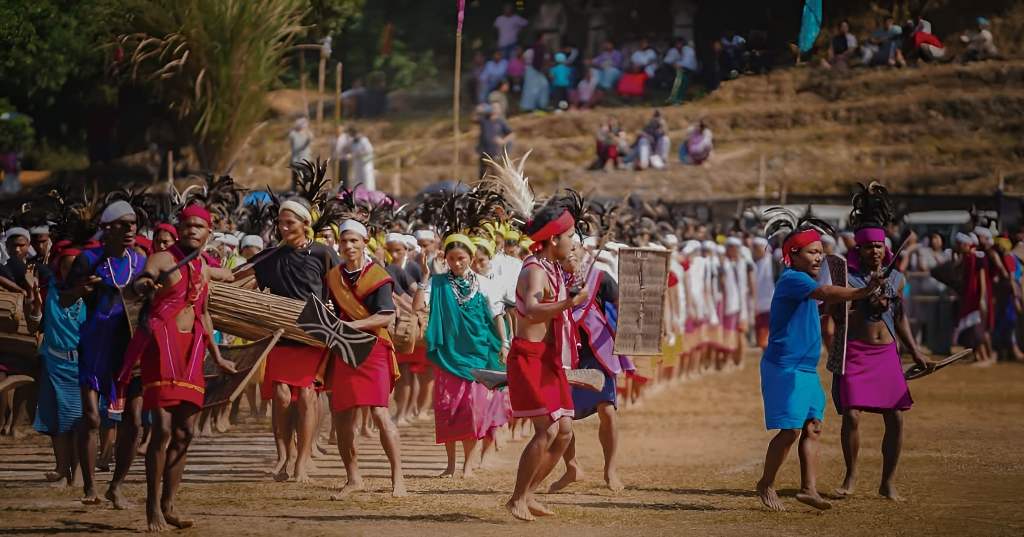
The second day is Kakkat, when the festival opens out to the wider community. People young and old, dressed in colourful traditional costumes with feathered headgear, dance to the rhythm of the dama and gong, and this is when the hills genuinely come alive — drums rolling across valleys for hours at a stretch. Kakkat is the day most visitors witness at a village-level Wangala, and it captures the festival’s communal, celebratory register most vividly.
Sound of the Hills: The Anatomy of the Dama Drum and Buffalo-Horn Adil
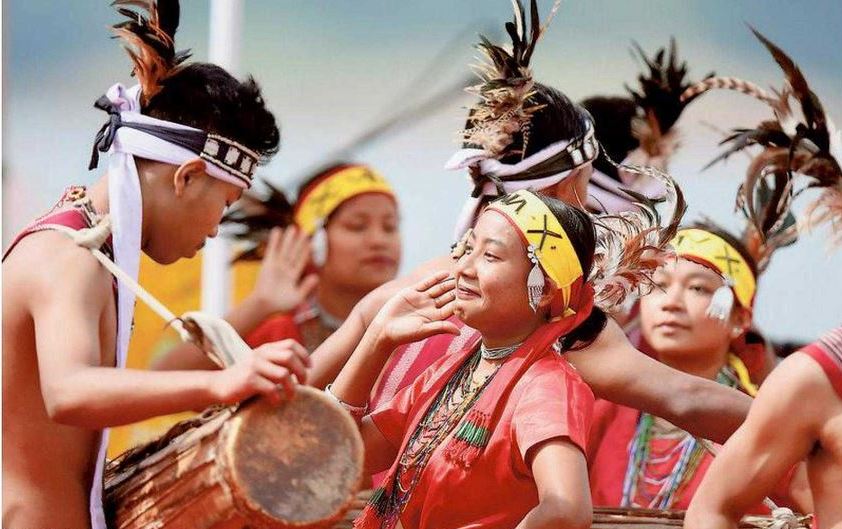
At the heart of Wangala is the music that gave the festival its popular name. The dama is a long, narrow, double-headed drum, carved from a hollowed tree trunk, tapered in the middle, and covered with stretched animal hide — its construction is what produces the deep, carrying boom audible across entire valleys.
Alongside the dama, the orchestra includes the Adil, a small trumpeting horn made from a wild buffalo horn fitted with a bamboo casing, and the Chigring, a rustic bamboo zither that supplies the delicate, melodic counterpoint to the heavy drumming beneath it. Bamboo flutes round out the ensemble. Together, these instruments create a soundscape with genuine textural range — booming low end, piercing horn calls, and a fine melodic thread weaving through it all.
The Wangala Dance is performed in two parallel lines — one of men, one of women — moving forward in rhythmic accord as the men beat the dama in perfect synchrony, in waves widely understood to mimic the physical rhythm of agricultural labour itself.
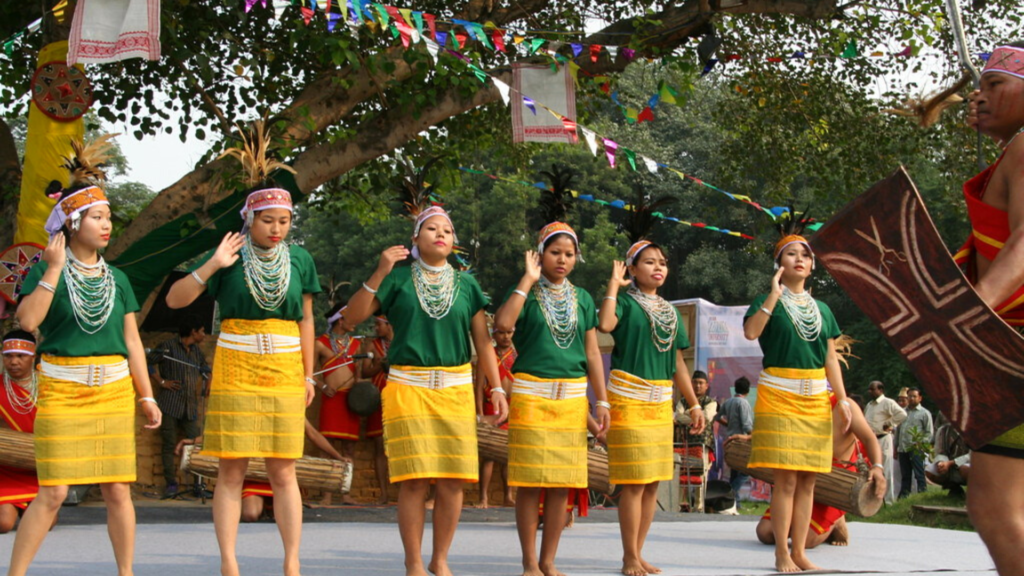
Traditional attire completes the spectacle. Women wear the dakmanda, a handwoven wraparound sheet, often paired with the daksari and the chroko ganna, an elaborate beaded necklace. The most prized dakmanda weaves feature the Murom, a central diamond-shaped motif traditionally representing the eye of the supreme deity. Dancers of both sexes wear the Kotip, a traditional headcloth turban, into which Do’kru feathers — from the wild hornbill or specialised forest pheasant — are tucked, symbolising dignity, status, and a connection to the upper spiritual realms.
The Golden Jubilee of the Hundred Drums: The Evolution of Asananggre
What is now widely known as “the Wangala Festival” by visitors is, more precisely, the Hundred Drums Wangala Festival — a modern, centralised version of the traditional village rite, first organised on 6–7 December 1976 at Asanang, under the leadership of Meghalaya’s first Chief Minister, Captain Williamson A. Sangma, and then Minister of Arts and Culture Sendfort K. Marak.
[ Day 1: The Gathering ] ──> Arrival of regional clans at Asanang; traditional stalls set up
│
▼
[ Day 2: Rugala & Incense ] ──> Kamal conducts Chu-Rugala and Cha’chat So’a inside the Nokma’s longhouse
│
▼
[ Day 3: The Grand Kakkat ] ──> Finale: ten lines of ten drummers form the iconic “100 Drums” synchronised dance
The transformation since 1976 has been significant. What began as a modest community gathering has grown into a state-sponsored event drawing dance troupes from across the Garo Hills, Karbi Anglong in Assam, Nagaland, Tripura, and Bangladesh’s Garo-populated regions, competing for substantial prize money. The 49th edition in November 2025 drew thousands of attendees and was supported by state initiatives upgrading venue infrastructure and accessibility ahead of the 2026 Golden Jubilee. Looking ahead, officials have floated the idea of regular evening cultural shows at the Garo Heritage Village in Asanang, so visitors can experience the spirit of Wangala beyond the main festival days.
Travel Route Manual: Navigating the Journey From Guwahati to Tura
Tura, the headquarters of West Garo Hills district and the nearest major town to Asanang, is the practical base for most visitors.
By air, Guwahati Airport (approximately 220–250 km from Tura) offers the best flight connectivity from major Indian cities; Shillong Airport (around 260 km) is a secondary option with more limited connectivity. By road, regular buses and shared taxis connect Guwahati to Tura, a journey of roughly 7 hours via Williamnagar. By train, Guwahati Railway Station is the nearest railhead with significant connectivity, with onward travel to Tura by road.
The Wangala Festival Cultural & Photography Field Protocol
- Mind the Tura-to-Asanang traffic: though Asanang is only 18 km from Tura, the highway gets heavily congested on the final Kakkat day. Depart your Tura accommodation by 7:30 AM to secure a clear vantage point near the main performance arena.
- The correct way to drink chubitchi: when offered rice beer from a dried gourd, accept it with your right hand while lightly placing your left hand under your right elbow — a universal sign of respect.
- No ILP required: unlike several neighbouring states, domestic Indian travellers need no Inner Line Permit for Meghalaya. Carry a valid government photo ID for routine highway checkposts.
- Photography: generally welcome at public dance performances; always check with a local guide regarding restrictions around the more intimate Rugala rites.
Practical Guide for Visitors: Homestays, Etiquette, and Photography Rules
Accommodation in Tura fills quickly during the festival period, so book at least a few weeks in advance. Local homestays around Asanang offer an immersive alternative to hotels in Tura and put you closer to the festival grounds. Hiring a local guide is genuinely useful — understanding the meaning behind specific dance movements and costume symbolism adds considerably to the experience.
Dress modestly and respectfully, particularly at village-level celebrations. The festival period coincides with Meghalaya’s cooler, drier season — pack layers for chilly evenings in the Garo Hills. Traditional Garo huts, built specifically for festival participants at Asanang, are worth a visit in their own right — simple, sustainable structures reflecting the community’s relationship with the surrounding landscape.
Why Wangala Matters Beyond the Spectacle
Beneath the visual spectacle of feathered Kotip and synchronised dama drumming lies something that matters considerably more to the Garo community: an annual act of cultural continuity in a region that has seen rapid religious and social change over the past century.
For a community that is now predominantly Christian, Wangala remains one of the clearest living threads connecting contemporary Garo identity to its pre-Christian Songsarek roots, its matrilineal social structure, and centuries of agricultural tradition specific to the hills. As the festival enters its Golden Jubilee year, that continuity is precisely what is being celebrated.
Use the NE India Trip Planner to start planning a November visit to the Garo Hills, and explore the NorthEast India Connect Festivals & Events category for more celebrations across the region.
