




A thousand years ago, somewhere in what is now a quiet stretch of farmland in South Tripura, monks and sculptors built one of the most important Buddhist-Hindu religious centres in the entire Northeast. Today, Pilak archaeological site sits scattered across ten square kilometres of agricultural landscape near Jolaibari, with stone images, brick stupas, and terracotta plaques still surfacing from the earth more than a century after the first excavation began.
If you’ve come here looking for a single dramatic monument, you’ll be disappointed. If you’ve come looking for a genuine, walkable piece of medieval history that almost nobody outside Tripura has heard of, Pilak delivers in a way few sites in India do.
Quick Facts About Pilak Archaeological Sites
| State | Tripura |
|---|---|
| District | South Tripura (Santirbazar Subdivision) |
| Location | Near Jolaibari village |
| Key Sectors | Thakurani Tilla, Shyampur Tilla |
| Distance from Agartala | 114 km; approx. 3.5 hours by road, or by train via Sabroom line |
| Distance from Udaipur | 51–62 km; approx. 1.5 hours |
| Distance from Jolaibari village | 2–3 km |
| Nearest Railway Stations | Jolaibari and Santirbazar, on the Agartala–Sabroom line |
| Area | Scattered across approximately 10 sq km |
| Period | 8th–12th centuries CE; Buddhist complex 9th–10th century CE |
| Kingdom | Part of the Samatata kingdom of historical Bengal |
| First Excavation | 1927; major ASI excavation in the 1960s uncovered brick stupas |
| Site Timing | 9 AM to 6 PM daily |
| Key Artefacts (now in Agartala) | 9th-century Avalokiteshvara; 12th-century Narasimha |
| Festival | Pilak Archaeological & Tourism Festival — 3 days, February/March, Jolaibari |
| Best Time to Visit | October to March |
Where Exactly Is Pilak, and Why Does It Matter?
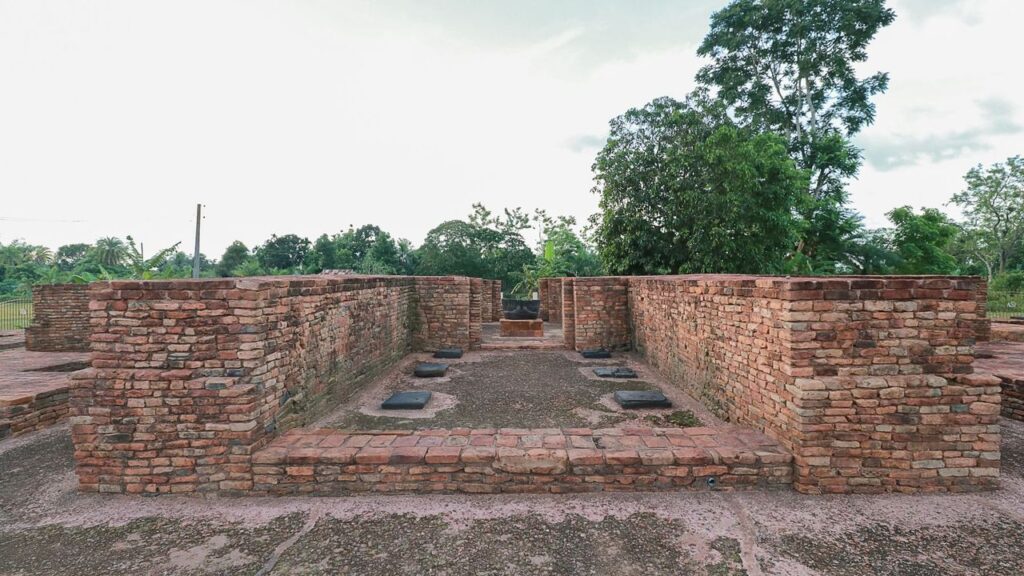
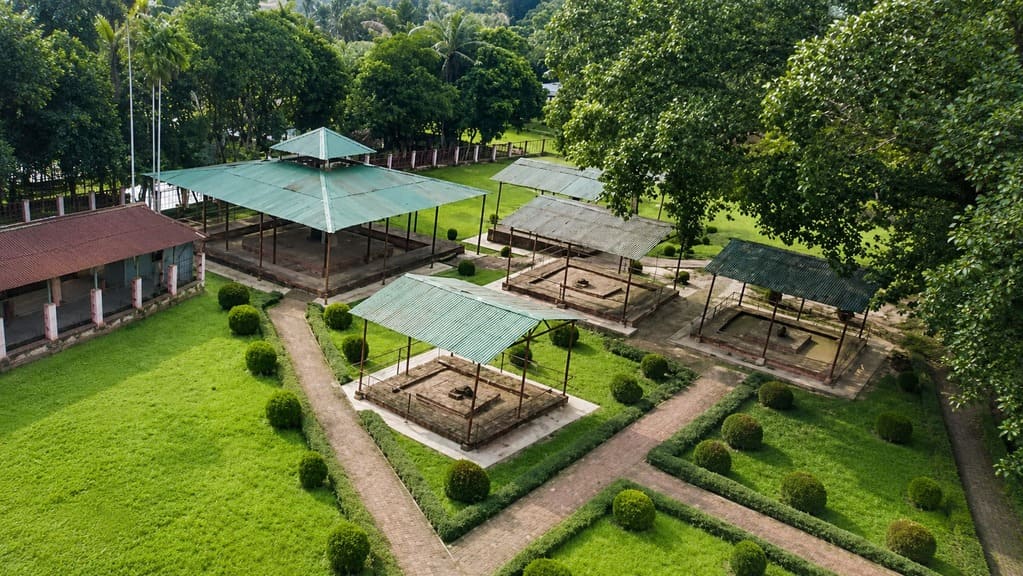
Pilak isn’t a single ruin, it’s a collection of scattered archaeological mounds spread across roughly ten square kilometres of the Santirbazar subdivision in South Tripura. The two most significant excavated sectors carry their own names: Thakurani Tilla, where the brick stupas, foundation walls, and several rock-cut reliefs sit, and Shyampur Tilla, a separate mound cluster a short distance away. Knowing these names matters if you’re trying to plan an actual visit, since asking a local driver for “Pilak” alone is far less useful than naming the specific tilla you want to reach first.
The site was once part of the Samatata kingdom, the historical maritime and agricultural power of coastal Bengal whose territory extended from the present-day Bangladesh coast northward into the hills of Tripura and Comilla. Samatata’s religious culture was a sophisticated synthesis of Mahayana Buddhism and Vaishnavite Hinduism, and Pilak is one of the clearest physical records of that synthesis anywhere in the region.
Official Style Analysis: According to the South Tripura District Administration, the artistic style of Pilak represents a rare cultural crossroads — a distinct blend of local sculpting traditions heavily influenced by the early medieval styles of Arakan, in modern-day Myanmar.
That Arakan influence is also visible at the Mahamuni Pagoda, just 19 kilometres away, and it reflects the broader cultural corridor that once connected the Arakan coast, the Chittagong Hill Tracts, and Tripura.
What Was Found at Pilak
The Avalokiteshvara Stone Image (9th Century CE)
The most celebrated find from Pilak is a colossal stone image of Avalokiteshvara, the Bodhisattva of Compassion and one of the central figures in Mahayana Buddhist iconography. Tripura Tourism describes it as one of the largest and most unique such images in India, and it now sits in the Tripura Government Museum in Agartala rather than at the site itself.
The Narasimha Image (12th Century CE)
A large stone image of Narasimha, the man-lion avatar of Vishnu, dated to the 12th century CE, was also recovered at Pilak. Together with the Avalokiteshvara, the two sculptures are the clearest physical proof of the religious plurality that defined this site, one Buddhist and one Hindu, both produced within the same sacred landscape.
The Brick-Built Stupas
During the 1960s ASI excavation, archaeologists uncovered brick-built stupas at Thakurani Tilla, the domed reliquary structures central to Buddhist sacred architecture, dated to the 9th or 10th century CE. Their discovery confirmed that Pilak functioned as a significant Buddhist monastic centre rather than simply a scattered collection of sculpture.
The Terracotta Plaques
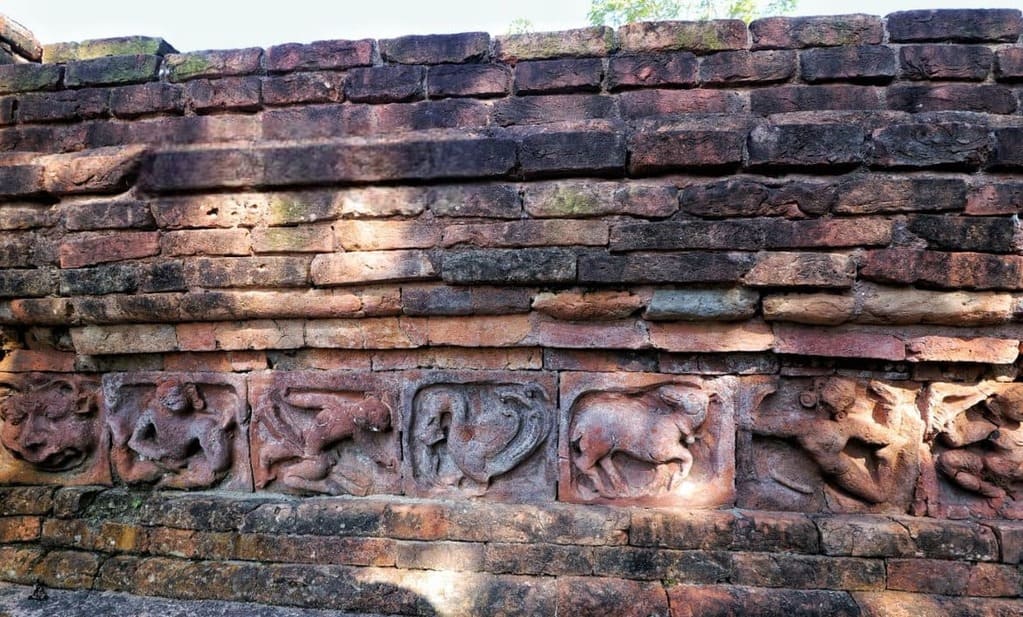
The moulded terracotta plaques found across the site bear a striking resemblance to those recovered at Paharpur, Bangladesh’s UNESCO-listed Somapura Mahavihara, and at Mainamati, another major Buddhist site in Bangladesh. That stylistic overlap places Pilak firmly within the same cultural network of medieval Bengali Buddhism, a connected world of monasteries and artistic workshops stretching from the Bengal delta into the surrounding hills. Some plaques remain at the site; the most significant have been moved to the museum in Agartala.
Visiting Pilak Today: What You’ll Actually See
The site today is a blend of landscaped archaeological remains and the working agricultural land that has grown up around them. Because the remains are scattered across ten square kilometres, no single viewpoint shows you everything, and walking the area between mounds is part of the experience rather than an inconvenience.
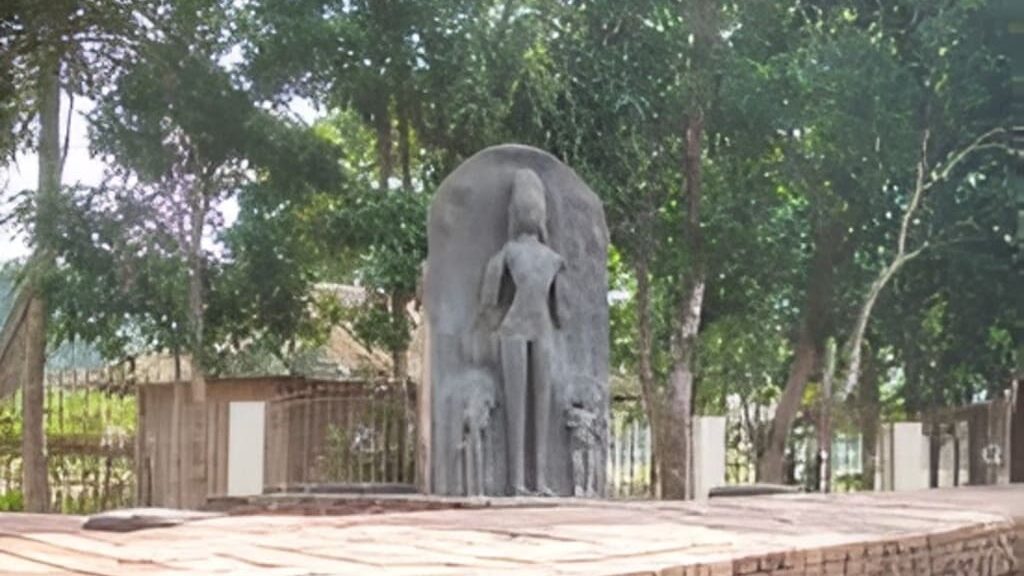
Images of Ganesha, Durga, Surya, and other Hindu deities remain in situ at the site, less imposing than the museum pieces but carrying an authenticity that a glass display case can’t replicate. A small, clear, hilly rivulet known as the Pilak Stream runs nearby, adding a pleasant environmental backdrop to the walk between sectors.
Photography of the in-situ Ganesha and Surya reliefs is allowed and genuinely worthwhile, but touching the delicate, exposed thousand-year-old terracotta tiles is strictly prohibited, since the surfaces are far more fragile than their stone appearance suggests.
Quick Checklist for Visitors
- Museum first: see the colossal Avalokiteshvara and Narasimha originals at the Tripura Government Museum in Agartala before walking the empty mounds at the site itself, since it gives you the visual context the ruins alone can’t provide.
- Cash is king: carry physical Indian rupees. Digital UPI payments can be unreliable around the rural mounds, where cellular networks are patchy.
- Footwear matters: wear sturdy, closed-toe walking shoes to safely navigate overgrown grass paths between the scattered tillas.
- Pack your own food and water: there are no major restaurants or clean tourist facilities at the ruins themselves, so either carry snacks and hydration or plan to eat in nearby Santirbazar or Jolaibari before or after your visit.
How to Reach Pilak: Road, Rail, and the Final Mile
Reaching Pilak has become much easier with the Agartala–Sabroom railway line, making it a convenient day trip from Agartala.
By road, Pilak is about 114 km from Agartala (around 3.5 hours) via Udaipur. If you’re staying in Udaipur, the journey is much shorter at 51–62 km, making it an ideal base for exploring South Tripura.
By train, you can travel to Jolaibari or Santirbazar railway stations, both located just a few kilometres from the archaeological site. Auto-rickshaws are readily available for the final stretch, offering an affordable alternative to hiring a car.
For a convenient day trip, take a morning train from Agartala, explore Pilak for a few hours, and return by train or continue onward to Udaipur or Mahamuni Pagoda. This rail-and-auto combination is one of the easiest ways to visit Pilak.
Best Time to Visit Pilak
February and March bring the Pilak Archaeological and Tourism Festival, a three-day celebration held at Jolaibari that combines guided tours of the site with cultural performances and traditional music from communities across the region, and it’s genuinely worth timing a visit around if your schedule allows it.
Outside the festival window, October through March offers the most comfortable weather for walking the site, with dry ground and manageable temperatures. June through September brings the monsoon, and the site can become waterlogged enough to make walking between the scattered tillas genuinely difficult, so it’s best avoided unless the festival dates happen to fall within that period.
A Site Worth the Effort
Pilak rewards patience in a way few destinations do. There’s no single grand structure to photograph and move on from; instead there’s a scattered, walkable landscape that asks you to piece together a thousand-year-old religious world one mound at a time. Pair a morning at the Tripura Government Museum in Agartala with an afternoon at the site itself, take the train if you can, and you’ll come away with a far richer picture of medieval Bengal’s religious history than most travellers to Tripura ever get.
If you’re building a wider Tripura itinerary, combine Pilak with the Mahamuni Pagoda and a stop in Udaipur for a complete South Tripura heritage circuit that very few visitors to the state ever attempt.
