




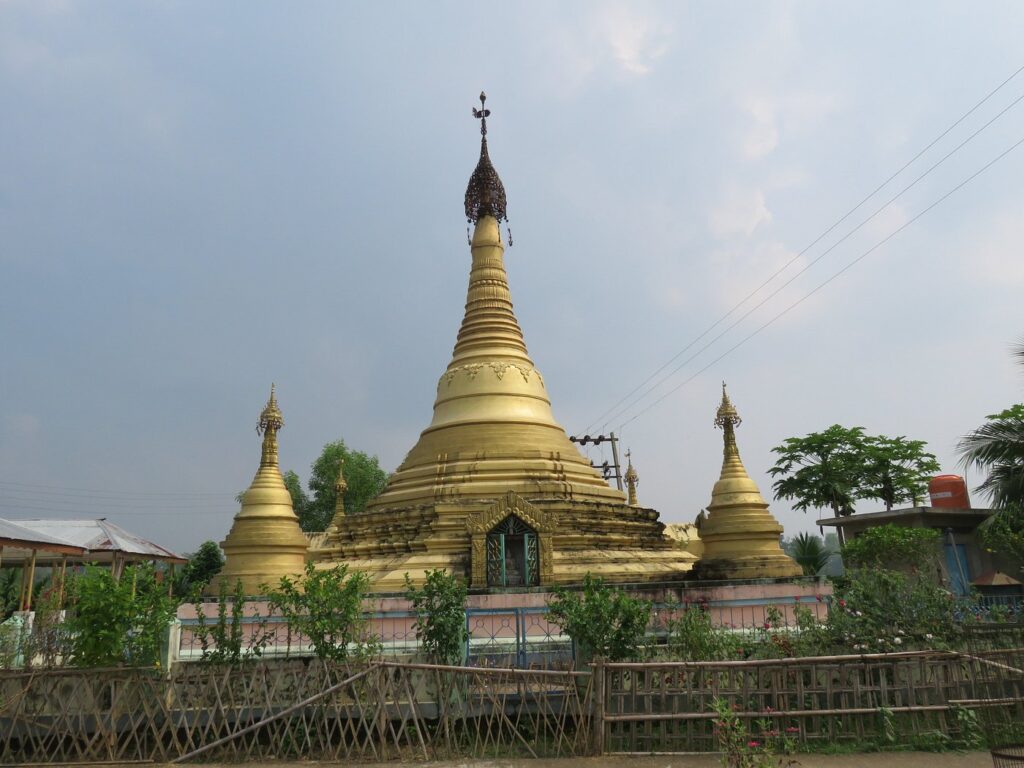
At the southern edge of Tripura, the Mahamuni Pagoda at Manu Bankul stands apart from any other Buddhist monument in the region. Built in the distinctive Myanmar and Arakanese architectural style, its gilded surfaces, tiered spire, and enclosed sanctuary resemble the great pagodas of Mandalay and Bagan rather than the temples of Northeast India. At its heart is a revered Buddha image brought from the Arakan region of present-day Myanmar in the 17th century by Chakma Buddhist pilgrims who believed it possessed miraculous powers.
Regarded as one of the most sacred traditional Buddhist statues in Northeast India, the shrine remains a spiritual centre for the local Mog and Chakma Buddhist communities, who have preserved its unique character for centuries. Today, Mahamuni Pagoda occupies a key place in South Tripura’s emerging cultural and pilgrimage landscape, near the Maitri Setu border corridor. For visitors exploring southern Tripura, it is among the region’s most remarkable landmarks and a highlight of an expanding Buddhist pilgrimage circuit.
Quick Facts About Mahamuni Pagoda
| State | Tripura |
| District | South Tripura |
| Location | Manu Bankul, South Tripura district |
| Distance from Agartala | 142 km south; approximately 4–4.5 hours by road |
| Distance from Sabroom | Approximately 25 km; Sabroom is an international gateway via Maitri Setu |
| Architectural Style | Myanmar/Arakanese Buddhist pagoda — unique in Northeast India |
| Sacred Image | One of the largest traditional Buddhist statues in Northeast India; brought from Myanmar/Arakan in the 17th century by Chakma pilgrims |
| Annual Festival | Bankul Mahamuni Buddha Festival (Mahamuni Mela) — held annually in March–April (Chaitra month); 78th iteration held in 2025 |
| Festival Duration | Week-long fair; draws devotees from Tripura, Mizoram, Bangladesh, and Myanmar |
| Key Recent Development | Official unveiling of 28 new Buddha statues on temple premises; ongoing Dhamma Dipa International Buddhist University project in Sabroom sub-division |
| No ILP Required | Tripura is open to all Indian nationals |
| Best Time to Visit | March–April (Mela); October to March otherwise |
The Origin Story: A Sacred Image Carried from Arakan
The Mahamuni Pagoda is named after the Mahamuni Buddha — ‘Maha’ meaning great, ‘Muni’ meaning sage or holy man. The Mahamuni Buddha image in Mandalay, Myanmar, is one of the most revered Buddhist images in Southeast Asia, drawing millions of pilgrims annually. The image at Tripura’s Mahamuni Pagoda is not that same image, but it shares its name and its ultimate origin tradition: the Arakan region of western Myanmar, from which the Buddhist faith and its sacred art spread westward into the Chittagong Hill Tracts and northward into Tripura through the movement of Chakma Buddhist communities.
According to the tradition preserved at Manu Bankul, the sacred image now housed in the pagoda was brought from Myanmar by Chakma pilgrims in the 17th century — a journey that traversed the forested hill country between the Arakan coast and the Tripura-Chittagong borderland. The image’s arrival and the subsequent construction of the pagoda in the Arakanese architectural style transformed Manu Bankul into one of the premier Buddhist pilgrimage sites in Northeast India, whose character is Myanmar in its essence while its physical location remains firmly on Indian soil.
The Mog Community: Guardians of a Theravada Tradition
While the origin story of the sacred image centres on the Chakma pilgrims who carried it from Myanmar, the immediate landscape of Manu Bankul is closely associated with the Mog ethnic community of Tripura — one of the state’s historically Buddhist peoples who have traditionally practised Theravada Buddhism. The Mog community has been deeply involved in the preservation of the pagoda’s Burmese architectural idioms, the maintenance of the monastery complex, and the continuity of the traditional Theravada rituals performed here.
This dual custodianship — by the Chakma community whose pilgrimage brought the sacred image here, and by the Mog community whose local presence has maintained the living Buddhist practice — gives Mahamuni Pagoda a layered cultural character that makes it a particularly significant site for understanding how Theravada Buddhism took root and flourished in this corner of Northeast India. These traditions make it a key point of interest for researchers and visitors interested in Buddhist pilgrimage sites in Northeast India.
The Architecture: Myanmar in Tripura
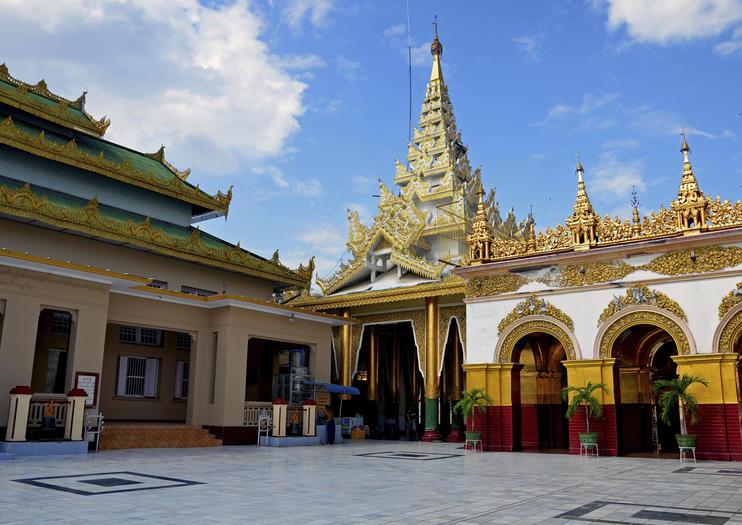
The pagoda’s most immediately striking feature is its architectural distinctiveness. Most Buddhist structures in Northeast India follow the Tibetan or Himalayan Buddhist aesthetic — the red and white facades, the flat rooflines, the prayer wheel corridors. Mahamuni Pagoda follows none of these conventions. Its tiered conical spire (called a stupa or zedi in Burmese Buddhist architecture) tapers to a delicate finial in exactly the manner of the pagodas of Bagan and Mandalay. The gilded surfaces catch the light in the same way. The sanctuary’s orientation and internal arrangement follow Burmese rather than Tibetan Buddhist spatial logic.
In a significant recent enhancement to the temple complex, the state government has accelerated a beautification programme that culminated in the official unveiling of 28 new Buddha statues on the temple premises — a landmark development that visibly expands Mahamuni’s stature as a premier global pilgrimage hub. The statues are designed to complement the existing Arakanese aesthetic and to create a more expansive spiritual landscape within the complex.
The result is that standing in front of the Mahamuni Pagoda feels like being transported. The surrounding South Tripura landscape — the rubber plantations, the Bengali-language signboards, the tropical heat of the southern district — makes the pagoda’s Burmese character all the more striking by contrast. It is an architectural anomaly that is simultaneously historically explicable and visually extraordinary.
The Bankul Mahamuni Buddha Festival: Annual Buddhist Pilgrimage Gathering
A 78-Year Living Tradition
The Bankul Mahamuni Buddha Festival (also known as the Mahamuni Mela), held annually in the Chaitra month (March–April) for approximately one week, is one of the largest Buddhist religious gatherings in Tripura. The 2025 festival marked a significant milestone: the 78th traditional iteration of this gathering, underscoring the deep, unbroken continuity of Buddhist community life at Manu Bankul that stretches back generations.
The mela draws devotees from Tripura’s Chakma and Mog communities, Buddhist communities from the Chakma Autonomous District of Mizoram, Chakma and other Buddhist communities from the Chittagong Hill Tracts of Bangladesh (subject to border formalities), and occasional pilgrims from the Arakan region of Myanmar, maintaining the connection to the image’s origin.
The mela period transforms the Manu Bankul area into a community of pilgrims — prayer, meditation, dharma talks, traditional Buddhist music and rituals, and the social exchange of a large multi-community religious gathering. This is also an important event on the calendar for those interested in Mog community festivals in Tripura, as the local community plays a central role in the week’s ceremonial life.
| Visiting Mahamuni Outside the Festival Open year-round, the pagoda remains active with local devotees. Outside the festival season, it offers a peaceful atmosphere for visitors. Dress modestly, remove footwear before entering, and respect it as a living place of worship. |
The Maitri Setu Corridor: Mahamuni on India’s New International Gateway
A crucial development that reframes how travelers should think about Mahamuni Pagoda is the transformation of Sabroom — located roughly 25 km from the pagoda — into a significant international gateway. The opening of the Maitri Setu (Friendship Bridge) over the Feni River connects India directly to Bangladesh, with onward transport corridors toward Chittagong and, via longer-distance routes, toward Myanmar’s transport network.
The Maitri Setu Sabroom tourism opportunity is substantial: South Tripura is no longer a geographic dead-end at the edge of the map. It is a living international corridor, and the Mahamuni Pagoda is its primary cultural and spiritual landmark. Travelers arriving in or departing through Sabroom as part of an India-Bangladesh journey have compelling reasons to stop at Manu Bankul. And travelers visiting from Bangladesh or planning overland journeys that use this crossing will find that Mahamuni is a natural first or last major cultural site on the Indian side.
The Dhamma Dipa Buddhist University Circuit: Mahamuni as a Spiritual Pillar
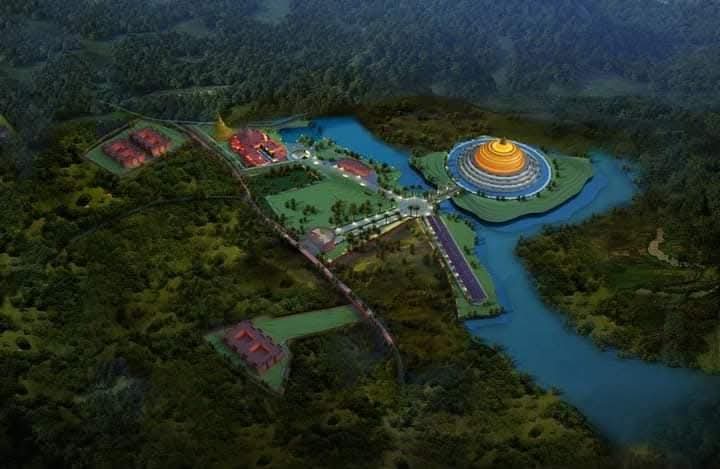
Mahamuni Pagoda does not stand alone in the broader Buddhist landscape of South Tripura. The state government’s ongoing development of the Dhamma Dipa International Buddhist University in the Sabroom sub-division is dynamically reshaping this part of Tripura into a major hub for international Buddhist studies and pilgrimage.
When completed, Dhamma Dipa is envisioned as a landmark institution drawing Buddhist scholars and practitioners from across Asia. Combined with the ancient sanctity of Mahamuni and the archaeological depth of Pilak, the Sabroom sub-division is emerging as a Buddhist circuit of genuine international significance. Visitors with an interest in Buddhist pilgrimage sites in Northeast India will find that this cluster of sites — the Dhamma Dipa campus, Mahamuni Pagoda, and the Pilak remains — constitutes one of the richest Buddhist cultural circuits in the entire region.
How to Combine Mahamuni with the Pilak Archaeological Sites
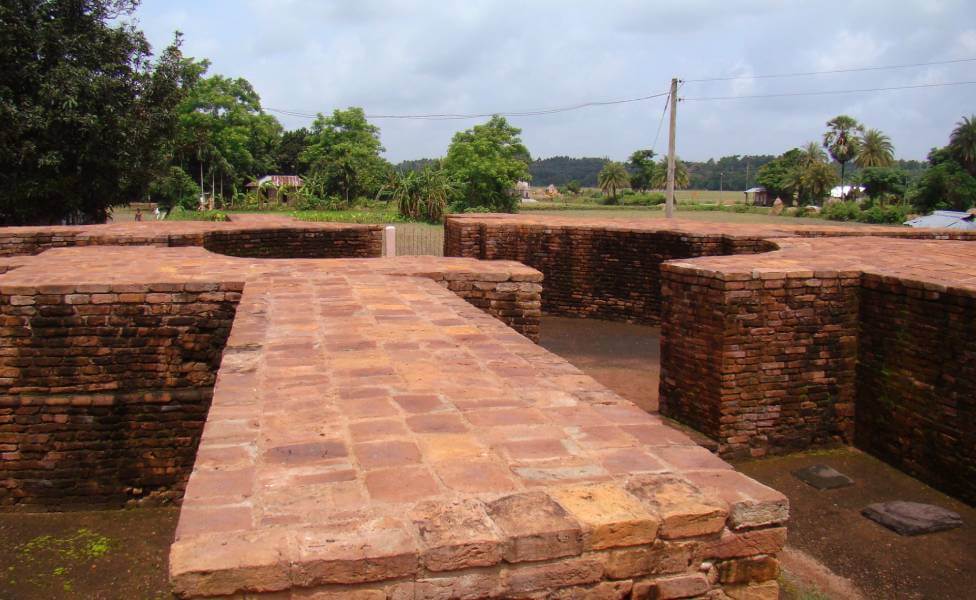
Mahamuni Pagoda and Pilak Archaeological Sites are approximately 19 kilometres apart in South Tripura — a natural combination for travelers making the journey to the southern district. The combination of a living 17th-century Buddhist sanctuary with the 8th–12th-century Hindu-Buddhist sculptural remains at Pilak creates a full day of South Tripura cultural exploration spanning over a thousand years of religious art and practice.
| 💡 Insider Cultural Circuit Tip: Allow at least 2–3 hours for the Pilak Archaeological Site before visiting Mahamuni Pagoda. Pilak’s ancient Hindu-Buddhist ruins contrast beautifully with Mahamuni’s living 17th-century Buddhist sanctuary, creating one of Northeast India’s most rewarding cultural journeys. |
Suggested South Tripura cultural circuit:
- Agartala (depart morning)
- Udaipur — Old Rajbari; Gunabati Temples (55 km)
- Pilak Archaeological Sites — allocate minimum 2.5 hours (51 km from Udaipur)
- Mahamuni Pagoda, Manu Bankul (19 km from Pilak)
- Overnight at Government Tourist Lodge in Sabroom area, or return to Agartala
How to Reach Mahamuni Pagoda: Granular Transit Guide
By Road from Agartala
Mahamuni Pagoda is 142 km south of Agartala via NH44 toward Sabroom. The journey takes approximately 4–4.5 hours by road. The route passes through Udaipur (55 km) and the Pilak area (114 km from Agartala). The highway is paved but the final approach through South Tripura requires standard road conditions awareness. Hire a private car or taxi in Agartala for maximum flexibility.
By Train: The Faster, Cheaper Option
For travelers prioritising speed and economy, the railway option is often significantly faster and cheaper than the full road drive. Trains run on the broad-gauge line from Agartala Railway Station directly to Sabroom (passing through Udaipur), making Sabroom the southernmost railway terminal in Tripura. From Sabroom station, hire an auto-rickshaw or local taxi for the 25 km onward to Manu Bankul — a short, straightforward final leg. This train-plus-local-taxi combination avoids the full 4.5-hour road journey from Agartala and is recommended for travelers not combining the journey with stops at Udaipur and Pilak.
From Sabroom (Maitri Setu Gateway)
Travelers arriving via the Sabroom-Ramgarh Maitri Setu international crossing from Bangladesh will find Mahamuni Pagoda approximately 25 km northwest of Sabroom town. Local taxis and auto-rickshaws are available at Sabroom for the onward journey. This is the recommended entry route for travelers using the India-Bangladesh Maitri Setu corridor.
Where to Stay and Eat: Accommodation and Food Near Mahamuni Pagoda
For travelers combining Mahamuni Pagoda with Pilak and the Sabroom corridor, the Government Tourist Lodge and Cafeteria is the main accommodation option in the area, offering basic but reliable lodging and meals. Advance booking is recommended, especially during the Bankul Mahamuni Buddha Festival in March–April.
Additional dining options are available in the growing transit hub of Sabroom.
Best Time to Visit Mahamuni Pagoda
- March–April (Chaitra): Bankul Mahamuni Buddha Festival — the most significant religious gathering; one week of Buddhist pilgrimage activity; the 78th iteration was held in 2025
- October to March: Best travel weather; comfortable for the 142 km road journey; Pilak archaeological sites simultaneously accessible; ideal for quiet contemplative visits
- June to September: Monsoon; heavy rain; roads through South Tripura generally remain open but the journey is less comfortable
Why Mahamuni Pagoda Matters
Most visitors to Tripura focus on its famous Hindu temples, but the Mahamuni Pagoda at Manu Bankul offers a distinctly different experience. Rooted in the Myanmar-Arakanese Buddhist tradition, it combines unique architecture, a revered sacred image, and centuries-old living heritage preserved in southern Tripura.
Recent developments—including the Maitri Setu international corridor, the Dhamma Dipa International Buddhist University project, the installation of 28 new Buddha statues, and the 78th Bankul Mahamuni Buddha Festival in 2025—have brought renewed attention to the shrine. After more than three centuries of quiet significance, Mahamuni is emerging as a key landmark in one of India’s fastest-growing cultural and pilgrimage corridors.
