




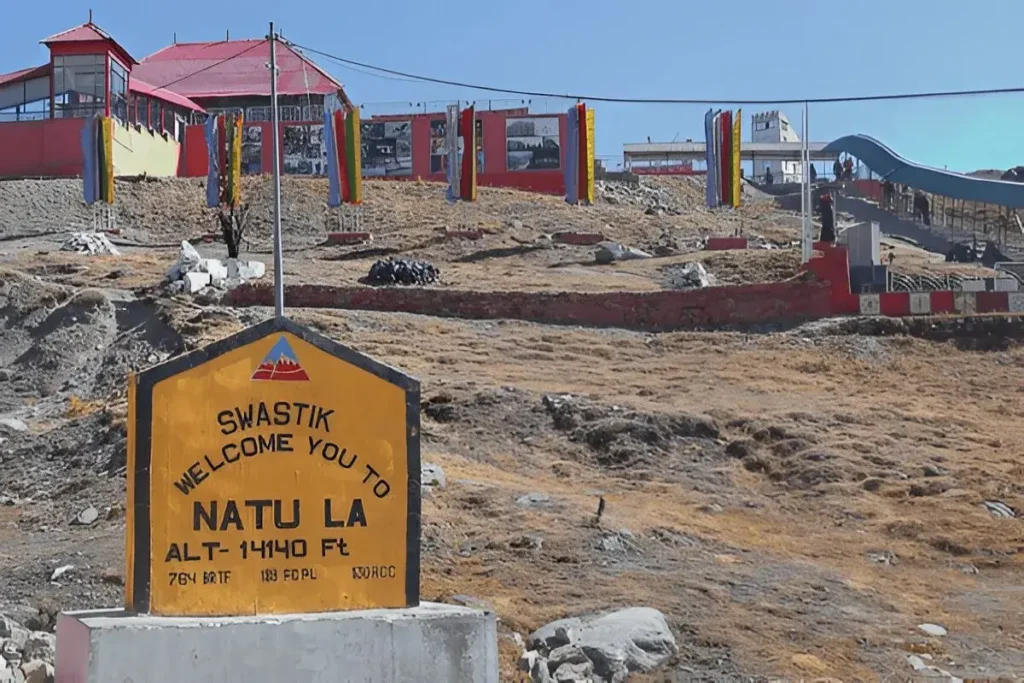
‘Nathu’ means listening ears in Tibetan. ‘La’ means pass. The name — Nathu La, the Pass of Listening Ears — has been used for this high Himalayan crossing for so long that its origin has been forgotten. Standing at 4,310 metres on the ridge that forms the border between Sikkim and Tibet, with the Indian Army bunkers on one side and the People’s Liberation Army fortifications on the other, the name acquires a particular resonance. Everything here listens. The wind listens at the boundary. The soldiers on both sides listen. The landscape — barren, snow-dusted, high and cold — listens. And the centuries of history that have moved through this pass listen to whatever happens here next.
Nathu La Pass is one of the oldest continuously used high-altitude trade routes in Asia — a key offshoot of the ancient Silk Route that connected the Indian subcontinent with Tibet and, beyond Tibet, with Central Asia and China. For centuries, caravans of mules crossed this pass carrying wool, salt, silk, gold, precious stones, medicinal plants, and the ordinary goods of two civilisations trading across the mountains. In 1962, the Sino-Indian War closed it for over four decades. On July 6, 2006, it reopened — the first formal land trade link between India and China in 44 years. The reopening was attended by 700 dignitaries from both countries, despite freezing rain and bitter cold.
Quick Facts About Nathu La Pass
| State | Sikkim |
| District | East Sikkim |
| Altitude | 4,310 metres (14,140 feet) |
| Distance from Gangtok | 54 km east; approximately 3 hours by road |
| Historical Role | Key offshoot of the ancient Silk Route — India–Tibet trade corridor |
| Closed / Reopened | Sealed after the 1962 Sino-Indian War; reopened on 6 July 2006 |
| Trade Status | One of three India-China border trading posts. Trade suspended since 2017 Doklam standoff — verify current status |
| Open Days | Wednesday to Sunday ONLY (closed Monday & Tuesday for military maintenance) |
| Timings | 8 AM to 3 PM |
| Permit | Indian nationals only — foreign nationals, OCI/PIO holders, and citizens of Nepal, Bhutan & Bangladesh are NOT permitted |
| Shared SUV cost | Approx. ₹900–1,200 per head (shared Bolero/Maxx, permit included) |
| Private vehicle cost | ₹6,500–10,000 depending on season and vehicle type |
| Photography | BANNED at the border fence and near military installations |
Crucial Travel Restrictions: Who Can Visit Nathu La Pass?
Why Foreign Nationals and OCI Holders Are Restricted
This must be stated plainly: Nathu La Pass is completely off-limits to all foreign nationals — including OCI and PIO cardholders, and citizens of Nepal, Bhutan, and Bangladesh. The restriction is absolute, enforced by the Indian Army at checkpoints well before the pass, and has no exceptions.
Foreign nationals on the East Sikkim circuit can travel as far as Tsomgo Lake (3,753 m) and Baba Harbhajan Singh Mandir with a Protected Area Permit (PAP) via Sikkim Tourism’s registered operators. Both are worth visiting. But the final 14 km to Nathu La is categorically closed due to military and geopolitical sensitivities at the international border.
| 📝 Nathu La Permit Document Checklist: Permits must be arranged through a registered Gangtok operator at least 24–48 hours in advance. Have these ready: –Original Government-Issued Photo ID: Passport or Voter ID card only. Aadhaar and PAN cards are frequently rejected at military checkpoints for border zone access –Two Passport-Sized Photographs: Required for physical permit sheets attached to your vehicle gate-pass. –Photocopies of ID: At least 3 printed copies –Authorised Vehicle Booking: Heavy SUV only (Scorpio, Bolero, Innova, or Maxx). Private hatchbacks are denied entry at checkpoints –Online booking: No Nathu La permit online booking system exists — permits are obtained exclusively through registered Gangtok operators |
Also Read: How to Apply For Travel Permits for Traveling to Northeast India
Understanding Nathu La: Geopolitical Importance of the Silk Route Pass
Long before the British arrived in Sikkim, Nathu La was a functioning trade corridor. Caravans of approximately 200 mules each — carrying 80 kg per animal, covering the Gangtok to Lhasa route in 20–25 days — moved wool, salt, silk, gold, musk pods, and medicinal plants in both directions. The Marwari trading community controlled roughly 95% of the 200 authorised firms running this commerce. Jawaharlal Nehru and Indira Gandhi used this pass to reach Bhutan in September 1958; the Dalai Lama crossed it in 1956 to visit India.
The 1962 Sino-Indian War ended the trade overnight and sealed the pass. In September 1967, Indian and Chinese forces fought a significant engagement here: Indian Army troops under Brig. Sagat Singh held their positions against PLA artillery and infantry over six days, sustaining approximately 65 fatalities. The pass held, sealed but defended. The 2006 reopening — symbolically coinciding with the Year of Sino-Indian Friendship — carried an implicit mutual acknowledgement: India recognising Tibet as Chinese territory, China recognising Sikkim’s 1975 accession to India. Official border trade has since been suspended following the 2017 Doklam standoff and 2020 Galwan clash; verify the current status with your operator.
| The Friendship Gate erected to mark the 2006 reopening stands directly next to the war memorial for those who died in 1962 and 1967. Optimism and memory, trade and sacrifice, fifty metres apart on the same ridge — the most honest architectural statement of Indo-Chinese relations in the Himalayas. |
| 🚫 Photography & Videography Rules at Nathu La — Strictly Enforced The Indian Army strictly prohibits photography, videography, and drone usage at the actual border fence and near military installations along the highway. Keep cameras packed away when instructed by army personnel. Ignoring instructions risks equipment confiscation and removal from the checkpoint. Permitted photography on the Indian side is signalled by army guides present at the pass. |
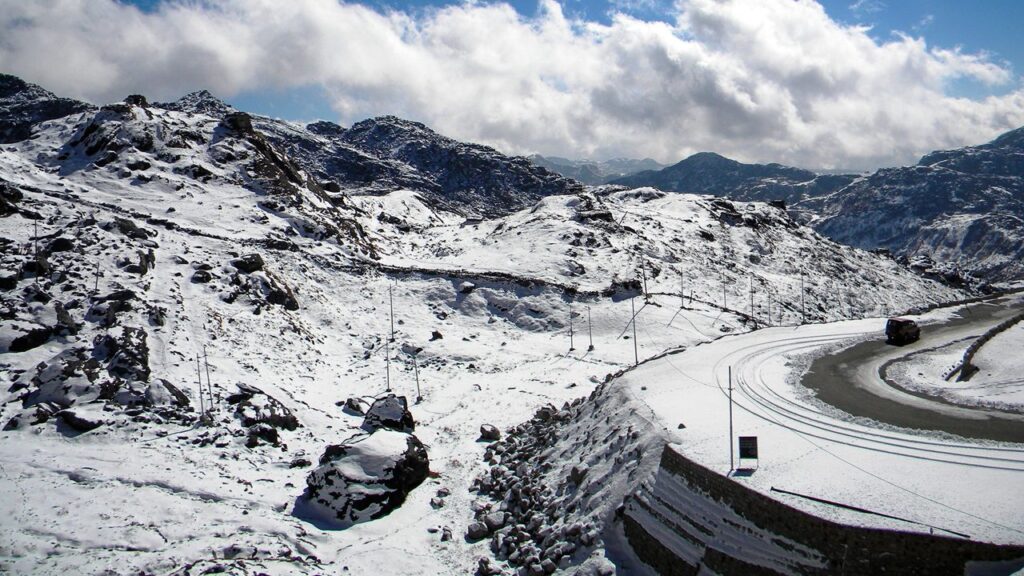
The Altitude Climb: Gangtok to Nathu La in 54 km
| Location | Altitude | From Gangtok | Notes |
| Gangtok | 1,650 m (5,410 ft) | 0 km | Departure point; eat light |
| Tsomgo (Changu) Lake | 3,753 m (12,313 ft) | 40 km | First acclimatisation stop |
| Baba Harbhajan Mandir | ~3,900 m | ~48 km | Military shrine; essential stop |
| Nathu La Pass | 4,310 m (14,140 ft) | 54 km | +2,660 m above Gangtok |
The Gangtok to Nathu La Circuit: Tsomgo Lake and Baba Mandir
Perfect Day Flow from Gangtok
- 7:30 AM — Depart Gangtok. Early departure is essential; noon clouds frequently reduce visibility at the pass. Your operator will have your permit ready.
- ~10:00 AM — Tsomgo (Changu) Lake (40 km; 3,753 m). This 1 km glacial lake sits directly on the highway in a bowl of alpine slopes and is considered sacred by Sikkimese Buddhists and Hindus alike. Spend 45 minutes here. This is your first altitude check — if a strong headache or nausea sets in, discuss descending with your driver before continuing.
- ~11:00 AM — Baba Harbhajan Singh Mandir (~48 km; ~3,900 m). Sepoy Harbhajan Singh of the Rajput Regiment drowned in 1968 while escorting a mule column. In the weeks that followed, fellow soldiers reported he appeared in their dreams, warning of Chinese intrusions. The Indian Army responded by building a shrine — which today functions as a fully operational military outpost: Baba Harbhajan is listed on the active duty roster, his annual leave application is sent to his Punjab village, and a reserved train berth is kept for him each year. One of the most singular places in Sikkim.
- ~12:00–1:00 PM — Nathu La Pass (54 km; 4,310 m). Limit your time to 30–45 minutes. See the war memorial, the Friendship Gate, the barbed wire boundary, and the Chumbi Valley view into Tibet. Follow all army instructions on photography and movement. Begin descending by 2:00 PM — the permit requires exit before 3:00 PM.
Acclimatisation & Safety: Managing Altitude Sickness at 4,310 Metres
The climb from Gangtok (1,650 m) to Nathu La (4,310 m) in under 3 hours is one of the steepest road-accessible altitude gradients in India. Most visitors experience some degree of Acute Mountain Sickness (AMS) — headache, nausea, shortness of breath. This is manageable for healthy people who follow basic protocols.
- Limit time at the pass to 30–45 minutes; descend if symptoms worsen significantly
- No running or strenuous physical activity at the pass
- Stay hydrated before and during the journey — dehydration compounds altitude symptoms
- Carry Paracetamol or Ibuprofen for altitude headache
- Diamox (acetazolamide): consult your doctor before visiting; advisable for those with prior AMS history
- The descent to Tsomgo Lake relieves most symptoms within 30–60 minutes
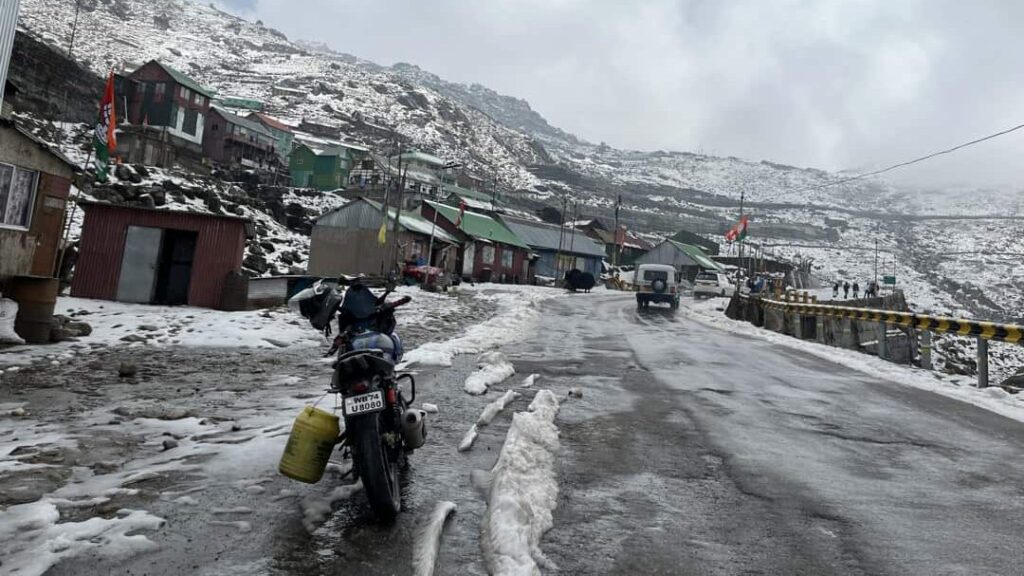
| 💡 Pro-Tip: Rent Warm Gear at Tsomgo Lake The temperature at 4,310 m can be 10–15°C colder than Gangtok. Local stalls near Tsomgo Lake rent heavy jackets, gloves, and snow boots for ₹100–250 per item — no need to overpack from home. Return the gear on your way back down. |
Step-by-Step Guide: How to Get a Nathu La Pass Permit in Gangtok
- Arrive in Gangtok the day before: Allow 24–48 hours for permit processing — same-morning requests are not guaranteed in peak season
- Choose a registered operator: Licensed Sikkim Tourism operators file the permit; find them along MG Marg. Confirm your vehicle is a heavy SUV (Scorpio, Bolero, Innova, or Maxx). Gangtok to Nathu La taxi fare for a private vehicle runs ₹6,500–10,000 depending on the season; shared Sumos run ₹900–1,200 per head
- Submit correct ID: Passport or Voter ID only — Aadhaar and PAN cards are frequently rejected at military checkpoints for the Nathu La border zone
- Confirm the day of the week: The pass is closed on Mondays and Tuesdays. A Wednesday–Sunday window is required
- Depart by 7:30 AM: Earlier is better for visibility and to avoid afternoon cloud cover at the pass
Best Time to Visit Nathu La Pass: Avoiding Monsoon Landslides
- May to June: Post-winter opening; snow still possible; alpine flowers emerging; clear skies likely
- September to October: Post-monsoon clarity; crisp air; excellent visibility into the Chumbi Valley; the finest overall conditions
- July to August (Monsoon): Possible landslides on lower road sections; reduced visibility; avoid unless confirmed open
- November to April: The pass is frequently closed due to heavy snowfall; confirm road and permit status locally before planning
