




There are festivals that entertain, and then there are festivals that carry the weight of centuries. The Behdienkhlam Festival is firmly the latter. Every July in the Jaintia Hills of Meghalaya, the Pnar tribe chases away the plague with bamboo poles and prayer, carries 40-foot towers through narrow streets on the shoulders of dozens of men, and plays a wooden-ball football match to decide which part of the valley gets a good harvest. They have been doing it for generations, and they do not dilute it for visitors.
The Behdienkhlam Festival 2026 falls on July 11–14 in Jowai, the headquarters of West Jaintia Hills district. If you have spent time in Meghalaya and only ever visited Shillong and Cherrapunjee, this festival will show you a completely different dimension of the state — older, more rooted, and utterly unlike anything in mainstream Indian tourism.
Quick Facts: Behdienkhlam Festival
| Detail | Information |
|---|---|
| Festival | Behdienkhlam Festival |
| Dates | July 11–14, 2026 |
| Location | Jowai, West Jaintia Hills District, Meghalaya |
| Also Celebrated At | Tuber Kmai, East Jaintia Hills |
| Celebrated By | Pnar (Jaintia) tribe — followers of the Niamtre faith |
| Key Rituals | Ka Knia Pyrthat, Cher Iung Blai, Khnong procession, Rot immersion at Aitnar |
| Key Games | Datlawakor (wooden-ball football), Latan-bhang (tug-of-war) |
| Distance from Shillong | 65 km — allow 3–4 hours in July monsoon conditions |
| Distance from Guwahati | 160 km (approximately 5–6 hours by road) |
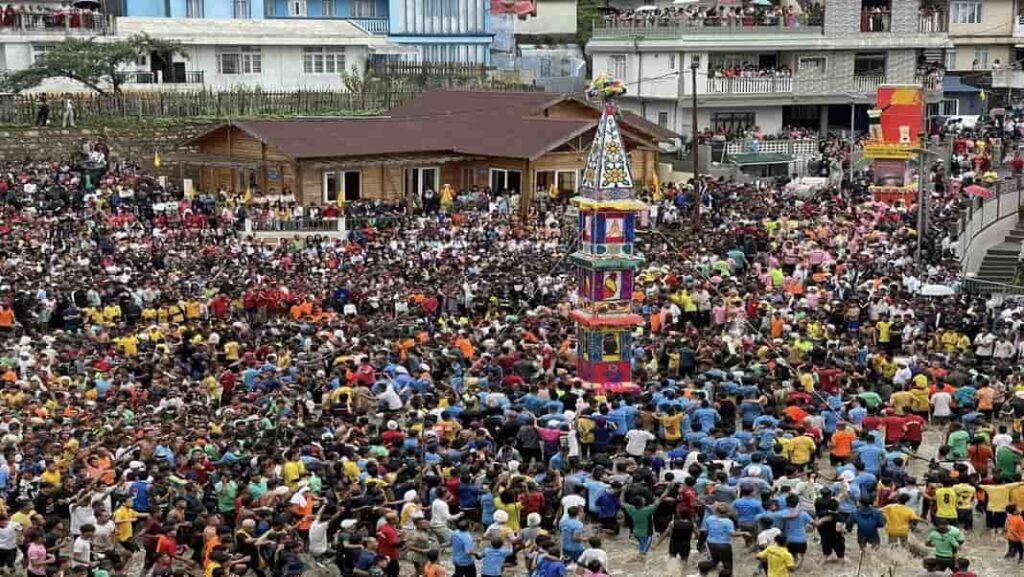
What Is the Meaning of the Behdienkhlam Festival?
The name tells the entire story. Behdienkhlam is a Pnar compound word: “Beh” means to drive away, “Dien” means wood or log, and “Khlam” means plague or pestilence — together, “driving away the plague with wood and prayer.”
This is not a metaphor. The Jaintia Hills were historically ravaged by cholera and smallpox, and the festival evolved as the community’s most powerful collective response. As O.R. Challam, President of Seinraj Jowai, has noted, the concept of khlam has expanded over time: it now refers to every social evil — atrocity, corruption, addiction — that afflicts any community anywhere. The official Meghalaya government portal describes it simply as “chasing away the Demon of Cholera,” which captures the original urgency still embedded in every ritual.
The Niamtre Faith and the Pnar Tribe
To witness Behdienkhlam meaningfully, you need to understand the spiritual framework beneath it. Niamtre is the indigenous belief system of the Pnar people — not a codified scripture religion but a living tradition transmitted through community ritual and oral practice, centred on the supreme God “U Tre Kirot” and on reverence for ancestral spirits and nature.
The festival’s public rituals are executed under the supervision of the Daloi (the traditional chief), the Langdoh, the Pator, and the Wasan — collectively known as the Ka Niam Raij. Alongside these, every household simultaneously performs its own private rites, known as Ka Niam Iong Iung. Prayers are offered to four guardian deities — U Mukhai, Mulong, Mooralong, and Musniang — whose presence at Jowai’s four corners is still marked by sacred stones.
One aspect that surprises visitors: women do not participate in the public dancing. Their role is equally indispensable — offering sacrificial food to the spirits of forefathers at home. This is a sacred division of roles, not exclusion.
Day-by-Day Guide to the Behdienkhlam Rituals
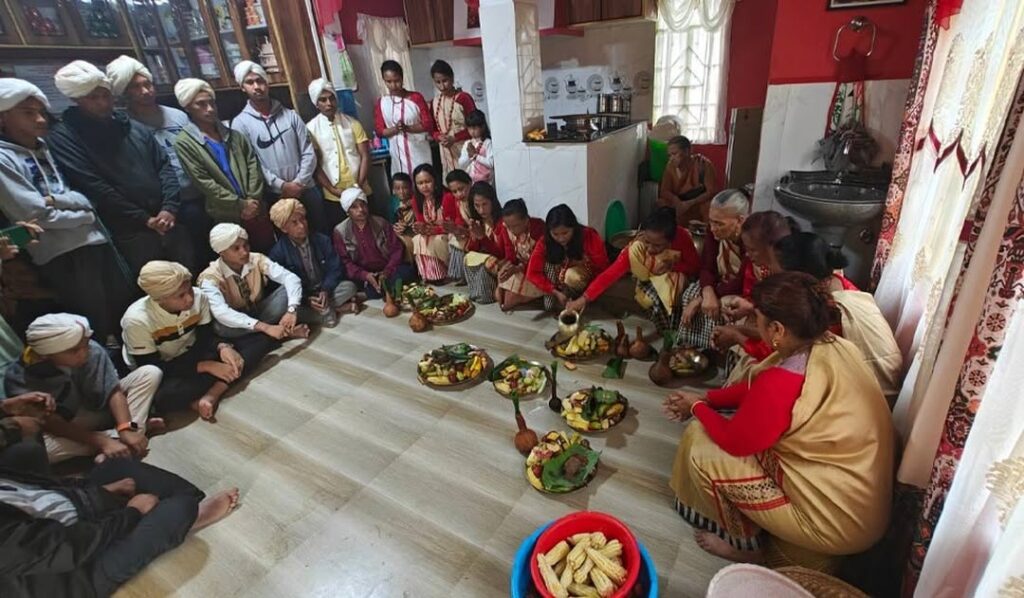
Pre-Festival: Ka Knia Pyrthat
A week before the main days, the Doloi and Langdoh of Chyrmang perform Ka Knia Pyrthat — one of the most important sacrificial rites of the entire festival calendar. A priest known as “Wasan” rings a bell and walks the town’s main road to the edge of the forest, marking the boundary between the human and spirit worlds. This sets the spiritual stage for everything that follows.
Day One — Bamboo Rooftops and Cher Iung Blai
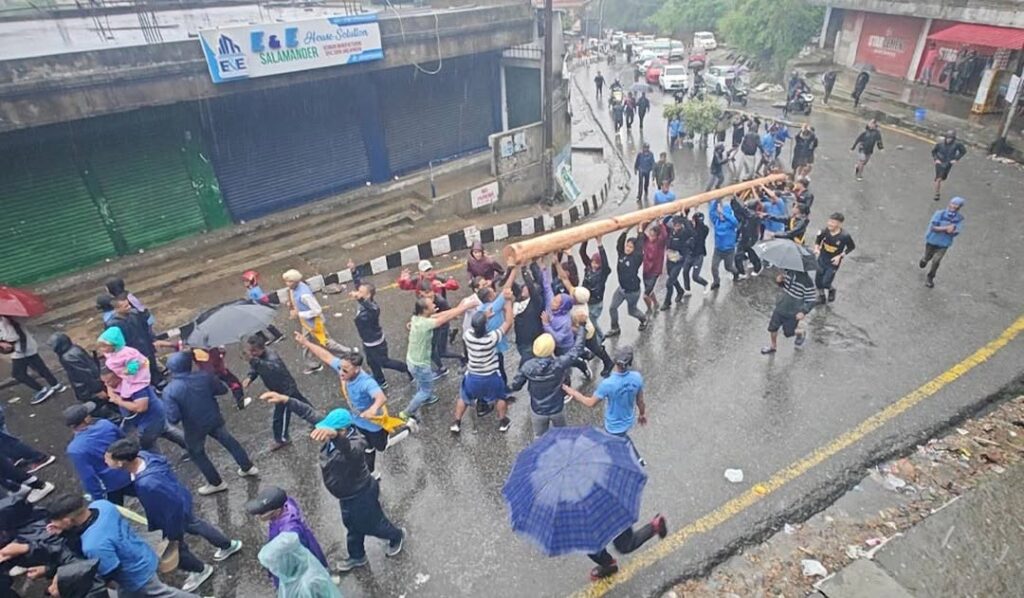
Young men move street by street through Jowai, beating every rooftop with long bamboo poles — a sacred act of exorcism, physically chasing evil out of the community’s homes. Simultaneously, the Cher Iung Blai ritual takes place: male members enter a newly built thatched hut of grass and bamboo with spears and symbolically kill the demons inside. A pig is then sacrificed to Knia Pyrthat, the thunder god, formally opening the public ceremonies.
Days Two and Three — The Khnong and the Rots
The Khnong is a massive, polished log felled from the forest and carried through town during the Symbud Khnong ceremony. Thousands line the streets for a chance to touch it — the belief being that contact with the Khnong protects from sickness and brings prosperity. The queues are long; nobody rushes.
Running alongside this are the Rots — towering bamboo-and-tinsel structures, often 30 to 40 feet tall, built over several weeks by the youth of each Dong (local locality). They are carried on the shoulders of dozens of men through Jowai’s narrow streets to the Aitnar sacred pool. The 2025 edition featured Rots depicting Operation Sindoor, digital addiction, and environmental degradation — ancient form, fully contemporary message.
Day Four — Aitnar Immersion and Datlawakor
The climax. At the Aitnar sacred pool, the Rots and Khnong logs are ceremonially immersed in water — the symbolic moment all accumulated evil is destroyed. The atmosphere is extraordinary: drums, flutes, thousands in traditional attire, four days of devotional energy releasing at once.
Then comes the Datlawakor — a football-like game played with a wooden ball between two teams representing the upper valley (Pynthorwah) and lower valley (Pynthornein), with the Doloi himself as referee. The winning side is believed to receive a blessing of good harvest for the coming year. In 2025, Pynthorwah won. The Latan-bhang tug-of-war follows a similar north-versus-south structure. The festival closes with the Bam Tyngkong ceremony, in which women offer sacrificial food to the Almighty — the final act of the community’s covenant with its gods.
Behdienkhlam Cultural Etiquette & Survival Guide
Because this is a living religious ritual — not a staged show — follow these ground rules:
- Footwear at Aitnar: The pool and its banks are consecrated ground. Follow local cues on where to remove footwear; do not wade in uninvited.
- Rain gear: Umbrellas are unworkable in dense festival crowds. Wear a heavy-duty waterproof poncho that keeps your arms free.
- Photography: Young men in the mud are generally welcoming, but always seek an explicit nod before pointing a lens at the Doloi or priests during sacrificial rites.
- Women’s rites: The Bam Tyngkong and other household rituals are private. Do not seek access unless specifically invited.
- Cash only: Jowai’s ATMs run dry during the festival. Withdraw everything in Shillong or Guwahati before travelling up.
- Gumboots: Buy a cheap pair at Jowai’s Polo Ground Market (₹300–₹500) on arrival. The area around Aitnar on Day 4 is deeply muddy.
Traveling to Jowai in July: Monsoon Road Warnings
Jowai has no railway station or airport. Getting there is entirely by road — and the July monsoon makes that road a different proposition than Google Maps suggests.
From Shillong (65 km via NH6): allow a minimum of 3–4 hours during festival week, not the standard 1.5–2.5 hours. Sudden cloudbursts near the Mawryngkneng and Thadlaskein stretches can reduce visibility to near zero. Fog is heavy on the ridgelines in the early morning and after afternoon rain. Minor landslides are not unusual. A private cab from Shillong costs ₹2,700–₹3,600; shared taxis from Police Bazaar run ₹200–₹300 per seat. Do not self-drive this road in the dark during the monsoon.
From Guwahati (160 km): fly or train into Guwahati, then travel via NH27 to Shillong and onward. ASTC and MTC buses connect Guwahati to Shillong from Paltan Bazaar; pick up a cab to Jowai from there. Arrive at least a day before the festival opens.
Calculate your exact route distance with our Map Distance Calculator tool
Accommodation: The Jowai Bottleneck and Your Backup Plan
Jowai’s guesthouses, circuit houses, and homestays sell out months in advance — often to government officials and media crews. Check Meghalaya Tourism for approved homestay listings and book the moment you decide to go.
If you cannot secure a room in Jowai, the practical fallback is to base yourself in Shillong and arrange a private cab departing by 6:00 AM on the final two festival days. It adds road time, but Shillong’s accommodation options are vastly wider, and a good driver will get you to the grounds before the key rituals begin.
For food, Jadoh (rice cooked in pork or chicken fat), Dohneiiong (pork with black sesame), and Putharo (rice cakes) are the staple Pnar dishes, available at local stalls throughout the festival. If a host offers you Iad — local rice beer — you are already inside Pnar hospitality.
Beyond the Festival: Jaintia Hills and Nearby
Attending Behdienkhlam puts you in the Jaintia Hills in July — Meghalaya at its most lush. A few additions worth building into your trip:
Krang Suri Falls (30 km from Jowai) is best in the July flush, its turquoise pools vivid after the early monsoon. The Nartiang Monoliths (20 km) — the largest collection of menhirs and dolmens in Northeast India — connect directly to the same ancestral tradition the festival honours. Thadlaskein Lake (10 km) is an easy half-day option.
Shillong (65 km) is the natural base: café culture, Elephant Falls, the Don Bosco Museum of Indigenous Cultures, and easy onward access to Cherrapunjee and Mawsynram. On the way in or out via Guwahati, a visit to the Kamakhya Temple is worthwhile — a spiritually compelling contrast to the Niamtre tradition you have just experienced.
Use the NE India Trip Planner to build your wider itinerary.
Final Visitor Checklist
- Dates: July 11–14, 2026 | Jowai, West Jaintia Hills, Meghalaya
- No permits required for Indian nationals
- Shillong–Jowai taxi: ₹2,700–₹3,600 (private); ₹200–₹300 (shared)
- Allow 3–4 hours for the Shillong–Jowai drive in July
- Book Jowai accommodation months in advance; 6 AM Shillong day-trip is the fallback
- Gumboots from Polo Ground Market: ₹300–₹500
- Cash only — Jowai ATMs run dry during the festival
- If attending one day only: Day 4 (Aitnar immersion + Datlawakor) is the one
The Behdienkhlam Festival is not a polished tourist event. It is a community conducting its most important annual ritual — in its own language, on its own sacred ground, with the same seriousness and joy it has brought to every July for as long as anyone can remember. Showing up and paying attention is one of the more genuinely rewarding things you can do as a traveller in Northeast India.
July 11–14, 2026. Jowai is waiting.
