




Meghalaya’s world-famous living root bridges have taken a significant step toward international recognition after India’s nomination of the “Jingkieng Jri / Living Root Bridge Cultural Landscape” was officially accepted for UNESCO’s 2027 World Heritage evaluation cycle.
According to documents released by the UNESCO World Heritage Centre, the nomination from India is among 34 submissions worldwide that successfully passed the completeness review and will now proceed to detailed examination by the World Heritage Committee during its 49th session in 2027.
The development marks a major milestone for Meghalaya and could eventually secure global recognition for one of the most remarkable examples of indigenous engineering and community-based conservation in the world.
UNESCO Evaluation Process Begins
A total of 46 nominations from around the world were submitted before UNESCO’s January 2026 deadline. Following an initial screening process, 34 nominations were accepted as complete and eligible for further assessment.
Meghalaya’s nomination has been submitted under UNESCO cultural criteria (i), (iii), and (v), which recognize outstanding human creativity, cultural traditions, and exceptional interactions between people and their environment.
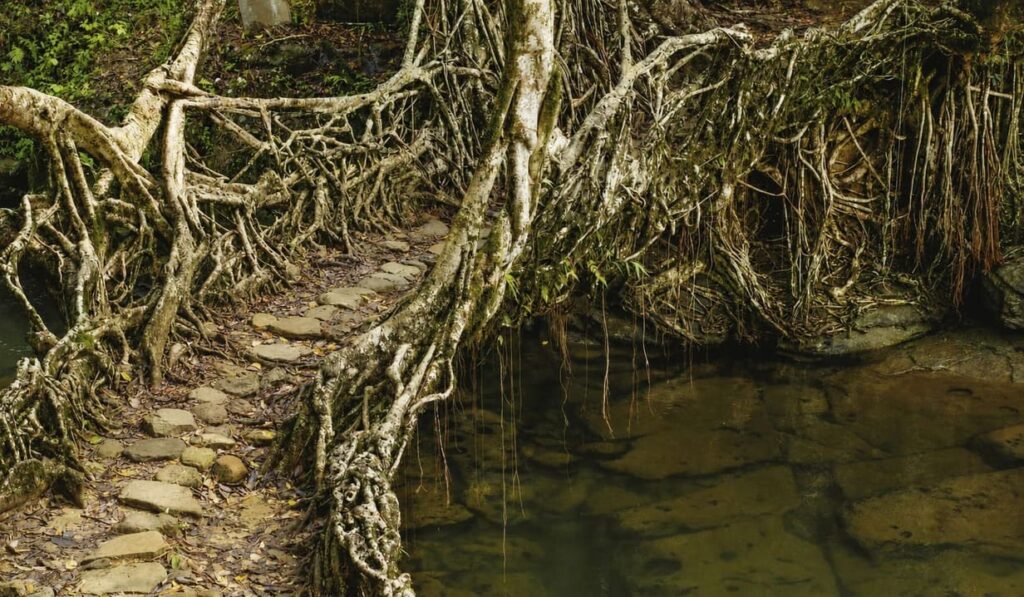
The nomination highlights the extraordinary living root bridges created by indigenous Khasi communities by carefully cultivating, guiding, and weaving the aerial roots of rubber fig trees across rivers and streams.
A Unique Living Architectural Tradition
Unlike conventional bridges built from concrete, steel, or wood, Meghalaya’s living root bridges are grown over decades through a traditional bioengineering process that combines ecological knowledge, patience, and collective community effort.
Found primarily in the Sohra (Cherrapunji) and surrounding regions, these structures continue to grow and strengthen with age, making them among the world’s most unique examples of living architecture.
UNESCO describes the nominated property as a cultural landscape comprising three interconnected components that illustrate the deep relationship between local communities and the natural environment.
The bridges represent centuries of indigenous innovation, where nature and human ingenuity work together to create sustainable infrastructure adapted to the region’s challenging terrain and heavy rainfall.
Lifeline for More Than 75 Villages
Beyond their architectural significance, the living root bridges remain essential infrastructure for rural communities across Meghalaya.
The network of bridges provides critical connectivity for more than 75 remote villages, enabling residents to cross rivers and streams safely while supporting daily livelihoods, trade, education, and access to services.
Experts note that the structures demonstrate exceptional climate resilience, as they naturally adapt to changing environmental conditions and become stronger over time rather than deteriorating.
The bridges are also regarded as powerful symbols of collective community stewardship, showcasing how traditional knowledge systems can offer sustainable solutions to modern challenges.
Centuries of Indigenous Knowledge
Historical records dating back to the early nineteenth century document root bridge construction traditions in the Sohra region. These accounts describe the remarkable engineering techniques used by Khasi communities to guide living tree roots into functional bridge structures capable of withstanding extreme weather conditions.
Over generations, the practice has evolved into a sophisticated form of ecological engineering that continues to attract researchers, conservationists, architects, and tourists from around the world.
The nomination emphasizes that the bridges are not merely tourist attractions but living cultural heritage that reflects the identity, traditions, and environmental wisdom of the Khasi people.
Final Decision Expected in 2027
The nomination will now undergo comprehensive technical evaluation by UNESCO’s advisory bodies, which will assess its cultural significance, authenticity, integrity, and long-term conservation framework.
Following these assessments, the World Heritage Committee will make its final decision during its 49th session in 2027.
If approved, Meghalaya’s living root bridges would join UNESCO’s prestigious World Heritage List, bringing global recognition to the state’s indigenous engineering heritage, community-led conservation practices, and sustainable relationship between humans and nature.
The potential inscription would also further strengthen Meghalaya’s position as a leading eco-tourism and cultural tourism destination, attracting greater international attention to one of Northeast India’s most extraordinary living traditions.
