




There’s a strange irony sitting over the hills of East Khasi Hills right now. Mawsynram, the village that has spent decades holding the title of the wettest place on Earth, is quietly getting drier. A peer-reviewed study published in February 2026 in the Journal of the Indian Society of Remote Sensing found that rainfall here fell from 10,235 mm in 2014 to 8,838 mm in 2023, a 14 percent drop in under a decade, with researchers pointing to rising air pollution as the cause. For a place whose entire identity is built around rain, that’s not a small story.
This is the village credited with the highest average annual rainfall recorded anywhere on the planet, where waterfalls sometimes spill across the highway and locals weave the knup, a bamboo-and-leaf shield worn like a portable roof. Getting here safely takes more field knowledge than most guides bother to share.
Quick Facts About Mawsynram
| State | Meghalaya |
| District | East Khasi Hills |
| Altitude | Approximately 1,400 metres above sea level |
| Distance from Shillong | 61 km; approximately 2 hours by road |
| Distance from Guwahati Airport | Approximately 162 km |
| Distance from Shillong Airport (Umroi) | Approximately 86 km |
| Distance from Guwahati Railway Station | Approximately 151 km |
| Average Annual Rainfall | 11,802–11,872 mm (long-term IMD average) |
| Single-Day Rainfall Record | 1,003.2 mm on 17 June 2022 |
| Key Attractions | Mawjymbuin Cave, Krem Puri, Mawlyngbna Split Rock, Phlangwanbroi |
| Best Time | October–February for trekking and caving; June–September to witness the rain phenomenon |
| Rain Gauge Location | Inside the Mawsynram PWD (Public Works Department) complex |
| Local Craft | The knup — a bamboo and palm-leaf rain shield worn while working the fields |
The Orographic Mechanism: Why Does Mawsynram Receive So Much Rain?
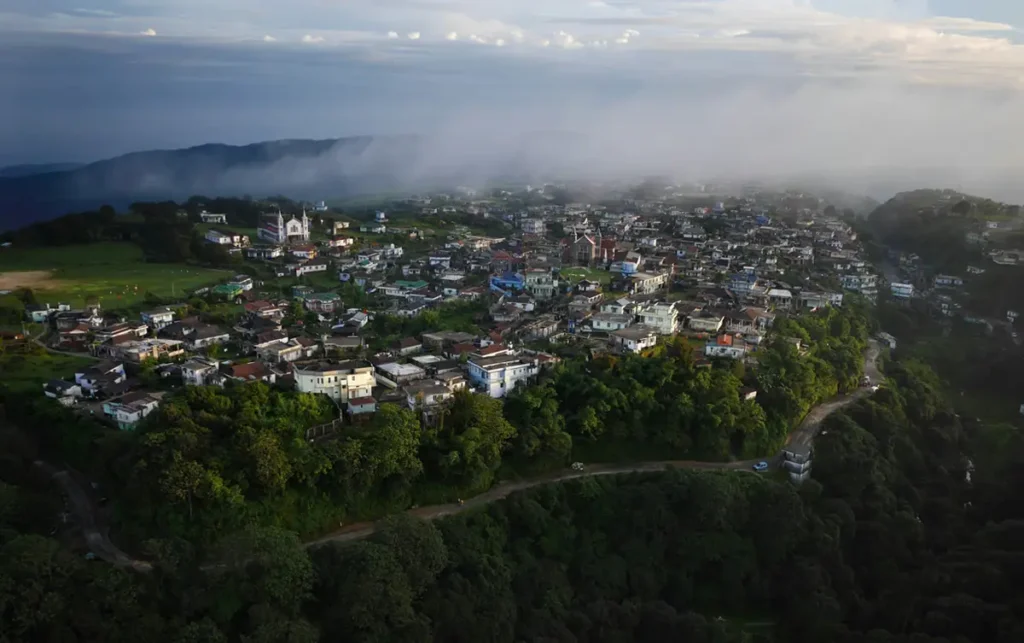
Mawsynram sits in the East Khasi Hills district, about 61 kilometres south of Shillong, in what the Köppen climate classification labels a subtropical highland zone. That clinical description undersells what actually happens here for nearly half the year.
The Funnel Effect: Bay of Bengal Winds and East Khasi Hills Topography
Moisture-laden winds from the Bay of Bengal are funnelled into a narrow south-facing valley formed by the Khasi Hills. This unique geography forces the air upward, where it cools and condenses, producing intense and near-continuous monsoon rainfall. Known as orographic rainfall, it makes Mawsynram one of the wettest places on Earth.
The official rain gauge is located within the Mawsynram Public Works Department complex. Long-term records show average annual rainfall of about 11,800 mm, depending on the dataset used. For perspective, London receives around 600 mm of rain annually, meaning Mawsynram gets nearly twenty times more.
Debunking the Rainfall Rivalry: Mawsynram vs. Cherrapunji (Sohra)
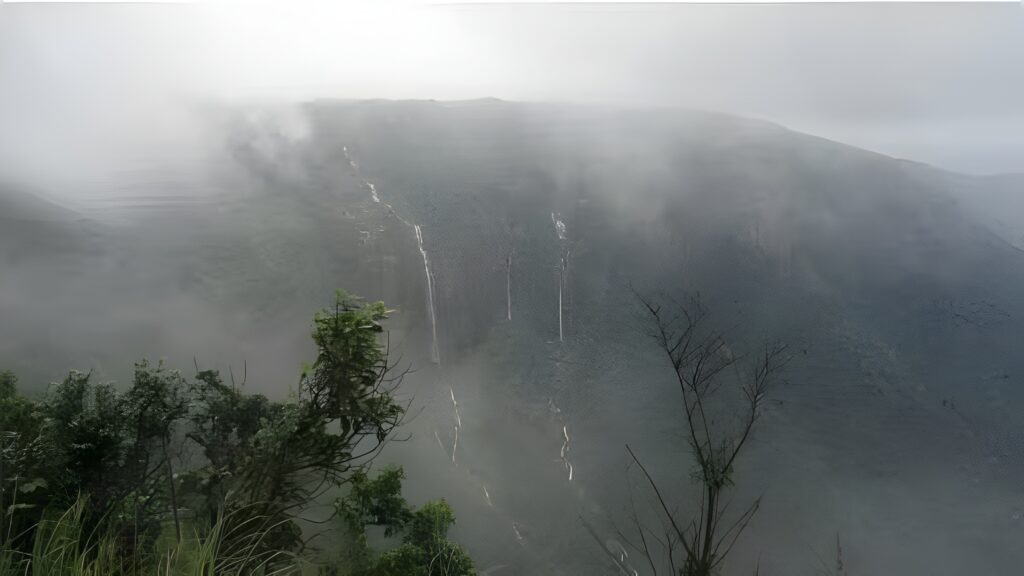
Most people who’ve heard of extreme rainfall in India know the name Cherrapunji first, also called Sohra, sitting just 15 kilometres east of Mawsynram. For decades, the two villages have traded the unofficial title depending on which year’s data you check.
| Feature / Metric | Mawsynram (The Rain Capital) | Sohra / Cherrapunji (The Legacy Giant) |
| Long-term average rainfall | ~11,802–11,872 mm annually | ~11,430 mm annually |
| Topographical mechanism | Strict funnelling via a narrow, south-facing cul-de-sac valley | Sits on an elevated, windward plateau edge |
| Geological cave dominance | Krem Puri — sandstone matrix, highly complex labyrinth | Mawsmai/Arwah — limestone matrix, easily accessible fossil passages |
| 2026 aerosol study impact | 14.6% decline over a decade, linked to black carbon density | Experiencing parallel multi-decade downward trends in seasonal rainfall |
Historically, Cherrapunji held the records for the highest monthly and annual rainfall and remains the better-known name. However, long-term IMD data shows its rainfall has declined over time, while Mawsynram’s has remained relatively stable. As a result, Mawsynram is now more consistently recognised as the wettest place on Earth, although locations in Colombia, including Lloró and López de Micay, also compete for the title.
The 1,003 mm Record Day: Historic Indian Monsoon Extremes
On 17 June 2022, Mawsynram recorded 1,003.2 mm of rain in 24 hours, breaking a record that had stood since 1966. Cherrapunji isn’t far behind, having recorded 1,563.3 mm in a single day back in June 1995. These aren’t outlier freak events so much as a normal feature of how the monsoon behaves over this stretch of hills.
The Climate Shift: Decoding the 2026 Aerosol and Black Carbon Study
This is where the story becomes more current. A study by the CSIR-National Physical Laboratory, conducted with researchers from the IMD, IIT Delhi, and the Indian Institute of Tropical Meteorology, analysed satellite and weather data from 2014–2023 to understand how airborne pollution particles affect cloud formation over the East Khasi Hills.
Researchers found a 14.6% rise in aerosol concentrations over Mawsynram during the decade, closely linked to declining rainfall, especially during the peak monsoon months of July to September. Black carbon from biomass burning and fossil fuel use was identified as a key factor disrupting the cloud processes that drive the region’s heavy rainfall.
The findings align with other observations. IMD data from 2024 showed both Mawsynram and Sohra receiving below-average rainfall, with similar trends continuing in 2025 across Meghalaya. While Mawsynram remains one of the wettest places on Earth, scientists are increasingly concerned about the long-term impact on agriculture, water resources, and tourism.
Top Expedition Sites: Underground Caves and Living Root Bridges
Mawjymbuin Cave
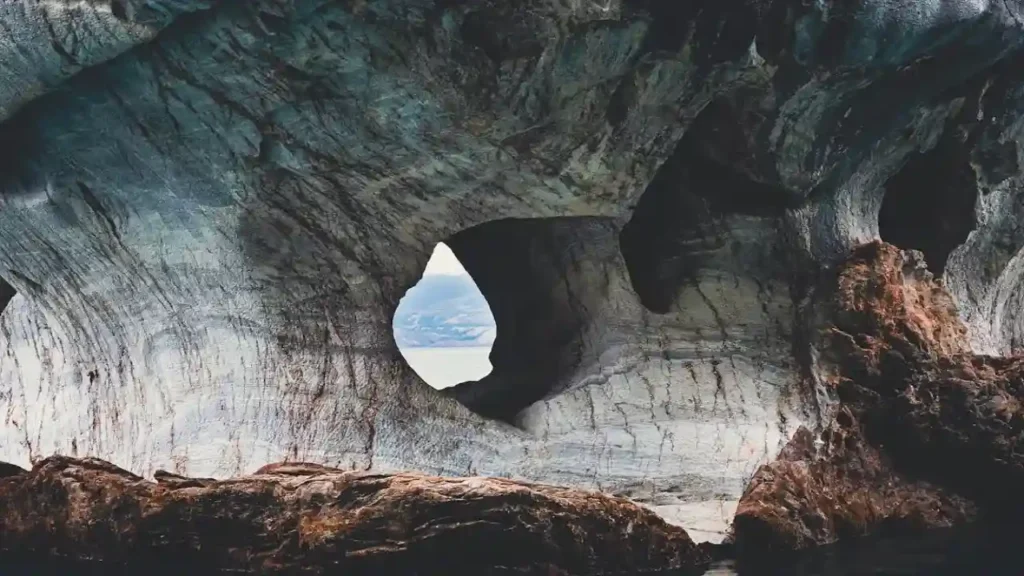
The most famous single attraction in the area is the Mawjymbuin Cave, known for an unusual rock formation: a large stalagmite shaped like a Shivling, with a stalactite formation above it resembling a cow’s udder, from which water drips continuously onto the formation below. The cave has been a pilgrimage site for Shiva devotees for generations, and the natural drip is treated as a kind of perpetual ritual offering.
Krem Puri Guide: Exploring the World’s Longest Sandstone Cave System
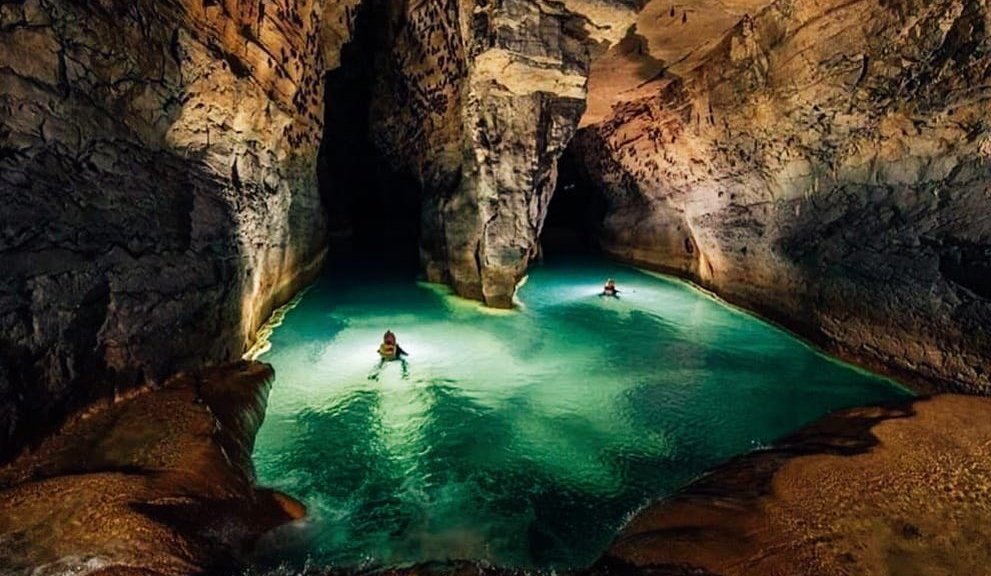
For caving enthusiasts, Krem Puri is a remarkable site. Stretching 24.5 kilometres, it is the world’s longest sandstone cave system and has yielded theropod dinosaur fossils dating back about 66 million years. Reaching the cave requires a steep descent, and visitors should explore it only with proper gear and an experienced local guide.
Mawlyngbna Split Rock: Tracking the 1897 Assam Earthquake
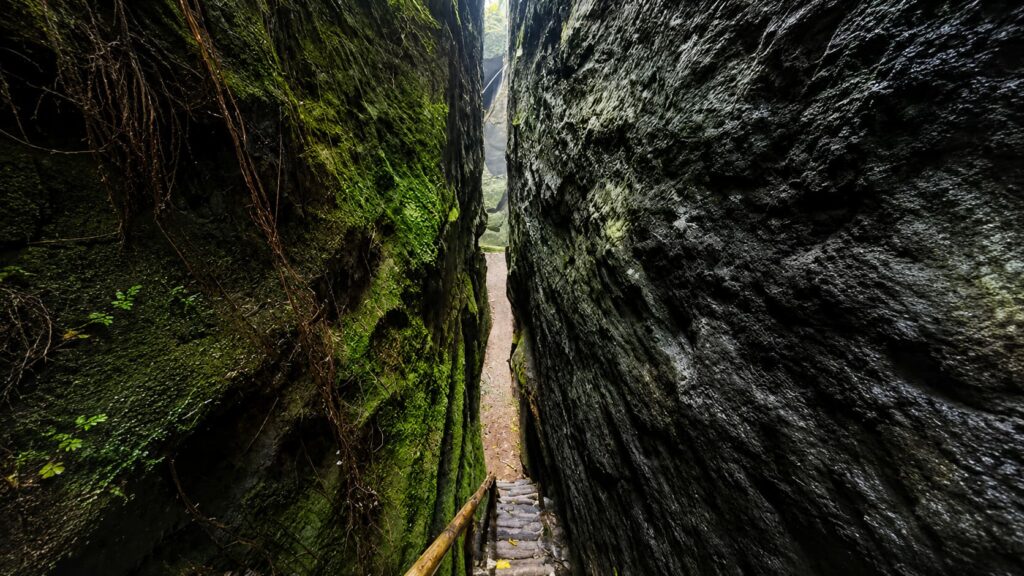
A short distance from town, Mawlyngbna has become a hub for water activities centred around the pretty Umkhakoi lake, where kayaking and swimming are popular. For this Mawlyngbna fossil site travel guide detail: the village sits on ground carrying evidence of a marine past stretching back millions of years, and it’s home to the Split Rock, a single massive boulder cleaved cleanly in two, an event locals attribute directly to the devastating magnitude 8 Assam earthquake of 1897.
Phlangwanbroi and the Hoolock Gibbons

For wildlife-focused travellers, Phlangwanbroi village offers jungle treks through a forest known to host a protected population of hoolock gibbons, one of the few ape species native to India. Sightings aren’t guaranteed, but the trek itself is worthwhile, taking visitors through dense subtropical forests rich in birdlife and native flora. Early morning walks provide the best chance of hearing the gibbons’ distinctive calls echoing through the canopy, even when the animals remain out of sight.
The Land of the Knups: A Cultural Adaptation to Permanent Rain
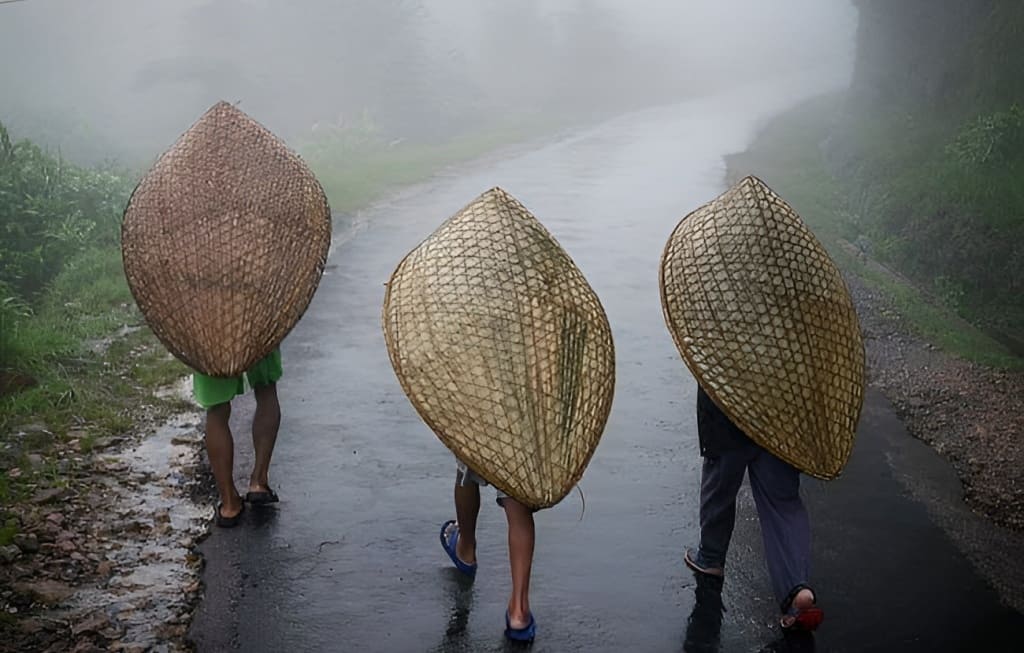
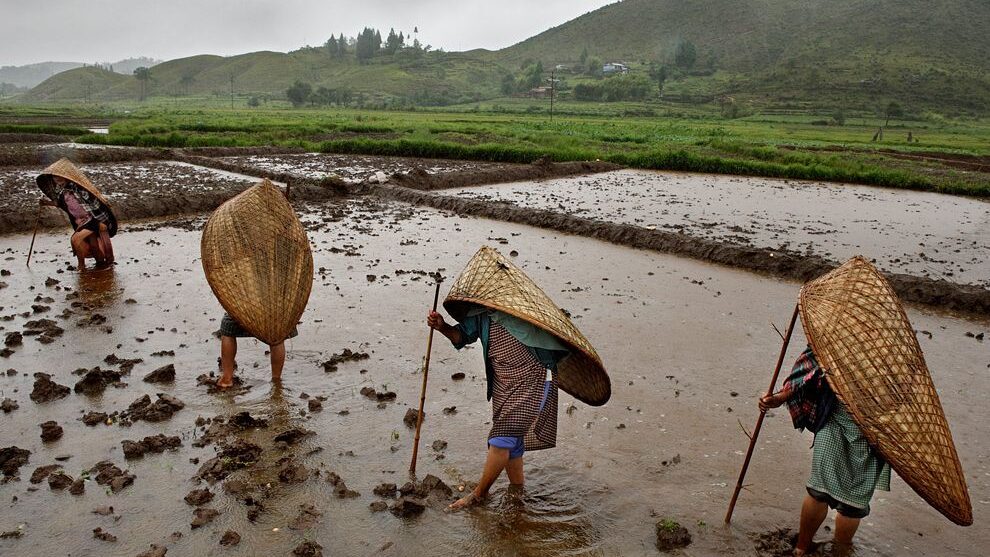
No discussion of Mawsynram is complete without the knup. This shell-shaped shield is woven from specialised local bamboo known as shken and covered with the waterproof leaves of the Knup palm, locally called thri. Worn over the head and back like a portable roof, it protects farmers from heavy rain while keeping their hands free to work.
The traditional Khasi knup remains in use across villages in the Khasi Hills. Seeing one on a farm terrace offers a glimpse into how local communities have adapted to one of the wettest climates on Earth, designing practical solutions to live and work with extreme rainfall.
Crucial Transit Geometries: Reaching Mawsynram from Guwahati Airport
Getting here is straightforward if you’re already based in Shillong, less so otherwise.
- From Shillong, it’s roughly 61 kilometres by road, generally taking around two hours, passing near the Mawphlang Sacred Grove, a worthwhile detour if you have the time.
- The nearest airport is Shillong Airport at Umroi, approximately 86 kilometres away, though most travellers fly into Guwahati’s Lokpriya Gopinath Bordoloi International Airport instead, roughly 162 kilometres from Mawsynram, since it carries far more flight connectivity.
- The nearest major railway station is Guwahati Railway Station, around 151 kilometres away, from where private taxis or shared vehicles complete the journey into the hills.
Driving Through the Cloud: Yellow Fog Lamps and Mountain Road Hazards
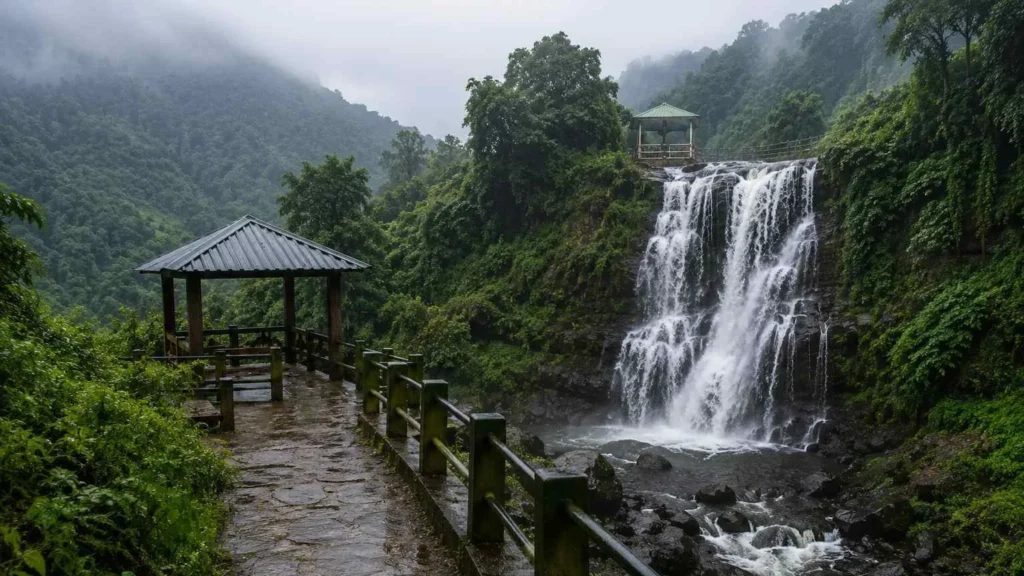
This is the most important consideration when driving the Shillong–Mawsynram highway. During the monsoon, dense fog known locally as lyoh can reduce visibility to just a few feet within minutes. Standard headlights are often ineffective, making fog lamps essential. If visibility suddenly disappears, slow down immediately or pull over until conditions improve.
The Ultimate Mawsynram Monsoon Survival Checklist
If you’re travelling between June and September to witness the rainfall phenomenon, your day-pack needs a few non-negotiable items:
- Heavy-duty, silicone-coated dry sacks. Standard water-resistant backpacks fail within about ten minutes of genuine orographic downpours, so seal passports, cameras, and electronics in proper airtight dry sacks.
- A high-lumen tactical headlamp. The paths inside Mawjymbuin and Krem Puri are completely dark with no industrial lighting, and a headlamp keeps your hands free on slick cave walls.
- Pre-downloaded offline maps. Cellular signals from networks like Jio and Airtel drop out entirely when heavy cloud walls settle over the valley.
- Silica gel packs. Ambient relative humidity during the monsoon sits at or near 100 percent, and silica packets inside your camera bag prevent lens mould and electronic corrosion.
Sustainable Accommodations: Community Homestays and Lakeside Camps
Don’t expect large hotel chains here. Several villages in the wider Mawsynram region run community-based lodges and homestays, and the Weiing Lakeside Camp in nearby Phlang Mawsyrpat village has become a favoured base for travellers who want to spend a proper night or two rather than treating this as a rushed day trip from Shillong.
Spending at least one night locally genuinely changes the experience — it opens up early morning birdwatching, gives you a realistic shot at exploring Krem Puri or the Mawlyngbna fossil sites without rushing, and lets you hear monsoon rain on a tin roof at close range, arguably the most honest way to understand why this place earned its reputation.
A Village Worth More Than Its Headline
Mawsynram will likely keep its claim to the title of the wettest place on Earth for the foreseeable future, even as the 2026 aerosol study suggests that claim stands on slightly less solid ground than it used to. But reducing this village to a rainfall statistic always missed the point. The caves, the lakes, the fossil beds, the knup-wearing farmers still working terraced slopes through the downpour, and the drama of watching a wall of monsoon cloud roll up the valley are worth the trip on their own terms.
If you’re planning a wider Meghalaya itinerary and have already pencilled in Cherrapunji, give Mawsynram its own dedicated day, pack for the fog and humidity, and the wettest place on Earth will give you far more than a drive-by ever could.
