




Southwest of Guwahati‘s urban sprawl, past a transition of paddy fields and satellite settlements, lies one of South Asia’s most biologically significant freshwater wetlands. Deepor Beel — also spelled Dipor Bil, with ‘beel’ being the Assamese word for lake — is a perennial oxbow lake in a former Brahmaputra channel supporting wild Asian elephants, 200+ bird species, 50+ fish species, and the world’s largest concentration of the critically endangered Greater Adjutant Stork.
Designated Assam’s only Ramsar Site in November 2002, Deepor Beel is also a BirdLife International Important Bird Area (IBA) and protected under the Guwahati Water Bodies Preservation and Conservation Act of 2008. In 2026, it stands at a genuine turning point: major infrastructure projects and a contested legal battle over its Eco-Sensitive Zone are reshaping its future — for better and worse.
Quick Facts: Deepor Beel (Dipor Bil)
| State | Assam |
| Also spelled | Dipor Bil |
| Location | Southwest Guwahati; bounded by Bharalu R (east), Kalmoni R (west), Rani-Garbhanga RF (south) |
| Ramsar Designation | November 2002 — Assam’s only Ramsar Site |
| Sanctuary Area | 4.1 sq km core; full beel up to 40.1 sq km in floods |
| Bird Species | 200+; 70 migratory; 26,747 birds of 96 species (2022 count) |
| Fish Species | 50+ species |
| ESZ (Revised) | Reduced from 148.97 sq km to 38.84 sq km |
| Best Time to Visit | October–March |
The Ecology of Deepor Beel: Lower Brahmaputra’s Hydrological Lifeline

Deepor Beel occupies a former Brahmaputra channel fed by the Basistha and Kalmani rivers, draining north via the Khonajan channel. Water depth swings from ~4 metres at peak monsoon to under 1 metre in the dry season — a contraction that concentrates wildlife at the beel’s edges and makes October–March the most rewarding visiting window. Beyond its biodiversity value, the beel is Guwahati’s primary natural flood buffer; its 40.1 sq km monsoon footprint absorbs runoff that would otherwise flood the city. Satellite imagery shows the beel’s area has shrunk by at least 35% since the late 1980s — a loss attributable to encroachment, sewage inflow, and landfill pressure.
The Winter Migratory Flyway: A Staging Ground for Rare Avian Species
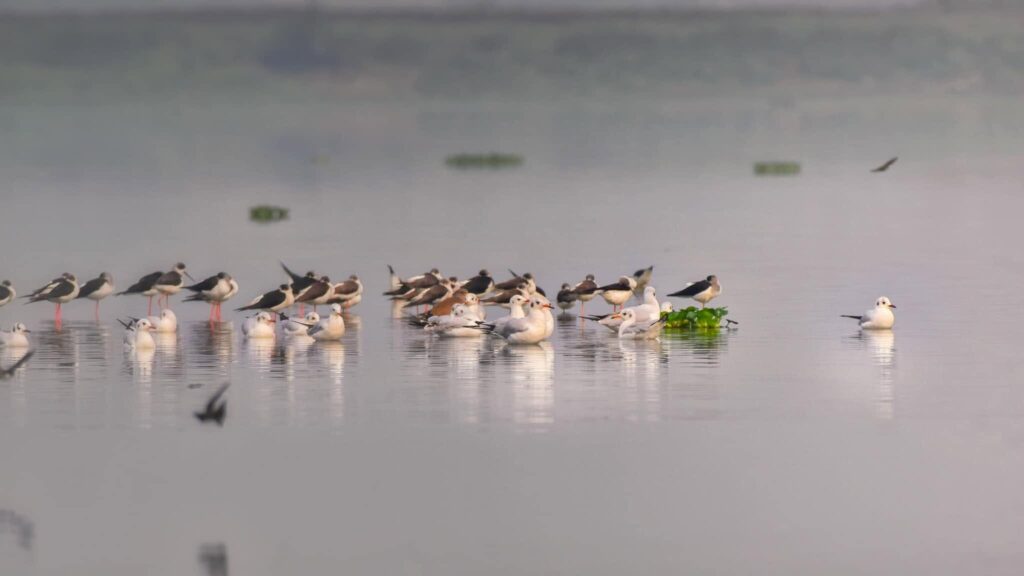
Sitting beneath the Central Asian Flyway, the beel receives waterfowl from breeding grounds across Central Asia, Tibet, and the Himalayan plateau. The 2022 Guwahati Wildlife Division bird count recorded 26,747 birds of 96 species — up from 10,289 the previous year. Key winter species:
- Greater Adjutant Stork (Leptoptilos dubius) — Critically Endangered; global population ~1,200; Deepor Beel is a primary stronghold
- Baer’s Pochard (Aythya baeri) — Critically Endangered; one of the world’s rarest ducks; key wintering site
- Spot-billed Pelican (Pelecanus philippensis) — Vulnerable; large open-water colonies in winter
- Lesser Adjutant Stork, Bar-headed Goose, Ferruginous Duck, Garganey — regular winter visitors
- Pheasant-tailed Jacana, Purple Swamphen — year-round residents on floating vegetation
The Greater Adjutant’s story is one of the beel’s most uncomfortable truths: these immense, critically endangered birds feed partly at the edge of the old Boragaon garbage dump — sustained by the same waste stream that is degrading their habitat. Conservation photographer documentation of this paradox has raised international awareness. Aaranyak, the Guwahati-based wildlife NGO most active at the beel, has been central to both tracking these colonies and connecting wetland conservation to the livelihoods of local fishing communities.
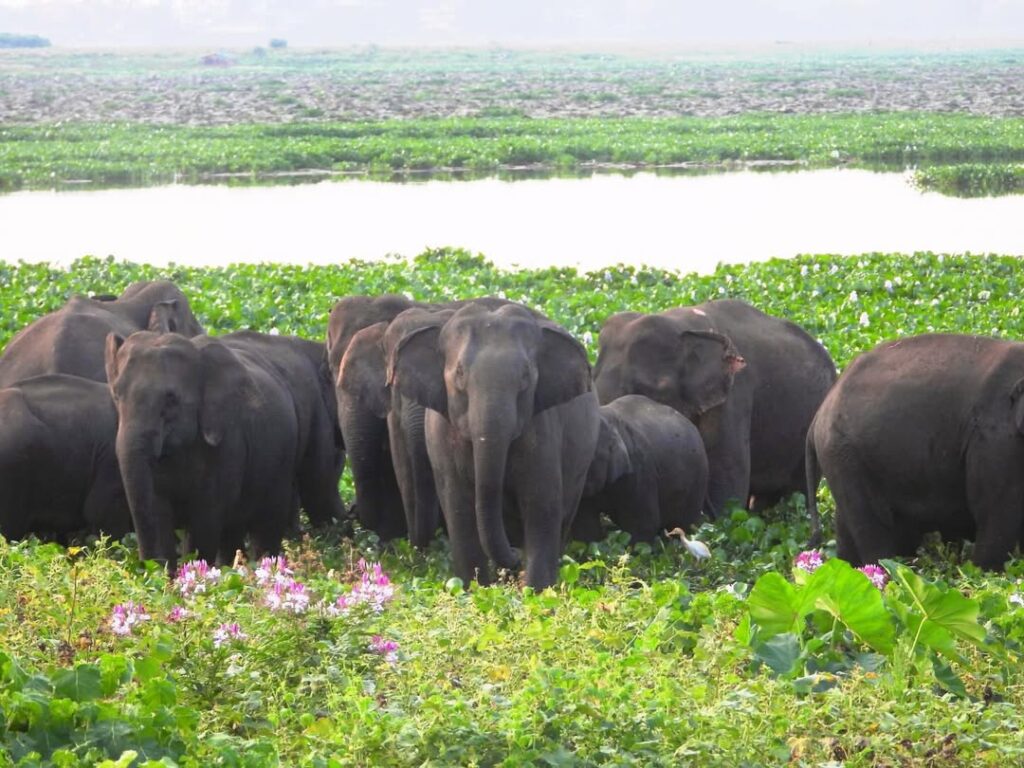
The Lake of Elephants: Rani-Garbhanga Corridors & 2026 Railway Update
Deepor Beel’s southern boundary adjoins the Rani-Garbhanga Reserve Forest, and herds of wild Asian elephants (Elephas maximus) regularly move between the forest and the beel through four elephant corridors — drawn by aquatic vegetation. The three most active entry points are the Mikirpara corridor, the Watch Tower area, and Belartal. Dawn and dusk are prime sighting windows.
For decades, the Northeast Frontier Railway (NFR) line skirting the beel’s southern edge has been deadly for these crossing herds. In 2026, that changes: the contract for a ₹536 crore, 4.7-km elevated railway viaduct through the Deepor Beel Wildlife Sanctuary has been officially awarded, and construction has commenced. The elevated design creates clearance specifically sized for elephant herds to pass safely underneath — permanently resolving a decades-old collision threat.
While the permanent structure takes shape, NFR has deployed an AI-powered Distributed Acoustic Sensing (DAS) Intrusion Detection System along the Azara-Kamakhya track. Sensor arrays detect elephant movements within 100 metres and immediately alert locomotive pilots to reduce speed to 30 km/h — a real-time wildlife safety protocol that represents some of the most sophisticated human-elephant coexistence engineering in India.
Micro-Ecosystem Zones at a Glance
| Zone | Key Features | Primary Threat / 2026 Project | Target Species |
| Core Sanctuary (4.1 sq km) | Deepwater, floating mats, fish nurseries | Invasive Water Hyacinth; urban sewage via Bharalu R | Baer’s Pochard, Spot-billed Pelican, Pheasant-tailed Jacana |
| Southern Railway Fringe | Active elephant corridors to Rani-Garbhanga RF | ₹536-cr elevated viaduct under construction; DAS monitoring | Asian Elephant, Lesser Adjutant Stork |
| Pamohi / Boragaon Edge | Seasonal wetlands, suburban interface | Leachate from Pamohi dump; elevated BOD | Greater Adjutant Stork colonies |
Crucial Conservation Challenges
Landfill Leachate and Urban Sewage
The old Boragaon municipal dump has technically closed, but leachate from the nearby Pamohi River dump site continues filtering into peripheral channels. The government’s bioremediation timeline targets the legacy West Boragaon site, but implementation is slow and elevated Biochemical Oxygen Demand (BOD) persists in the beel’s eastern margins. Invasive Water Hyacinth (Eichhornia crassipes) meanwhile chokes open-water sections, further reducing carrying capacity for waterbirds.
The Eco-Sensitive Zone Legal Battle
A revised notification drastically reduced Deepor Beel’s legally protected Eco-Sensitive Zone (ESZ) from an original 148.97 sq km to just 38.84 sq km — a 73% reduction that environmental researchers and conservation organisations have contested vigorously. This legal tug-of-war determines how much land surrounding the beel can be developed, and how much buffer remains to protect the core sanctuary. The outcome will shape Deepor Beel’s ecology for decades. Community conservation through Aaranyak and local fisherfolk — whose livelihoods depend on the beel’s 50+ fish species — remains the most direct human stake in that outcome.
Practical Birdwatching Guide & Responsible Visitor Checklist
Top Viewpoints
- Main Watch Tower — primary vantage point; best for open-water species and pelican colonies
- Western Access Road — elevated sightlines into reed beds and deeper beel sections
- Mikirpara, Watch Tower & Belartal corridors — the three most active elephant entry points
- Dawn (5:30–8:00 AM) — maximum bird activity; greatest chance of elephant movement
- November–February — peak season; all migratory species present; beel at its most concentrated
- Hire a local field guide from the sanctuary entrance for rare species locations and minimum-disturbance practice
Before You Go: Site Rules Checklist
- 5:00 PM Forest Departure Rule: All visitors must clear sanctuary boundaries before dusk for safe elephant corridor passage
- Binoculars & telephoto lens: Essential — do not approach Greater Adjutant roosting colonies closely
- Hire a local guide: Significantly improves sighting rates; supports community livelihoods
- Check road conditions: Western fringe access can waterlog after heavy rain — confirm locally
Getting There from Guwahati
- City centre: ~12 km southwest via Jalukbari; auto-rickshaws, app taxis, city buses all available
- Guwahati Airport (Lokpriya Gopinath Bordoloi International): ~8 km by taxi, ~20 minutes
- Guwahati Railway Station: ~12 km; taxi or auto-rickshaw recommended
- By road: Take the Jalukbari–Azara direction; the sanctuary entrance and Watch Tower are signposted
Deepor Beel — or Dipor Bil — is not simply a birdwatching stop. It is a living argument for whether genuinely wild ecosystems can survive at the edge of a fast-growing Indian city. The elevated railway viaduct under construction, the contested ESZ boundaries, and the communities and NGOs working the beel’s margins together represent a fragile, contested, and extraordinary moment in one of Northeast India’s most important conservation stories. Discover more wildlife and nature destinations across Northeast India on NorthEast India Connect.
