




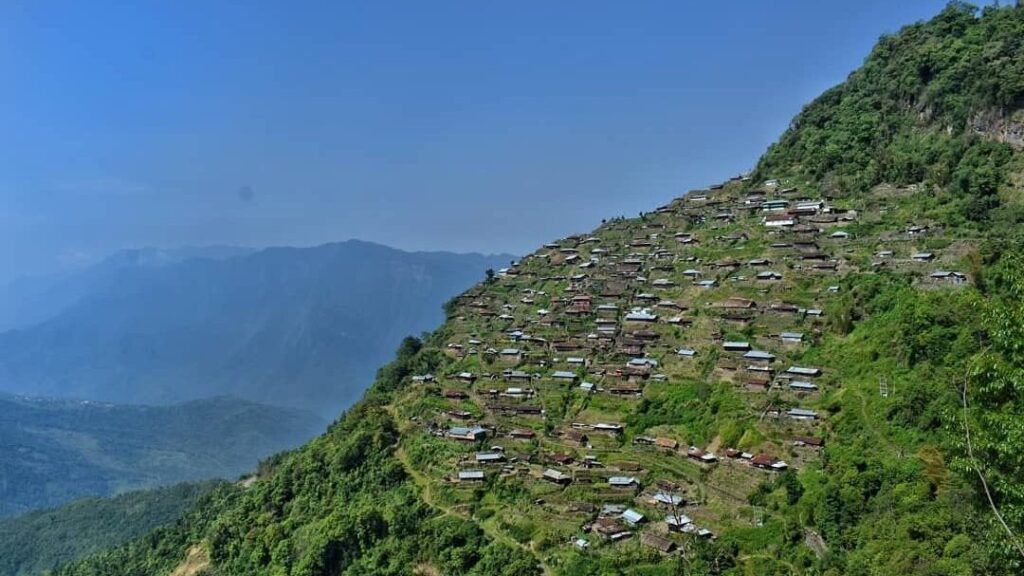
Picture a village stacked onto the face of a cliff, its stone steps so steep that climbing them feels more like a pilgrimage than a walk. That is Yangkhullen — a 500-year-old Zeme Naga settlement in Manipur’s Senapati district that locals still call the “hanging village,” because from a distance, its wood-and-thatch houses genuinely look like they are clinging to the mountainside. If you have been following our coverage of offbeat corners of Manipur and the Naga heartlands of Nagaland, Yangkhullen deserves a spot right at the top of your list — and this guide tells you exactly why.
Quick Facts About Yangkhullen
| Location | Willong sub-division, Senapati district, Manipur (near the Nagaland border) |
|---|---|
| Also Known As | Ze-Mnui, or historically “Zi village” |
| Tribe | Zeme Naga (one of the three Zeliangrong Naga communities) |
| Elevation | Approximately 1,600 metres |
| Population | Roughly 2,500 people across about 180 households |
| Distance from Imphal | Approximately 135 km (4-5 hours by road) |
| Distinct Feature | A defensive cliffside fortress with four clan-guarded stone gates |
| ILP Required | Yes — Manipur Inner Line Permit (Temporary Permit / Form C for tourists) |
| Best Time to Visit | October to March |
| Entry Fee | None; open sunrise to sunset |
The village’s older name, Ze-Mnui (or “Zi village,” after the mountain it’s built into), hints at an identity that predates Manipur’s modern district lines. Agriculture is still the backbone of life here, with most households practising settled farming alongside limited jhum (shifting) cultivation.
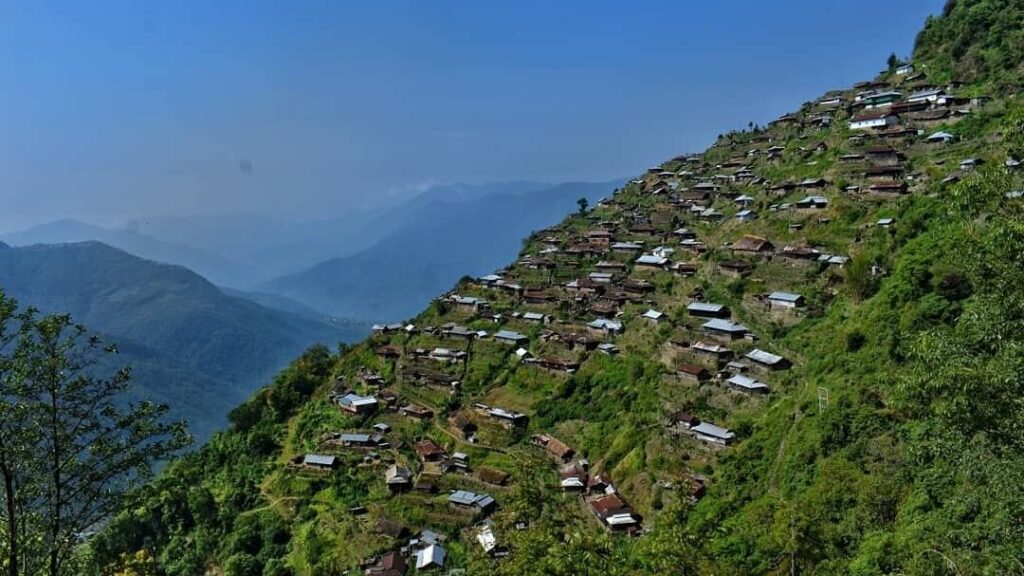
The Engineering of the Hanging Village: Four Gates, One Fortress
Yangkhullen wasn’t built for the view, although the view is spectacular — it was built for survival. According to local accounts carried by The Sangai Express, Yangkhullen was deliberately constructed as a fortress against raiding enemies, with massive boulders and stone slabs stacked into bastions and steps along the slope.
Yangkhullen has exactly four entrances — two on the eastern side, one to the southwest, and one to the south — each traditionally maintained by a particular clan, with stones stacked in odd numbers, a custom still observed today. Closing the gates once sealed the entire settlement off from outside attack, effectively turning the whole village into one giant fort.
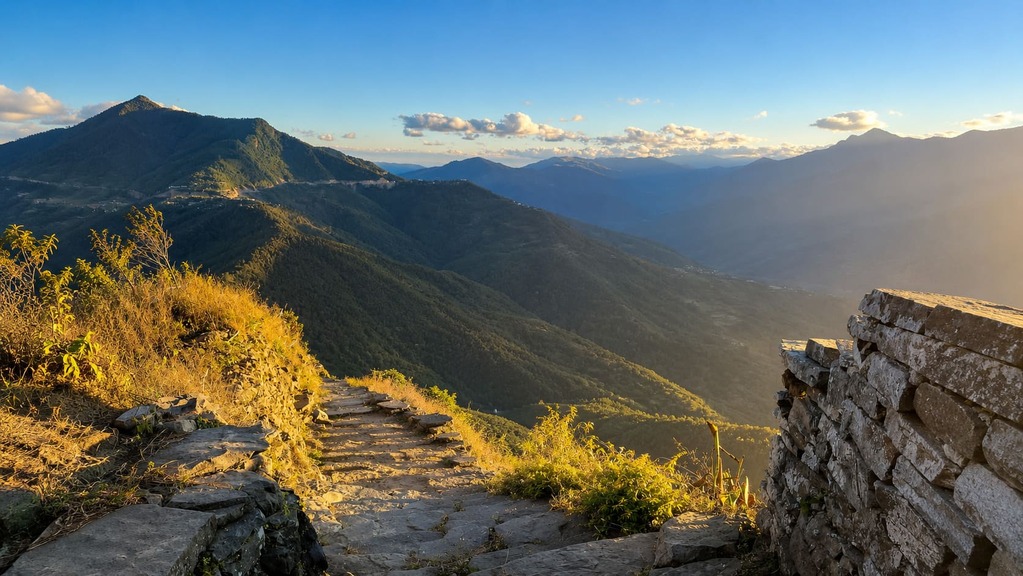
To reach the village core, visitors must park at the foothill and climb roughly 250 metres of stone steps — there is no other way in. It’s a workout, but the cold mountain breeze and the panoramic view make it worthwhile.
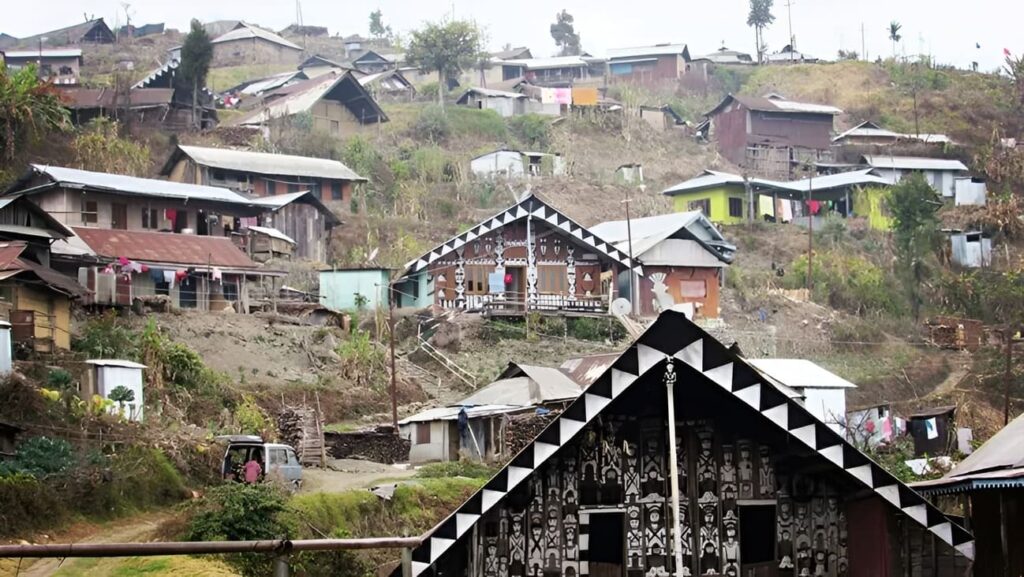
Inside the Chief’s House: Mithun Horns and a 1976 Peace Spear
What makes Yangkhullen worth the climb isn’t just the architecture — it’s the living culture. The chief’s residence in Yangkhullen doubles as a repository for Zeme history, holding traditional pottery, hand-woven garments, weapons, a rice-beer vessel carved from a single log, close to 500 mithun horns, and assorted deer skulls, as detailed by Morung Express.
Among the chief’s most treasured relics is a spear gifted by the neighbouring Maram Naga village, commemorating a 1976 peace treaty that ended years of conflict between the two communities. The village also preserves Rangki Lee, a giant wooden communal bed traditionally used by unmarried young men.
Customary Law and Taboos: The Warrior’s Pond and Clan Conservation
One curious custom involves a pond once used exclusively by warriors returning from battle to wash before re-entering the village; to this day, women are not permitted to draw water from it. Hunting follows its own code too — meat from a kill is shared within the clan, while the upper hill slopes have been declared a reserved forest where hunting is banned entirely, a quiet conservation practice that predates the term itself.
The Zeme Lunar Calendar: How Hega Ngi Times the Harvest
Like most Naga communities, the Zeme have traditionally reckoned their ritual and agricultural year by the moon rather than the Gregorian calendar. Their principal festival, called Hega Ngi by the Zeme (Gaan-Ngai among the related Rongmei, Gin Ngi among the Liangmei), is dated to the 13th day of a specific lunar month — which is why it typically falls anywhere between late December and mid-January, shifting slightly each year with the moon’s cycle.
Hega Ngi marks the close of the farming year, once the harvest is threshed and granaries are full. It opens with the ceremonial lighting of a sacred fire by rubbing bamboo and wood together, carried to every household to relight home hearths as a symbol of renewal, while ancestors are honoured with offerings and youth dormitories organise the feasting and games that follow.
Where Hega Ngi closes the farming year on the moon’s schedule, the Zeme — alongside several other Naga communities of Manipur — also observe Lui-Ngai-Ni, the seed-sowing festival that opens the next one. Unlike Hega Ngi, this has been fixed by government declaration to 15 February since 1988. Together, the two festivals offer a respectful glimpse of how an indigenous lunar worldview and the modern calendar now sit side by side in Zeme village life.
Yangkhullen vs Khonoma, Longwa & Willong Khullen: How Does It Compare?
Northeast India has no shortage of striking Naga villages, so it’s fair to ask how Yangkhullen stacks up against other well-known heritage settlements.
| Heritage Village | Tribal Group | What Makes It Distinct | Tourist Infrastructure (2026) |
|---|---|---|---|
| Yangkhullen (Ze-Mnui) | Zeme Naga | Cliffside fortress with four clan-guarded stone gates | Minimal — no hotels; a few community guest houses; 250m foot climb |
| Khonoma | Angami Naga | Pioneering terrace farming and community-led conservation | Well-developed — homestays, paved roads, registered guides |
| Longwa | Konyak Naga | Chief’s house straddles the India-Myanmar border | Moderate — popular with frontier travellers; unpaved tracks |
| Willong Khullen | Maram Naga | Field of prehistoric megaliths, some over 7 metres tall | Developing — maintained by district administration, roadside access |
If Khonoma represents “heritage tourism done well” and Longwa represents “frontier curiosity,” Yangkhullen is rarer still: a fortress village that genuinely works the way it was designed to, minus the crowds.
The 2026 Wait for Heritage Village Status
No honest article about Yangkhullen can skip its biggest ongoing story. In May 2022, then Chief Minister N. Biren Singh visited Yangkhullen and promised official heritage village recognition along with Archaeology Department support. The Ministry of Development of the North-Eastern Region reportedly sanctioned around Rs 3 crore for preservation, yet villagers say progress has been slow.
As one local youth, Hingdailong, put it, the village is “a heritage passed down from our forefathers” that the community has largely had to preserve on its own — building three heritage guest houses with local effort while still lacking adequate homestays, a police outpost, and reliable water infrastructure. As of early 2026, the formal tag remains pending, even as the cultural case for it keeps growing.
Best Time to Visit and How to Reach Yangkhullen
October to March brings cool, pleasant weather that makes the steep climb manageable and views clearer; a smaller wave also visits April-June. Avoid the monsoon, when steps and roads turn slippery.
- Fly or drive into Imphal, roughly 4-5 hours from Yangkhullen by road.
- Take NH-2 (Imphal-Kohima highway) through Senapati town to Maram.
- Branch off at Maram onto the Maram-Peren road toward Willong, then on to Yangkhullen — a narrower, less-maintained stretch where a vehicle with higher ground clearance is a sensible choice outside winter.
- Park at the foothill and climb the final stone steps on foot.
Shared taxis run between Imphal and Senapati, but beyond Maram, commercial transport is scarce; hiring a private vehicle or a verified local guide makes the trip smoother. Every non-resident Indian citizen needs a Manipur Inner Line Permit — for short visits, the Temporary Permit (Form C), valid up to 30 days, is the relevant category. Apply online in advance, or get it on arrival at Imphal airport or the Mao Gate checkpost on NH-2, both usually within 10-15 minutes. Carry a printed copy and photo ID for checkpoints en route.
Also Read: How to Apply For Travel Permits for Traveling to Northeast India
Nearby Attractions and Where to Stay
Yangkhullen sits in a cluster of culturally rich villages worth pairing into one trip:
- Willong Khullen — the region’s famous megaliths, some over 7 metres tall, maintained by the Senapati district administration.
- Maram Khullen — one of the oldest and largest Naga villages in the district.
- Dzükou Valley — accessible via Mao, this high-altitude valley straddles the Manipur-Nagaland border; we’ve covered it fully in our Dzükou Valley trekking guide.
Don’t expect resort comfort — that’s part of the charm. A handful of community-built guest houses and homestays take in visitors, but most travellers base themselves in Senapati town or Maram and visit Yangkhullen as a day trip.
Travel Tips Before You Visit
- Wear proper trekking shoes — the final stone-step climb is steep, and flip-flops are a genuinely bad idea.
- Carry cash, since ATMs and card payments are unreliable this far into the hills.
- Respect local customs — ask before photographing inside the chief’s house, and don’t approach the women ‘s-restricted pond out of curiosity.
- Check current advisories. The Naga-majority hill areas around Senapati have generally stayed outside Manipur’s recent ethnic unrest, but it’s wise to confirm the latest situation and travel with a local guide.
- Carry your ILP and photo ID for checkpoints along the route.
Final Thoughts
Yangkhullen is the kind of place that makes you understand why people fall in love with Northeast India in the first place — a fortress village where centuries-old gates still stand, a chief’s house still functions as a living archive, and a community is fighting, almost entirely on its own steam, to protect a heritage that deserves far more recognition. Go before the heritage tag finally arrives and the crowds follow.
For more, explore our Dzükou Valley guide, browse the latest from Manipur, or check our travel permits guide before you set off.
