




India’s rail network is one of the largest on earth, and most travelers rely on it instinctively. Book a train, arrive somewhere, continue. That logic works across most of the subcontinent. In Northeast India, it breaks down in ways that catch travelers off guard — not because the trains are bad, but because the geography and the network’s reach simply do not match the assumption.
Here is the reality upfront: of the eight Northeast states, Assam and Tripura are well-served, and Mizoram now has its first operational rail line following the 2025 inauguration of the Bairabi–Sairang line. Everything else ranges from limited to nonexistent. Manipur’s line is still under construction. Meghalaya and Sikkim have no rail connection to their capital cities.
This is not a criticism — it is the most useful thing to know before you plan. The train gets you to the gateway; the road journey completes the arrival. Understanding exactly where that handoff happens, for every state, is what this guide covers.
The Northeast Frontier Railway — What It Is and Why It Matters
The Northeast Frontier Railway (NFR) was carved out as a separate railway zone in 1958, specifically because the region’s geography demands a different kind of management. The Brahmaputra floodplain floods every monsoon. The hill ranges running between states require tunneling and gradient engineering that standard mainline operations cannot handle. International borders with Bangladesh, Bhutan, Myanmar, Nepal, and China create operational and strategic constraints that exist nowhere else in the Indian rail network.
NFR headquarters sits at Maligaon in Guwahati — the same city that anchors every road itinerary in this region. That is not a coincidence. Guwahati is the hub because the geography makes it the hub, whether you are arriving by air, road, or rail.
The NFR covers Assam comprehensively, reaches Tripura via the Lumding junction, touches Nagaland at Dimapur, edges into Arunachal Pradesh at Naharlagun, and is extending into Manipur with one of the most extraordinary engineering projects currently underway in India. Its limitations are real, but within those limits it operates through terrain that is genuinely spectacular — the Brahmaputra valley, the Barak hill forests, the tea estate corridors of Upper Assam.
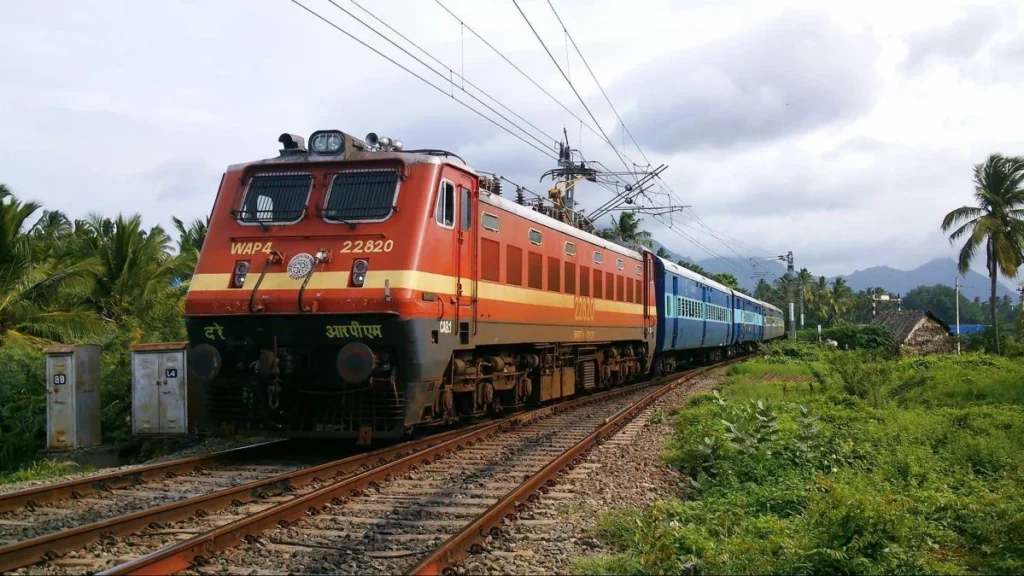
Getting to Northeast India by Train — The Main Entry Routes
From Kolkata
Kolkata is the most common rail entry point for Northeast India, with well-established services on two main corridors.
The Saraighat Express (12345/12346) runs daily between Howrah and Guwahati — approximately 18 hours, the classic connection. This is the train most travelers use to enter the region, and it has operated this route for decades. The name refers to the Battle of Saraighat on the Brahmaputra, which is visible as the train crosses into Assam. Book 3AC well in advance; this train fills up throughout October–March.
The Kanchanjunga Express (12658/12657) runs three times weekly between Sealdah and Agartala, covering approximately 36 hours. This is the most convenient service for travelers entering via Tripura and heading directly to Agartala without routing through Guwahati.
The Kamrup Express (15959) is the slower, more affordable Howrah–Dibrugarh option — useful if budget is the priority and time is not.
From Delhi
The Rajdhani Express (12235/12236) is the fastest and most comfortable option — New Delhi to Dibrugarh via Guwahati in approximately 36 hours, running weekly. 2AC on the Rajdhani is comfortable enough for the long haul, and the section through Assam in the early morning, when the Brahmaputra floodplain opens up on either side, is worth being awake for.
The North East Express (12505/12506) runs from Anand Vihar to Dibrugarh via Guwahati — similar journey time, better frequency than the Rajdhani, and a practical alternative when the Rajdhani quota is exhausted.
Travelers coming from western or central India should note the Avadh Assam Express (15909), which originates in Rajasthan and passes through Lucknow, Patna, and Guwahati en route to Dibrugarh — a useful through-service that avoids a Delhi change.
State-by-State Rail Access — The Honest Guide
Assam — The Northeast’s Rail Core
Assam has by far the best rail connectivity of any Northeast state. The broad-gauge mainline runs the full length of the Brahmaputra valley from Guwahati east to Dibrugarh and Tinsukia, passing through the tea estate heartland of Upper Assam. Key stations and what they connect to:
Guwahati is the hub for everything. Furkating and Jorhat Town are the closest stations to Kaziranga — from Jorhat, a taxi covers the remaining distance to the national park in under an hour. Rangapara/Dekargaon serve the Tezpur area and are the rail gateway for the Tawang road into Arunachal. New Bongaigaon is the approach station for Manas National Park in Bodoland. Dibrugarh and Tinsukia serve the eastern end of Assam and are well-connected from Guwahati by multiple daily trains. For Majuli, the approach is Jorhat or Mariani — the Brahmaputra ferry crosses from Neemati Ghat, a short taxi ride from either station.
Tripura — Better Than Most Travelers Expect
Tripura’s rail connection is solid and underutilised by most itinerary planners. Agartala is connected to both Guwahati (10–12 hours) and Kolkata via the Lumding–Sabroom broad-gauge line. Beyond the capital, two secondary stations are useful for specific destinations: Dharmanagar in North Tripura is the gateway for Unakoti and the Jampui Hills; Udaipur in South Tripura puts you 20 km from Neermahal water palace and 12 km from the Tripura Sundari temple at Matabari. The rail journey through the Barak Valley and the forests approaching Tripura is genuinely scenic — one of the more beautiful rail approaches in the Northeast.
Nagaland — One Station, One Entry Point
Nagaland has exactly one railway station: Dimapur, on the Guwahati–Dimapur broad-gauge line (approximately 5 hours from Guwahati). Rail access to Nagaland begins and ends here. The station sits at the state’s western edge; Kohima, the capital and the destination most travelers are heading for, is 74 km east on NH29 — a 2.5 to 3-hour road climb. Taxis are available outside Dimapur station. The rail gets you to the threshold; the road takes you into the hills.
Arunachal Pradesh — Limited but Improving
Naharlagun, near the state capital Itanagar, has a limited rail service from Guwahati extended to it in 2014. Trains are infrequent and slow; most travelers fly into Guwahati and drive, or fly directly into Itanagar. For the Tawang route — the most popular destination in Arunachal — Tezpur in Assam is the practical starting point, reached via Rangapara or Dekargaon stations. The Naharlagun connection matters more to locals than to tourists on standard itineraries.
Meghalaya — No Rail to the Capital
There is no railway to Shillong. The closest station is Guwahati, 100 km away. A rail link to the capital has been in planning stages for years with no confirmed completion date. All travelers to Meghalaya arrive by road from Guwahati or, on a limited schedule, by helicopter. For most visitors, this means a 3-hour drive from Guwahati — manageable, but worth factoring into arrival day planning.
Manipur — Under Construction and Worth Watching
Jiribam, on the Assam–Manipur border, is the current rail terminus — 225 km from Imphal on mountain roads. This is not a practical rail option for reaching Imphal. The Jiribam–Imphal railway is under active construction and includes the Noney Bridge, which when complete will carry the world’s tallest railway pier at 141 metres above the Ijai river valley. Until the line opens — the timeline remains uncertain — flying to Imphal is the only realistic option for most travelers.
Mizoram — Now Connected, and Worth Knowing About
Mizoram’s rail status changed in September 2025. On September 13, Prime Minister Modi inaugurated the Bairabi–Sairang line — Mizoram’s first operational railway, a 51 km single-diesel line running from Bairabi on the Assam border to Sairang, the station nearest to Aizawl. The project took a decade to build at a cost of ₹8,071 crore, and the engineering involved is extraordinary: 45 tunnels accounting for 30% of the route, 142 bridges including 55 major bridges, and a 105-metre pier over the Kurung river — one of the tallest railway bridge piers in India.
The practical impact for travelers is significant. The journey from Bairabi to Aizawl, which previously took 6–7 hours by road, now takes under an hour by train. Silchar, a key access city, is now 3 hours away by rail compared to the 8–12 hours it used to take by road. Three direct services were launched at inauguration: the Sairang–Delhi Rajdhani Express, the Sairang–Guwahati Express, and the Sairang–Kolkata Express.
Sairang station is the gateway for Aizawl — the capital is a short taxi ride from the station. For travelers heading to Mizoram for Chapchar Kut in March or general highland exploration, this line now makes a surface arrival genuinely viable for the first time. Lengpui Airport remains the faster option for those connecting from within the Northeast, but the rail option is now real and affordable.
Sikkim — Gateway via West Bengal
No rail line enters Sikkim. The primary gateway is New Jalpaiguri (NJP) in West Bengal, 148 km from Gangtok — the shared starting point for the Darjeeling Himalayan Railway and the road to Gangtok via the Teesta river. A proposed Rangpo–Sivok rail link into Sikkim is under development. Until it arrives, NJP is where the train journey ends and the 4-hour road transfer begins.
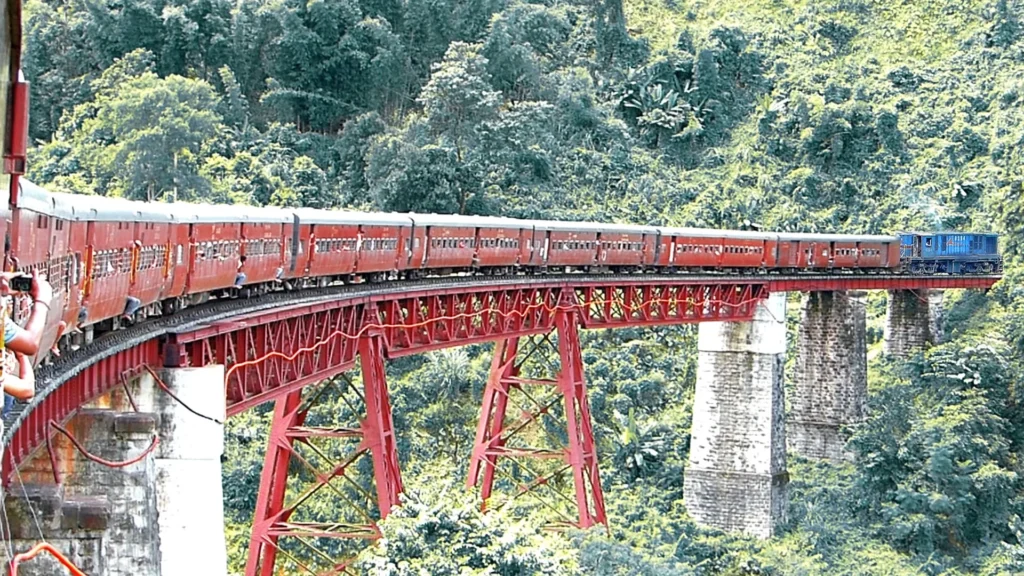
The Most Scenic Train Journeys Worth Taking
Guwahati to Dibrugarh — the Brahmaputra run. The mainline through Assam follows the river valley for hours — wide braided river channels, floodplain forests, water birds, and tea estates stretching to the foothills of Arunachal on the northern horizon. The Rajdhani covers this section between roughly 6 AM and noon on its eastbound run. A window seat here is not incidental; it is the point.
Guwahati to Agartala via Lumding. The rail route to Tripura passes through some of the least-touristed terrain on the entire NFR — the Barak Valley forests and the forested hills approaching Tripura’s border. This is not a journey most travelers take deliberately, but it should be. It is beautiful and unhurried in a way that road travel through the same terrain is not.
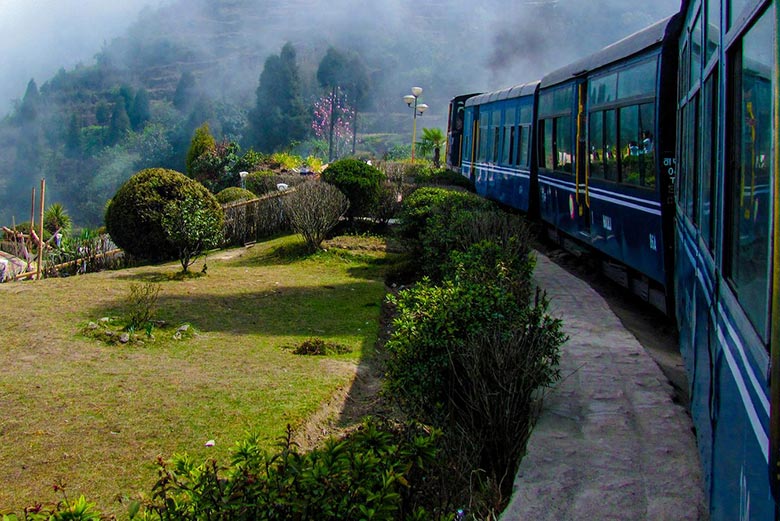
The Darjeeling Himalayan Railway — NJP to Darjeeling. Technically in West Bengal, but this UNESCO-listed narrow-gauge toy train is the gateway experience for Sikkim-bound travelers arriving at NJP. The 88 km climb from the plains to Darjeeling at 2,000 metres takes 7–8 hours and passes through tea gardens, mountain villages, and a series of spectacular loops and zigzags built in the 1880s. It is one of the world’s great mountain railway journeys. Book separately from your main rail ticket.
Practical Rail Tips
Book in advance and use IRCTC. The Rajdhani and Saraighat Express fill weeks ahead in October–March. Tatkal quota opens 24 hours before departure if standard quota is exhausted — use it as a backup, not a first option.
Class choice. 3AC (three-tier air-conditioned sleeper) is the best value for overnight journeys — comfortable, private enough, and affordable. 2AC offers more berth space and slightly more privacy for the longer Delhi–Guwahati run. Sleeper class is very affordable and fine for day journeys; less comfortable for 18-hour overnight trips in the hot season.
Monsoon disruption. The Brahmaputra floods annually in July and August, and trains serving Assam’s eastern districts can be delayed or cancelled. Check IRCTC for service alerts before traveling in monsoon. The Agartala route is generally more reliable in this season than the eastern Assam lines.
Station taxis. Every Northeast station has a pre-paid taxi counter outside. Use it. The price is fixed, the vehicles are registered, and you avoid the negotiation that follows independent operators who target arriving passengers. The Dimapur to Kohima pre-paid booth in particular is busy, efficient, and the right way to cover that 74 km.
Train vs. Fly — When Each Makes Sense
Choose the train for: entering Guwahati from Kolkata or Delhi (the Saraighat and Rajdhani are comfortable, affordable, and the arrival itself is atmospheric); traveling between Guwahati and Agartala (scenic and far cheaper than flying); any Assam journey where seeing the landscape is part of the point.
Choose the flight for: Imphal (no practical rail connection); Aizawl if connecting from within the Northeast (Lengpui Airport is faster than routing via Sairang for short hops); Gangtok (NJP is 148 km away; flying to Bagdogra and driving is faster for tight itineraries); Dibrugarh for Kaziranga when time matters more than the journey.
The hybrid strategy is what most experienced Northeast travelers use: fly into Guwahati, use trains within Assam and for Tripura — and now Mizoram via the new Sairang line — fly out of a different city (Imphal, Dimapur, or Bagdogra) to cover more ground without backtracking. It costs more than a pure rail trip but less than flying every leg, and it keeps the itinerary moving without the monotony of long backtrack drives.
The NFR is a remarkable network operating in some of India’s most challenging terrain. What it can do, it does well. The value of this guide is knowing exactly where its reach ends and your road journey begins.
