




Goecha La trek is Sikkim‘s signature wilderness experience — a 10 to 12 day journey through rhododendron forests, alpine meadows, glacial moraines, and high-altitude passes that culminates at 4,940 metres with a direct view of Kangchenjunga’s south face. At 8,586 metres, Kangchenjunga is the world’s third-highest mountain — and the Goecha La viewpoint places you close enough to the massif that its scale becomes genuinely difficult to comprehend. Not the distant postcard view from Pelling or the Darjeeling sunrise vantage. This is the mountain at full size, filling most of your visual field, showing you its glaciers, its seracs, its corniced ridgelines.
The Goecha La is not Sikkim’s most technically demanding trek — there is no glacier crossing, no fixed-rope section. But it is long, it reaches a significant altitude, it passes through terrain of extraordinary beauty and complete wilderness, and it demands consistent physical effort over multiple days. For trekkers who have found the standard Himalayan day hikes and cable car rides insufficient, the Goecha La is the answer — Sikkim’s full offering, delivered in full.
Quick Facts About Goecha La Trek
| State | Sikkim |
| Trek Region | Kangchenjunga National Park, West Sikkim |
| Maximum Altitude | 4,940 metres (Goecha La pass viewpoint) |
| Trek Duration | 10–12 days (Yuksom to Goecha La and return) |
| Start/End Point | Yuksom (West Sikkim) — 40 km from Pelling |
| Distance | Approximately 90–100 km return |
| Difficulty | Moderate to Challenging — requires good fitness; no technical climbing |
| Best Season | March to May; October to November |
| Permits Required | Forest Dept permit (Yuksom) + North Sikkim RAP not required; Kangchenjunga NP entry fee |
| Guide Requirement | Mandatory — solo trekking not permitted in the park |
Why Trek Goecha La?
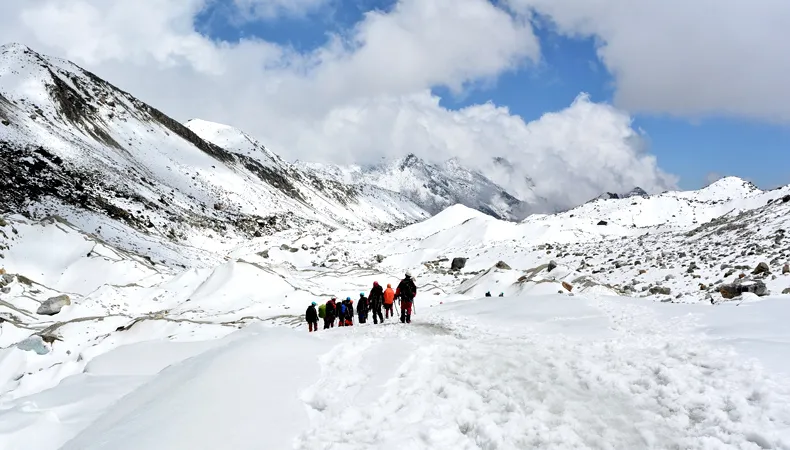
Kangchenjunga Base Camp in the conventional sense does not exist — the mountain’s base is not accessible due to its status as a sacred peak whose summit is left unstepped by Indian mountaineering tradition (climbers stop one metre below the summit out of respect for Sikkim’s guardian deity). The Goecha La viewpoint is the closest any trek brings you to the mountain’s face, and the combination of this proximity with the journey through Sikkim’s finest alpine terrain makes it the most rewarding long trek in the Northeast.
- Unmatched mountain proximity: The Goecha La viewpoint delivers Kangchenjunga at a scale and proximity unavailable anywhere else in Sikkim without technical mountaineering
- Ecological diversity: The trek passes through subtropical forest, temperate rhododendron forest, alpine scrub, and high-altitude desert within a single continuous journey — more ecological zones than most long treks in the Himalayas
- Cultural access: Yuksom, the starting point, is Sikkim’s first capital and a Bhutia Buddhist community with deep historical roots; the trek passes sacred sites, mani walls, and ancient trading routes
- Wilderness quality: The Kangchenjunga National Park is one of India’s finest protected areas; wildlife including Red Panda, Snow Leopard, and Himalayan Black Bear inhabits the forest and high-altitude zones through which the trek passes
Trek Route & Itinerary
Day 1: Yuksom to Sachen (2,290m) — 8 km, 4–5 hours
The trek begins at Yuksom (1,780m) and climbs steadily through dense subtropical and temperate forest to Sachen camp. The forest is rich in bird life — laughingthrush, sunbird, and drongo species are commonly seen. The first day establishes the physical rhythm of the trek.
- Yuksom Forest Department office: collect permits and register before departing
- Forest trail through mixed subtropical forest — excellent birdwatching
- First camp at Sachen in a forest clearing
Day 2: Sachen to Tshoka (3,050m) — 8 km, 4–5 hours
The climb continues through increasingly dense rhododendron forest as altitude increases. Tshoka is a small settlement at the forest edge where local families maintain simple tea stalls and camping areas. The first views of the higher peaks begin to emerge above the treeline.
- Rhododendron forest density increases dramatically from Bakkhim upward
- Tshoka settlement: tea houses available; first acclimatisation camp
- First glimpses of Kangchenjunga massif in clear conditions
Day 3: Tshoka to Dzongri (4,020m) — 8 km, 5–6 hours
The day from Tshoka to Dzongri is the most altitude-intensive of the trek’s first half — a sustained climb through the upper rhododendron forest and into the open alpine zone. Dzongri meadow, at 4,020 metres, is one of the finest camping locations in all of Sikkim — a wide, open plateau with Pandim (6,691m) to the south and clear views toward Kangchenjunga on good days.
- The climb from Tshoka is steep and long — take it slowly; altitude begins to be felt
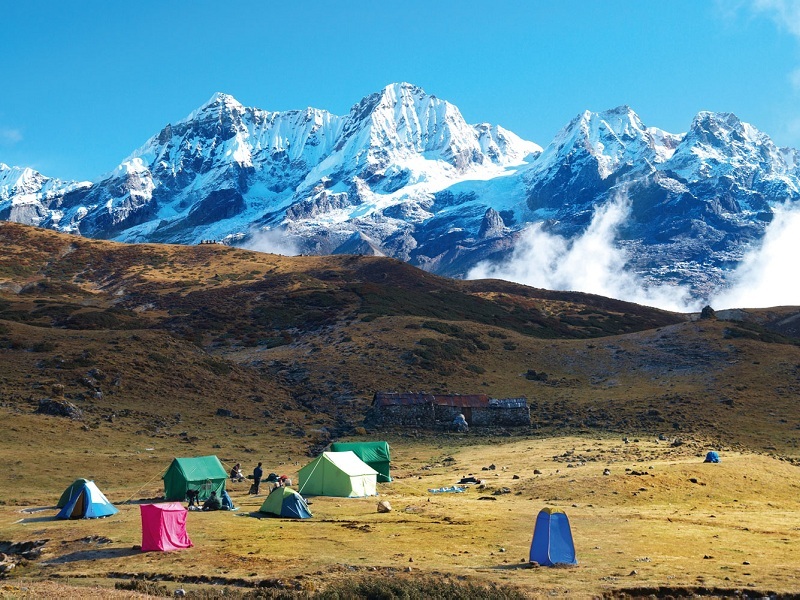
- Dzongri meadow: wide, open, panoramic — one of the finest campsites in the Eastern Himalayas
- Altitude acclimatisation night — headache common; drink water, rest, avoid alcohol
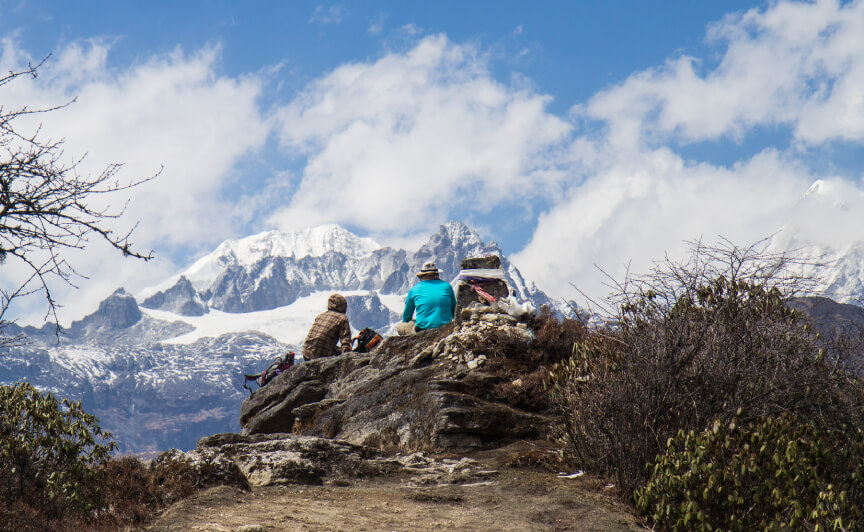
Day 4: Dzongri Acclimatisation Day — Side Trip to Dzongri Top (4,350m)
A rest and acclimatisation day at Dzongri with a recommended morning side trip to Dzongri Top (4,350m) — a 2-hour ascent that rewards with the finest Kangchenjunga panorama of the entire trek’s first half. The gradual climb follows the ‘climb high, sleep low’ acclimatisation principle.
- Dzongri Top: 2-hour ascent from camp; exceptional Kangchenjunga views
- Pandim, Tenchenkang, Kangchenjunga, and Kabru all visible on clear days
- Return to Dzongri for the night — rest and hydration day
| Dzongri Top at dawn is the most popular photography stop on the entire trek. The pre-dawn alpenglow on Kangchenjunga, viewed from 4,350 metres with the open meadow below, is one of the great Himalayan photography moments. Set your alarm for 4:30 AM and be at the summit by first light. |
Day 5: Dzongri to Thansing (3,930m) — 8 km, 4–5 hours
From Dzongri, the trail descends into the Prek Chu valley and follows the river north toward the high ridgeline of Goecha La. The terrain shifts to alpine moorland — wide, open, and increasingly dramatic. Thansing camp sits in a valley bowl with sweeping views of the Kangchenjunga massif ahead.
- Descent from Dzongri into the Prek Chu valley
- Kockchurang camp (optional tea stop) approximately halfway
- Thansing valley: open bowl with Kangchenjunga fully revealed to the north
Day 6: Thansing to Lamuney (4,200m) — 6 km, 3–4 hours
A short but altitude-intensive day to the Lamuney camp, the highest overnight camp of the trek. The trail passes Samiti Lake — a glacial lake of extraordinary clear beauty at 4,200 metres — before arriving at the upper camp. From Lamuney, the Goecha La pass is a 3-hour approach away.
- Samiti Lake: glacial lake with mirror reflections of surrounding peaks — exceptional
- The terrain above Samiti Lake becomes increasingly boulder-strewn and high-altitude
- Lamuney: the highest camp; altitude felt strongly; rest completely after arrival
Day 7: Lamuney to Goecha La Viewpoint (4,940m) and Back to Lamuney — 14 km, 7–8 hours
The summit day. Departure at 4:00–4:30 AM to reach the viewpoint at dawn. The approach crosses glacial moraine and boulder fields in darkness, guided by headtorch. At the viewpoint — technically below the actual pass, but the point from which Kangchenjunga is fully visible — the mountain reveals itself at a scale that stops most trekkers silent.
- 4:00 AM departure from Lamuney — reach the viewpoint at first light
- The Goecha La viewpoint at 4,940m: direct face-on view of Kangchenjunga at approximately 8 km distance
- Descend back to Lamuney for breakfast; continue down to Thansing or Dzongri for night
| The Goecha La summit morning is the reason you came. Do not rush it. Sit with the mountain for as long as conditions and altitude allow. The return descent is long and your legs will feel the previous days, but the views from the viewpoint — the full south face of Kangchenjunga, the satellite peaks of Kabru and Talung, the glacier systems reaching down toward you — deserve time and attention. |
Days 8–10: Return via Dzongri to Yuksom
The return follows the ascent route in reverse — Dzongri, Tshoka, Sachen, Yuksom. Two to three days are typically allocated, allowing for a gentle descent and time to appreciate the forest ecology that was passed quickly on the way up.
Permits & Regulations
- Kangchenjunga National Park Permit — Obtained at the Forest Department office in Yuksom before departure; approximately ₹200/day for Indian nationals, higher for foreign nationals
- ACAP/trekking registration — All trekkers must register with the Forest Department in Yuksom
- Guide requirement — Mandatory for all trekkers; solo trekking not permitted inside the national park
- Porter regulations — Porters must be registered locals; no overloading; fair wage policy enforced
- No campfire rule — Open fires not permitted in the national park; all cooking via camp stoves
Guides, Porters & Operators
- Registered local guides — Essential and mandatory; available in Yuksom; rates approximately ₹1,500–₹2,000 per day
- Porters — Available in Yuksom; maximum load 25 kg per porter; rates approximately ₹1,000–₹1,500 per day
- Organised treks — Multiple Gangtok and Pelling-based operators offer complete Goecha La packages including permits, guide, porter, tent, meals, and equipment rental; approximately ₹25,000–₹45,000 per person for 10 days
- Independent trekking — Possible with Yuksom-arranged guide; self-carrying or with porter; more flexible but requires more planning
Essential Gear Checklist
Mandatory
- Trekking boots with ankle support (broken in before the trek)
- Sleeping bag rated to -10°C minimum
- Waterproof jacket and trousers
- Thermal base layers (top and bottom)
- Mid-layer fleece
- Trekking poles — highly recommended for long descents
- Headtorch with spare batteries (the Goecha La summit day starts in total darkness)
- 3-litre water carrying capacity with purification method (iodine tablets or filter)
Recommended
- Gaiters — for snow and wet terrain on the approach to Goecha La
- Glacier glasses/sunglasses (high UV at altitude)
- High-SPF sunscreen and lip balm
- First aid kit including blister treatment, pain relief, antibiotic, and altitude medication
- Camera equipment in a waterproof bag
- Dry bags for sleeping bag and critical clothing
Physical Preparation
The Goecha La trek requires sustained aerobic fitness over multiple days at altitude. Trekkers who arrive fit have a significantly better experience — not just physically but in their ability to appreciate the landscape rather than manage their bodies.
- Minimum preparation: 3–4 months of regular aerobic training; running, cycling, or swimming at least 4 days per week; include hill training if possible
- Ideal preparation: 6 months; include multi-day hiking with loaded pack; practice descending with loaded pack (the knees feel this most on a long trek)
- Prior altitude experience: Having spent time at 3,000m+ before attempting Goecha La is a significant advantage; a Dzongri-only (4-day) trek is an excellent preparation route
Where to Stay Before/After the Trek
- Yuksom homestays and guesthouses — The starting and ending point; Bhutia homestays with excellent food and warm hospitality; book in advance for October–November peak season
- Pelling — 40 km from Yuksom; the most convenient larger base for pre/post-trek accommodation and rest
Best Time for Goecha La Trek
- April to May: Rhododendrons in full bloom on the lower and mid sections; trail conditions good from April; snow possible at Goecha La itself in April
- October to November: Post-monsoon; the finest conditions overall — clear skies, stable weather, dry trails, best Kangchenjunga visibility; the most popular season
- March: Early season; some snow on upper sections; rhododendrons beginning on lower trails
- June to September: Monsoon; heavy rain; trails very muddy; leeches active; poor visibility; not recommended
- December to February: Deep winter; Goecha La will be under significant snow; only for experienced winter mountaineers
Trek Cost Estimates
| Component | Approximate Cost (Per Person) |
| National Park permit (10 days) | ₹2,000–₹5,000 (varies by nationality) |
| Registered local guide (10 days) | ₹15,000–₹20,000 |
| Porter (10 days, optional) | ₹10,000–₹15,000 |
| Accommodation in Yuksom (2 nights) | ₹1,500–₹3,000 |
| Camping equipment (if renting) | ₹3,000–₹8,000 |
| Full organised package (guide, porter, meals, tent) | ₹25,000–₹45,000 |
| The Goecha La trek is one of the finest investments a traveler can make in India. The combination of mountain grandeur, ecological diversity, cultural richness, and physical challenge produces an experience that stays with people for decades. The costs are reasonable by international trekking standards, and every rupee spent through local guides, porters, and Yuksom operators supports communities that have coexisted with the Kangchenjunga ecosystem for generations. |
