




There is a particular quality to the silence at Rabdentse. It is not the silence of an empty space but the silence of a space that was once full of people, of administration, of the daily transactions of a royal court that governed a Himalayan kingdom for 144 years. The stone walls are chest-high now, the foundations of the palace visible as outlines in the grass, the three tall chortens of the Namphogang standing on their ridge platform like witnesses to whatever is left. In the middle distance, through a gap in the forest, Kangchenjunga is occasionally visible — the mountain that the kingdom of Sikkim considered its guardian deity, standing watch over a capital it could not protect.
Rabdentse was the second capital of the Kingdom of Sikkim from 1670 to 1814. It was established by the second Chogyal (king), Tensung Namgyal, who shifted the court from Yuksom, the first capital, where his father Phuntsog Namgyal had been consecrated as Sikkim’s first king in 1642. Tensung Namgyal chose a site on a forested ridge in West Sikkim, protected by natural terrain and within the cultural heartland of the Bhutia community. He built a palace, a monastery, a courtyard complex, and the administrative architecture of a functioning kingdom. For over a century and a half, Rabdentse was Sikkim.
Then the Gorkha armies came. And the capital was destroyed.
Quick Facts About Rabdentse Ruins
| State | Sikkim |
| District | West Sikkim |
| Distance from Pelling | 3 km; approximately 15 minutes by vehicle + 2 km forest walk |
| Distance from Pemayangtse Monastery | 2 km forest walk |
| Capital Period | 1670–1814 (144 years) |
| Founded By | 2nd Chogyal Tensung Namgyal; son of 1st Chogyal Phuntsog Namgyal |
| Destroyed By | Gorkha army; repeated invasions culminating in early 19th century destruction |
| Status | Archaeological Survey of India (ASI) protected site — declared of national importance |
| Key Structures | Namphogang chortens, stone throne, Taphap Chorten, palace ruins (north + south wings), Dab Lhagang, white marble slab |
| Entry Fee | Nominal; purchased at gate |
The History of Rabdentse — Rise and Destruction
The Establishment: 1670
When Tensung Namgyal, the second Chogyal of Sikkim, shifted his capital from Yuksom to Rabdentse in 1670, he was making a political as well as geographical decision. Yuksom was the site of his father’s consecration — historically significant but situated in a western valley that had become increasingly exposed to the pressures of Nepal’s expanding Gorkha kingdom. Rabdentse, on a ridge above Pelling, offered better visibility of approaching threats and a more central position within the territories the Chogyal controlled.
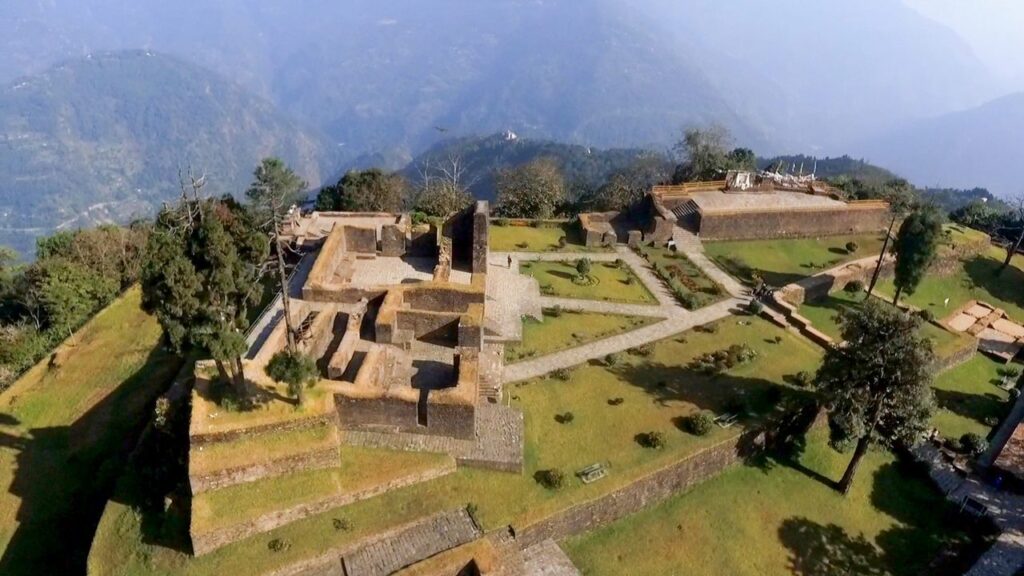
The capital he built at Rabdentse was modest by the standards of lowland kingdoms but substantial for a Himalayan hill state. The complex comprised a north wing (royal residential quarters), a south wing (religious complex and monastery), a series of courtyards for public and private royal functions, the Namphogang (the three-chorten judicial and ceremonial platform), and the Taphap Chorten that served as the formal entry point to the palace precinct.
The Centuries of Conflict
The history of Rabdentse is inseparable from the history of Sikkim’s relations with its neighbours — particularly Nepal and Bhutan. The kingdom was subject to repeated invasions, court intrigues, and periods of abandoned capital as different Chogyals fled to Tibet for safety or were driven out by neighbouring armies.
The Bhutanese interventions: The Chogyal Chador Namgyal was driven from Rabdentse by his Bhutanese half-sister Pendiongmu and spent ten years in exile in Lhasa before returning with Tibetan support to reclaim his throne. The politics of the Rabdentse court — involving three queens of Tibetan, Bhutanese, and Limbu origin, and their competing claims — were repeatedly exploited by neighbouring powers.
The Gorkha invasions: From the 1770s onward, the Gorkha armies of Nepal began systematic pressure on Sikkim’s western and southern territories. In 1788, Gorkha forces advanced through Elam into southern Sikkim; Johar Singh’s forces captured Rabdentse itself, prompting the Chogyal to flee to Lhasa. The Chogyal died in Lhasa in 1780 without reclaiming his capital.
The final abandonment: The Chogyal’s son Tshudpud Namgyal returned to Sikkim in 1793 with Chinese assistance to reclaim the throne. But finding Rabdentse too vulnerable — too close to the Nepalese border, too easily reached by Gorkha forces — he shifted the capital north to Tumlong in North Sikkim. Rabdentse was abandoned and gradually destroyed by continued Gorkha incursions. By 1814, the capital that had stood for 144 years was reduced to the ruins visible today.
| The historical irony at Rabdentse: The very qualities that made Rabdentse attractive as a capital — its ridge position with views over the western valleys — also made it visible and exposed to the Gorkha armies advancing from Nepal. The same landscape that gives today’s visitors their view of Kangchenjunga was the same landscape from which the capital’s defenders watched their enemies approach. The ruins are a record of a kingdom that could see clearly and still could not hold its ground. |
The Ruins — What Survives and What It Means
The Namphogang — The Three Chortens
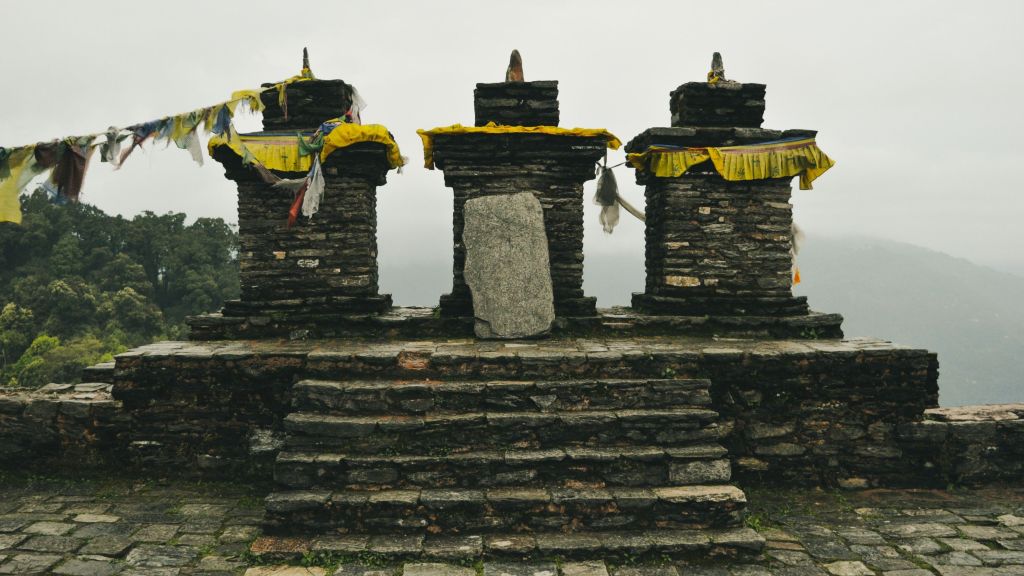
The three tall chortens of the Namphogang stand on an elevated stone platform on the ridge — the most dramatically positioned structures at Rabdentse and the first major sight after the forest path emerges above the treeline. In the active years of the capital, this was where the Chogyal and his courtiers conducted their daily activities as both kings and spiritual heads, making decisions and pronouncing judgments from the elevated platform. The stone throne adjacent to the Namphogang — three standing stones forming a seat — is still intact; the Chogyal sat here to hear cases and issue royal commands.
- The three chortens represent the Triple Gem of Buddhism: the Buddha, the Dharma, and the Sangha
- The platform is elevated above the palace complex — providing a visual authority over the space below
- The view from the Namphogang platform: Kangchenjunga to the north (on clear days); the valleys of West Sikkim in all other directions
- A 7-foot-long white marble slab at the base of the platform was the site for ritual offerings by the royal family and still receives offerings from local visitors
The Taphap Chorten — The Palace Gate
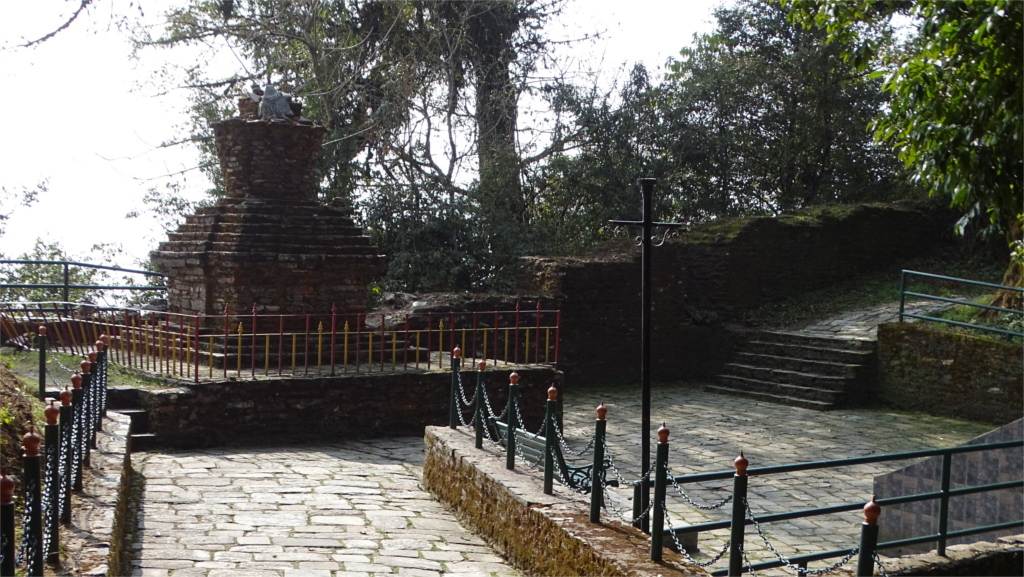
The Taphap Chorten marks the formal entry to the palace precinct. By tradition, any person seeking access to the royal court was required to dismount from their horse and remove their hat at this chorten as a mark of respect to the Chogyal. The chorten is in semi-ruined condition but the logic of its position — between the approach path and the palace courtyard — is immediately legible. You walk through this threshold today as visitors to the court walked through it for 144 years.
The Palace Ruins
The palace complex is centred on the fourth courtyard, where the outlines of the northern and southern wings are clearly visible as stone foundations and low wall stubs. Archaeological Survey of India excavations have identified and labelled the functions of different areas:
- Northern wing: royal residential quarters — the private rooms of the Chogyal and the royal family
- Southern wing: the religious complex — the monastery and prayer hall available to both royal family and subjects
- Dab Lhagang: the exclusive royal prayer area in the northern quadrangle, away from the southern wing open to the public
- Royal kitchen, guard room, assembly room, public courtyard: all identified and labelled by ASI
- The ‘Risum Gompa’ monastery site: marked by a white marble slab
The Forest Approach
The 2-kilometre walk from Pemayangtse Monastery (or from the gate on the Pelling-Geyzing road) to Rabdentse passes through one of the finest sections of accessible temperate forest in West Sikkim. The path is lined with avenue chestnut trees whose branches carry thick moss and occasional orchids; the forest floor is dense with fern. Birdwatching on this path is excellent — the forest supports laughingthrushes, sunbirds, woodpeckers, and the occasional Himalayan Monal descending from the higher ridge.
The ASI and Conservation
The Archaeological Survey of India has maintained Rabdentse since Sikkim’s integration into India in 1975, with annual maintenance allocations covering erosion control, ruin reinforcement, and vegetation management. In the 2023–24 fiscal year, ₹43.44 lakh was directed toward upkeep at the site. The ruins are stable but the balance between the living forest and the stone foundations requires continuous management — tree roots exert pressure on wall structures and the annual monsoon washes soil from around the foundations.
The ‘Machu Picchu of India’ comparison that appears in many Rabdentse articles is an overstatement of scale — Rabdentse is a modest ruin complex, not a monumental lost city. But the comparison captures something true: a royal capital abandoned under military pressure, preserved in a forest setting, with mountain views that transform the experience of standing among the ruins. The comparison earns its keep not in size but in atmosphere.
Combining Rabdentse in West Sikkim
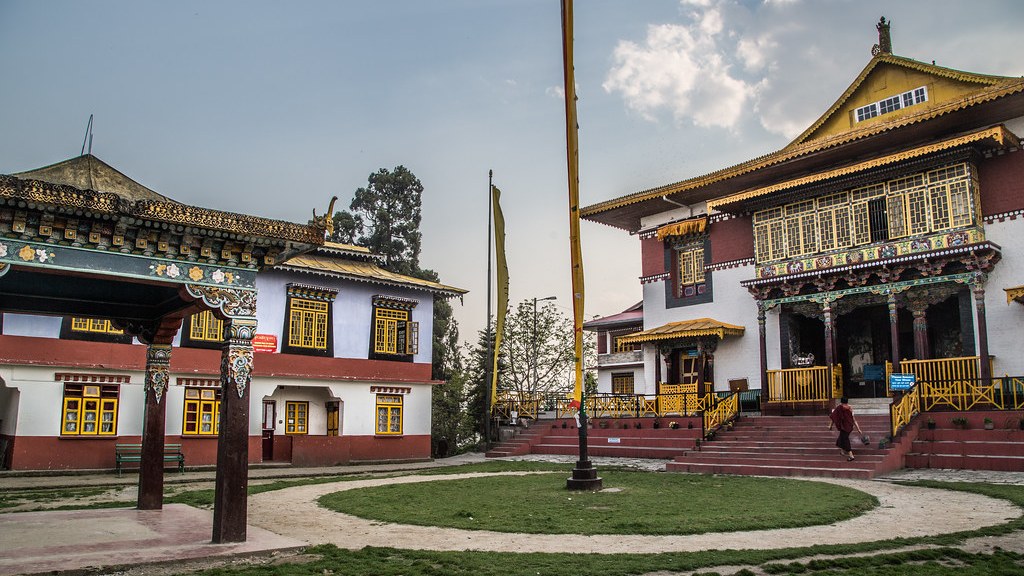
Rabdentse is located 2 km from Pemayangtse Monastery on a forest path — the most natural combination in West Sikkim tourism. The standard Pelling day circuit covers:
- Pemayangtse Monastery (morning): Oldest Nyingma monastery; Zangdog Palri model; morning prayers 5:30 AM
- Rabdentse Ruins (mid-morning): 2 km forest walk from Pemayangtse; 1.5–2 hours at the ruins
- Khecheopalri Lake (afternoon): 34 km northwest; sacred wish-fulfilling lake; the thorax of West Sikkim’s sacred geography
- Return to Pelling: Sunset from Helipad viewpoint; Kangchenjunga alpenglow
How to Reach Rabdentse
- From Pelling: 3 km to the gate on the Pelling-Geyzing road; vehicle to the gate then 2 km forest walk. Walking from Pelling town to Rabdentse takes approximately 1 hour at a moderate pace.
- From Pemayangtse Monastery: 2 km forest walk through the chestnut and oak forest; 30–40 minutes; the finest approach.
- By taxi from Pelling: ₹300–₹400 to the entrance gate; walk the forest section.
Best Time to Visit
- October to May: Best overall; clear skies for Kangchenjunga views; comfortable trekking temperatures; forest accessible without monsoon mud
- March to April: Spring; the forest approach is in new leaf; rhododendrons bloom on the walk from Pemayangtse; the most beautiful seasonal window
- June to September: Monsoon; forest intensely green; path slippery in rain; Kangchenjunga views obscured; not recommended for first visits
Also Read: How to Apply For Travel Permits for Traveling to Northeast India
