




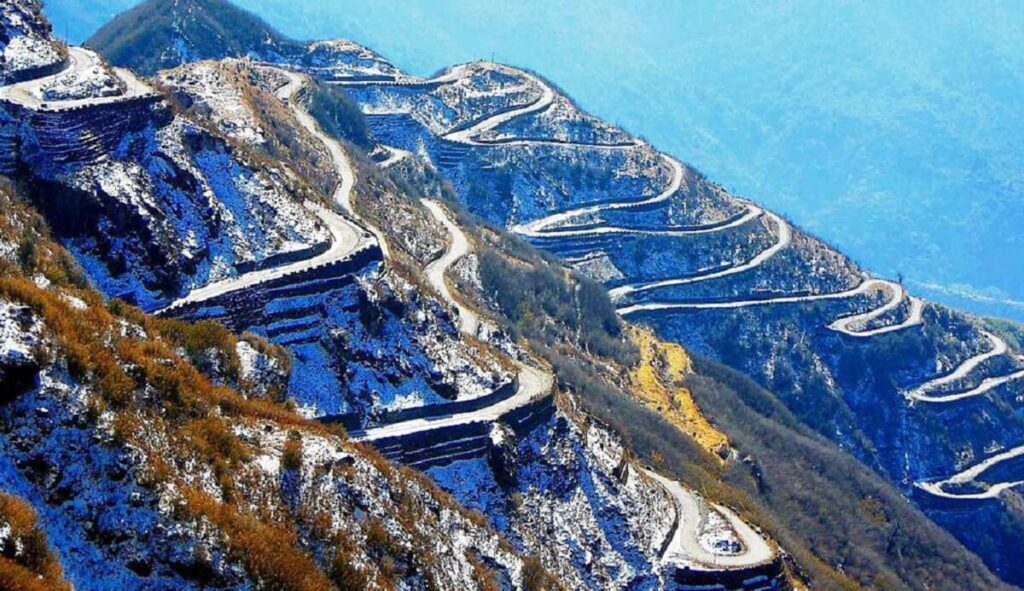
There’s a moment on the road out of Rongli, somewhere past the last shop selling instant noodles and butter tea, when the forest opens up and the mountain in front of you looks like someone has drawn a staircase up its face. That’s Zuluk’s zigzag road — more than 30 hairpin bends stacked on top of each other, climbing from around 5,000 feet to over 13,000 feet across a single high-altitude loop.
That visual drama is exactly why the Zuluk hairpin bends were named the “Most Instagrammable Landscape” at the India Today Tourism Awards 2026, held in Goa earlier this year. If you’ve searched “sikkim tourism award 2026 most instagrammable landscape,” this is the story behind the headline: Sikkim’s Tourism and Civil Aviation Minister Tshering T. Bhutia received the award on behalf of the state, recognising years of work by local communities to put this once-forgotten Silk Route village on the map.
What follows is everything the award citation doesn’t tell you — the permit workflow, the exact altitude progression, the military protocols that can shut the road without warning, and the homestay economy that makes an overnight here possible at all.
Where Is Zuluk? Tracing the Map of the Old Silk Route
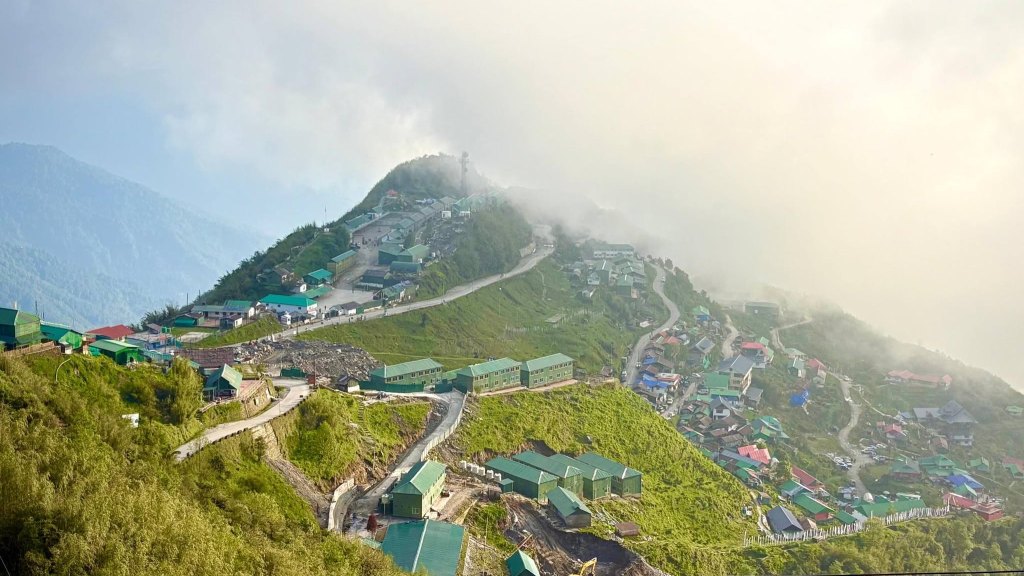
Zuluk (sometimes written Dzuluk) is a small village in East Sikkim, sitting at roughly 9,400 feet, about 100 kilometres from Gangtok and close enough to the India-China border that the Indian Army maintains a constant presence here. It sits on the Old Silk Route — the historic corridor that carried silk, wool, and fur between India and Tibet for centuries, running from Kalimpong through Rongli and Zuluk, up through Nathang Valley and Kupup, and finally over the Jelep La pass into Tibet’s Chumbi Valley.
The Sino-Indian War of 1962 shut the Jelep La pass for good, and Zuluk spent the next four decades as a quiet military outpost. Civilian tourism only opened up in the early 2010s once the Army eased restrictions. Today this is one corner of the broader Baba Mandir–Nathula–Gangtok loop — a circuit linking several of East Sikkim’s most restricted and most rewarding high-altitude stops into a single multi-day route.
The 2026 Tourism Award: Why the Loops Are Nationally Recognized
The recognition wasn’t for a single viewpoint or monument — it was for the road itself, the way the hairpin bends stack visually when shot from above, turning a functional mountain highway into something that looks almost computer-generated. That’s a rare thing for an award citation to single out, and it’s accelerated visitor numbers noticeably since the announcement.
Navigating the Sikkim Border Permit System: Rongli vs. Gangtok Portals
Here’s the part most blog posts gloss over: you cannot just drive to Zuluk on a whim. The entire Silk Route corridor sits inside a sensitive border zone, so every visitor needs a Protected Area Permit (PAP) before entering, and how you get one depends on which direction you’re approaching from.
To get an Old Silk Route permit at Rongli Bazaar, visit the SDPO office in Rongli with original photo ID and passport-sized photographs, and the permit is processed on the spot. The office stays open until 2 PM on weekdays and 11 AM on Saturdays, and it’s closed on Sundays — plan around that or you’ll be stuck waiting overnight.
There’s a faster route if you’re coming from Gangtok, though. Have a registered Gangtok tour operator process your PAP in advance, and instead of queuing at Rongli, your physical verification happens at the smaller Padamchen check-post further along the route. This single substitution routinely saves up to two hours of daylight driving time — which matters when you’re racing the afternoon cloud cover that swallows the higher viewpoints.
One detail that trips up a lot of travellers:
Why Foreign Nationals Are Permanently Restricted
Foreign nationals are not permitted to visit Zuluk at all, because of the border restrictions — this isn’t a stricter-permit situation, it’s an outright bar. Tsomgo Lake, which runs on a separate, less restrictive permit system, is the closest comparable experience available to international travellers.
Permits aren’t guaranteed even for Indian nationals. They’re issued based on prevailing weather and security conditions, so a storm forecast or a shift at the border can see your permit for Nathang Valley denied on the day. You’ll also need a Sikkim-registered vehicle for the whole route — private cars generally can’t make this drive, which is why almost everyone books a local taxi or joins an operator-run group.
The Altitude Ascent: Packing for Sub-Zero Nights and Preventing AMS
The Zuluk loop gains elevation fast, and that matters more than most travel guides admit. Here’s the exact progression, stop by stop:
| Location Stop | Altitude | Distance from Previous Stop | Highlight |
|---|---|---|---|
| Rongli Bazaar | ~5,250 ft | Base level | Primary permit check-post; last reliable ATM |
| Lingtam | ~5,000 ft | 10 km | Gentle microclimate; entry checkpoint |
| Zuluk Village | ~9,400 ft | 25 km | Primary homestay hub; baseline acclimatisation |
| Thambi View Point | ~11,200 ft | 14 km | 30 hairpin bends visible; Kanchenjunga sunrise |
| Lungthung | ~12,500 ft | 8 km | High-perch panoramic loop view |
| Nathang Valley | ~13,500 ft | 12 km | “Little Ladakh”; high risk of evening AMS |
That’s a gain of more than 8,000 feet across roughly 70 kilometres, most of it compressed into the final stretch past Zuluk. Mild altitude sickness — headaches, nausea, breathlessness — is a real possibility once you push past Thambi toward Lungthung and Nathang, especially if you’ve driven up fast without a buffer night.
Treat your first night in Zuluk as an acclimatisation stop before going higher. Drink more water than feels necessary, avoid overexertion on day one, and if anyone in your group feels genuinely unwell, descend a few hundred metres rather than pushing through it. Pack accordingly too — even in summer, nighttime temperatures at Zuluk fall to 5–10°C, dropping further at Lungthung and Nathang. Thermal innerwear, a windproof jacket, and proper trekking shoes aren’t optional extras here.
Stops on the Loop: From the 30 Hairpin Loops to the Stark Plains of Nathang
Thambi View Point — the Classic Shot
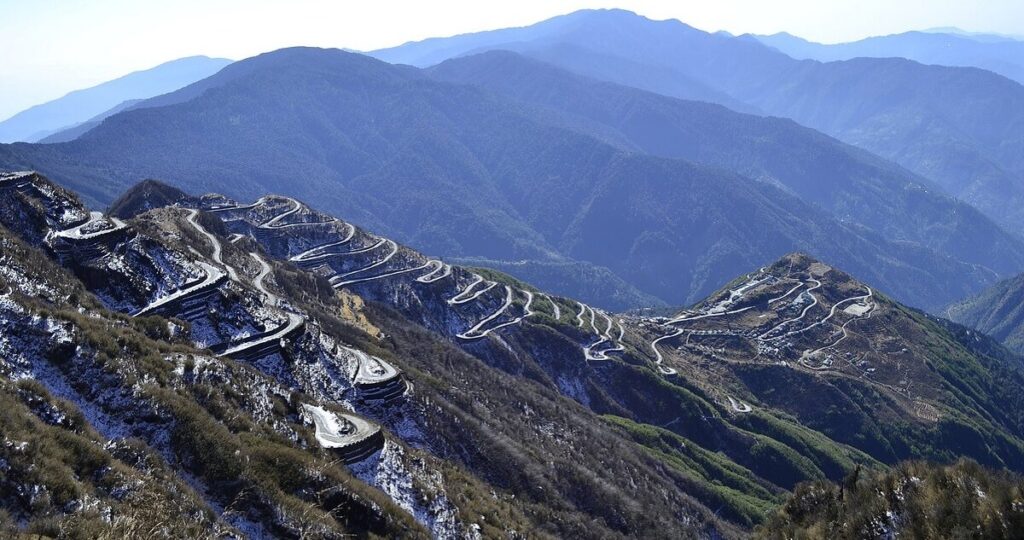
This is the headline act, and the best viewpoint for Zuluk zigzag road photography sits right here, around 11,200 feet. Sunrise is when it photographs best — Kanchenjunga and the wider Eastern Himalayan range tend to be clearest before the morning cloud builds. Leave your Zuluk homestay by 4:00 AM sharp if you want that shot without alpine fog ruining it. Cloud cover rolls in fast, often by 8:00 AM, and once it sets in, the vista disappears for the rest of the day.
Lungthung — the Higher, Wider Angle
Most guides stop describing the loop at Thambi, but Lungthung, roughly 1,300 feet higher at around 12,500 feet, gives a genuinely different photograph. Where Thambi offers the iconic low-angle grid shot of the hairpins, Lungthung sits high enough that the entire geometric progression of the road is visible against the Tibetan plateau beyond. If you’ve already got the Thambi shot, Lungthung is the upgrade.
Nathang Valley — Sikkim’s “Little Ladakh”
Keep going and you’ll reach Nathang Valley at roughly 13,500 feet — stark, wind-scoured, ringed by barren peaks that look more Tibetan Plateau than tropical Northeast India. It transforms with the seasons: golden-brown in autumn, scattered with wildflowers during monsoon, buried under snow in winter. This is also the point on the route with the highest risk of evening altitude sickness, so most operators discourage overnighting here unless your group has already acclimatised at Zuluk.
Old Baba Mandir vs. New Baba Mandir
A short distance further sits the Old Baba Mandir, a shrine dedicated to Baba Harbhajan Singh of the Indian Army’s 23rd Regiment, who died here during the 1962 war — this is the original bunker where he was stationed, still maintained by the Army. Travellers often confuse this with the New Baba Mandir near Nathula, on a completely different stretch of road. The newer shrine is larger and easier to reach, but it isn’t the historically significant original site. If you’re chasing the 1962 war history specifically, make sure your driver knows you want the Old Mandir on the Zuluk side, not the Nathula-side replica.
Kupup, Menmecho Lake, and the One-Way Loop Rule
Further along, you’ll pass Kupup, home to the long-disused world’s-highest golf course, and the serene, trout-stocked Menmecho Lake. This stretch is also where the loop’s directional rule kicks in: during peak season, the military frequently enforces a one-way traffic system across the Baba Mandir–Nathula–Gangtok loop. Travellers typically enter via Rongli–Zuluk and exit via Tsomgo Lake–Gangtok, not the reverse. Assuming you can run the loop backward is a common planning mistake — confirm the current direction rule with your operator before committing to an itinerary, since it changes where you can stop and when.
Winter Closures and the Black Ice Problem
If you’re travelling between December and February, there’s a protocol worth knowing about. The Indian Army will block civilian vehicles past Zuluk at the Padamchen or Lingtam gates if overnight black ice has formed on the upper hairpin loops — not a rare event at 11,000+ feet in winter, and it can close the road with effectively no warning.
The sensible response is to keep an alternate lower-altitude buffer night in Aritar or Reshikhola, both well below the ice line, so a sudden closure doesn’t strand your itinerary. Travellers who book a single fixed homestay night with no flexibility sometimes end up stuck at a checkpoint for hours, or have to turn back entirely.
The Homestay Economy: Wood-and-Tin Hospitality
There are no hotels in the conventional sense here, and that’s part of the charm. Almost everyone stays in a homestay — a simple wood-and-tin family home converted to host guests, with home-cooked meals and a wood-burning stove that becomes the evening’s social centre.
For Nathang Valley homestay prices specifically: expect ₹1,200–₹1,800 per person in Zuluk itself including meals, rising to roughly ₹1,800–₹2,500 per person at Nathang Valley, where supplies have to be carried in further and the altitude makes everything logistically harder.
A few ground realities to plan around:
- No ATMs anywhere on the route. Withdraw everything you’ll need in Gangtok or Siliguri — cards and UPI don’t work here.
- Mobile networks mostly fail past Rongli. Premium 5G plans are useless; carry a BSNL prepaid or postpaid SIM specifically — it’s the only network that reliably pings local towers for emergency coordination.
- Vehicle clearance matters more than comfort. Standard non-4WD Innovas can struggle on the unpaved stretches past Nathang. Confirm your operator is sending a high-clearance Scorpio or Bolero, not a city-spec vehicle.
Transit Blueprint: The 3-Day Loop From Bagdogra
For travellers asking about the distance from Gangtok to Zuluk via Tsomgo Lake, or planning a full loop starting from Bagdogra, here’s the structure that works:
- Day 1: Bagdogra or NJP to Gangtok (4–5 hours), with permit paperwork submitted to your operator the same evening.
- Day 2: Gangtok to Zuluk via Rongli or Padamchen, depending on how your permit was processed. Settle in by early afternoon, with the rest of the day for acclimatisation.
- Day 3: Pre-dawn departure (4:00 AM) for Thambi and Lungthung, onward to Nathang Valley and Kupup, then exit via Tsomgo Lake back to Gangtok, respecting the one-way rule.
Build in the Aritar or Reshikhola buffer if travelling in winter, and don’t schedule a same-day flight out of Bagdogra on Day 3 — weather and checkpoint delays here are common enough that a tight connection is a genuine risk.
A Quiet Village With a Loud View
What makes Zuluk worth the permit paperwork and the cold nights isn’t any single attraction — it’s the cumulative effect of the whole corridor: genuine Silk Route history, a village that still feels lived-in rather than built for tourists, some of the rawest high-altitude scenery in Sikkim, and a road that has now, officially, earned its viral reputation.
It’s not a place you stumble into casually, and that’s the point. Pair it with a stop in Pelling or a few extra days in Gangtok, sort your permits early, respect the directional and seasonal rules, and Zuluk delivers one of the most rewarding two-to-three-day detours anywhere in the Eastern Himalayas.
