




In July 2024, at the 46th session of the UNESCO World Heritage Committee held in New Delhi, the Charaideo Moidams were inscribed on the UNESCO World Heritage List — India’s 43rd World Heritage Site and the first from Assam. The inscription recognised something that the people of upper Assam had always known: that the burial mounds of the Tai-Ahom kings, rising in silent hemispherical forms from the forested hilltops of Charaideo, are among the most extraordinary funerary monuments in Asia — comparable in ambition, and in the depth of cultural meaning they carry, to the royal tombs of China and the pyramids of the Egyptian pharaohs.
Charaideo, more than 400 kilometres east of Guwahati in the Charaideo district, was the first permanent capital of the Ahom dynasty — founded by Chao Lung Sukaphaa in 1253 CE when he led his Tai people across the Patkai Range from Yunnan province in China into the Brahmaputra valley. The name means ‘shining city atop a hill’ in the Tai language. Even after the capital moved to different locations, Charaideo remained the royal burial site for 600 years — the place where Ahom kings, queens, and nobles were returned to the earth according to the ancient Tai burial traditions that their dynasty maintained long after the surrounding world had changed around them.
Quick Facts About Charaideo Moidams
| State | Assam |
| District | Charaideo |
| UNESCO Status | World Heritage Site — inscribed July 2024 (India’s 43rd WHS) |
| Distance from Sivasagar | 25 km; approximately 45 minutes by road |
| Distance from Guwahati | 400+ km; approximately 10–11 hours by road |
| Number of Moidams | 90 royal moidams at Charaideo (out of 386 explored across upper Assam) |
| Period | 13th–19th century CE (Ahom dynasty rule of Assam) |
| First Ahom King | Chao Lung Sukaphaa — arrived in Assam 1228 CE; founded Charaideo capital 1253 CE |
| Ritual | Me-Dam-Me-Phi and Tarpan — practiced at Charaideo necropolis annually |
| Managed By | ASI (Group of Four Maidams) + Assam Government DOA (remaining site) |
| Best Time | October to March |
The Ahom Dynasty — 600 Years of Unbroken Rule
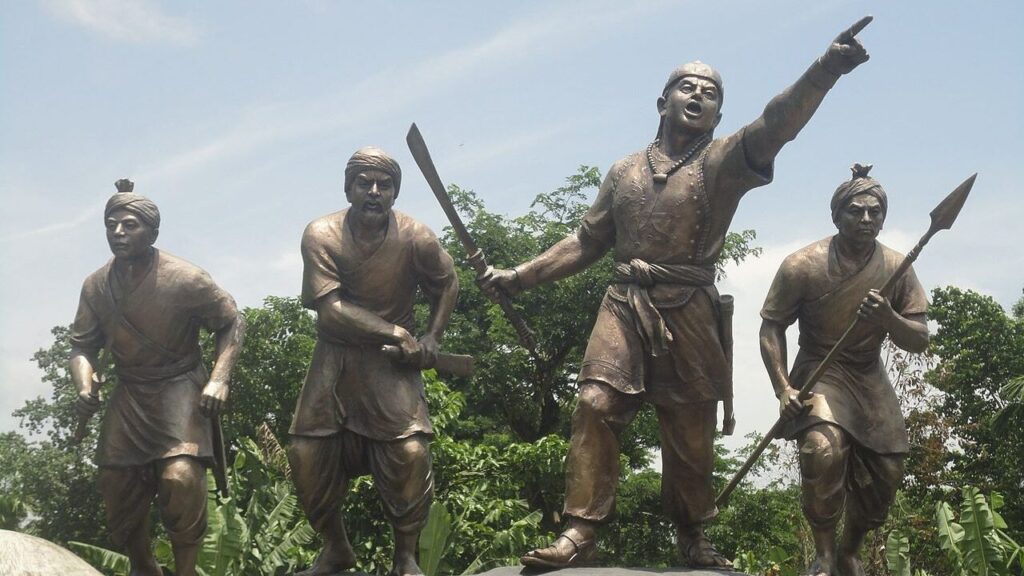
The Ahom dynasty holds a distinction unique in the medieval history of the Indian subcontinent: it ruled the Brahmaputra valley continuously for approximately 600 years — from 1228 CE to 1826 CE — resisting multiple Mughal invasions (the Ahom forces defeated the Mughals at the Battle of Saraighat in 1671 in one of the most celebrated military engagements in Assamese history) and maintaining a sophisticated administrative, military, and cultural system that shaped the Assamese identity.
The Ahom were a Tai people — part of the same broad Tai linguistic and cultural family that also produced the Thai, Lao, and Shan peoples of Southeast Asia. Chao Lung Sukaphaa, their first king in Assam, led his people across the Patkai Range from Yunnan province in what is now southwestern China, entered the Brahmaputra valley through Patkai, and gradually established hegemony over the existing kingdoms of the region. The Ahom brought with them their language (Tai-Ahom), their religion (a form of animism centred on ancestor veneration and the worship of sky deities), their administrative system, and their burial tradition — the moidam.
The transition to Hinduism: From the 17th century onward, Ahom kings increasingly adopted Hinduism under the influence of the broader Vaishnava tradition that was transforming Assam’s cultural landscape. After this adoption, the physical tradition of moidam burial changed: instead of burying the body of the king, the ashes after Hindu cremation were placed in the moidam. But the structure itself — the hollow vault, the hemispherical mound, the octagonal boundary wall — was maintained. The moidam form persisted through the religious transformation.
The Architecture of a Moidam
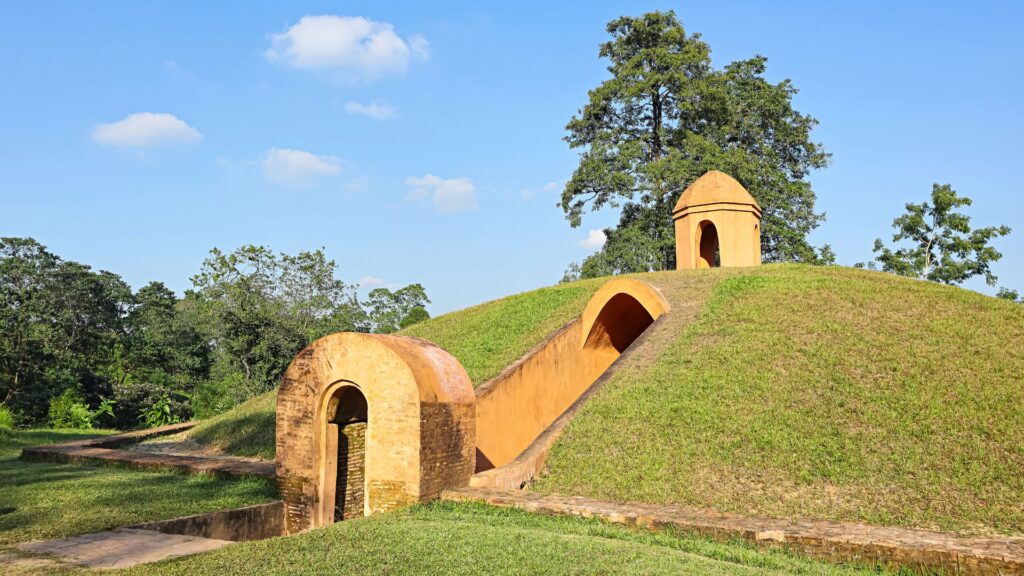
Every moidam follows a specific structural programme, executed with varying degrees of elaboration depending on the rank and wealth of the person being honoured.
- The underground vault (chamber): The central chamber, built of brick, stone, or earth, holds the body or ashes of the deceased together with grave goods — food and drink for the afterlife, weapons, jewellery, and personal objects. In the earliest royal moidams, living servants, horses, and elephants were interred along with the king. This practice was abolished by the reformist king Rudra Singha in the 18th century.
- The domical superstructure: The chamber is capped with a domical brick or stone construction that is then covered by a hemispherical earthen mound — rising above the natural ground level to create the characteristic hillform of the moidam landscape.
- The Chow Chali: An open pavilion at the peak of the hemispherical mound — the structural marker that identifies a moidam from a distance and gives the Charaideo hilltops their distinctive silhouette.
- The octagonal boundary wall (Garh): An octagonal dwarf wall encloses the entire moidam — defining the sacred perimeter of the funerary monument and marking the boundary between the ordinary world and the resting place of the royal dead.
| The UNESCO inscription comparison: The experts who assessed Charaideo for the World Heritage inscription compared the moidams to the royal tombs of China and the pyramids of the Egyptian pharaohs — not in scale, but in conceptual ambition: the determination of a ruling dynasty to create permanent, architecturally distinctive markers of royal mortality. What makes Charaideo exceptional is the unbroken 600-year period of consistent monument-making by a single dynasty in a single landscape. Source: UNESCO WHC official; VOA News UNESCO committee announcement (July 2024). |
What Was Found Inside the Moidams
The ASI excavation of Moidam No. 2 at Charaideo in 2000–02 recovered objects that illuminate the Ahom court culture — ivory decorative pieces depicting a dragon (the Ahom insignia), wooden objects, cowries, round ivory buttons, gold pendants, and lead cannonballs. An earlier excavation supervised by Sergeant C. Clayton in the 1840s found a silver toothpick case, rings, ear ornaments, goblets, and platters. The objects confirm that these were not simply burial sites but deliberate treasure-houses designed to equip a royal soul for a continuation of royal life.
The Ahom community today considers excavation of the moidams an affront to their tradition. The ASI excavations were conducted with considerable controversy, and the community’s objections to further excavation have shaped the conservation management approach at Charaideo — prioritising preservation and presentation over archaeological investigation. The moidams are not being systematically excavated; they are being maintained as living sacred sites.
Me-Dam-Me-Phi — The Living Ritual
The Me-Dam-Me-Phi festival, held annually on 31 January, is the most important religious festival of the Tai-Ahom community — a ceremony of ancestor veneration (Tarpan) in which offerings are made to deceased family members and to the spirit of the Ahom king. The festival is held at the Charaideo necropolis itself — the most sacred site for the ritual — and brings together Ahom community members from across Assam and beyond. The continuation of this ritual at the same site where the moidams were built connects the living community to its ancestral past in an unbroken cultural thread.
- Held annually on 31 January
- The ritual involves the offering of food, water, and prayers to ancestral spirits
- Me-Dam means ‘to offer to the dead’; Me-Phi means ‘to offer to the gods’
- The most authentic time to visit Charaideo for cultural depth — the site is alive with community participation
Visiting Charaideo — What to See
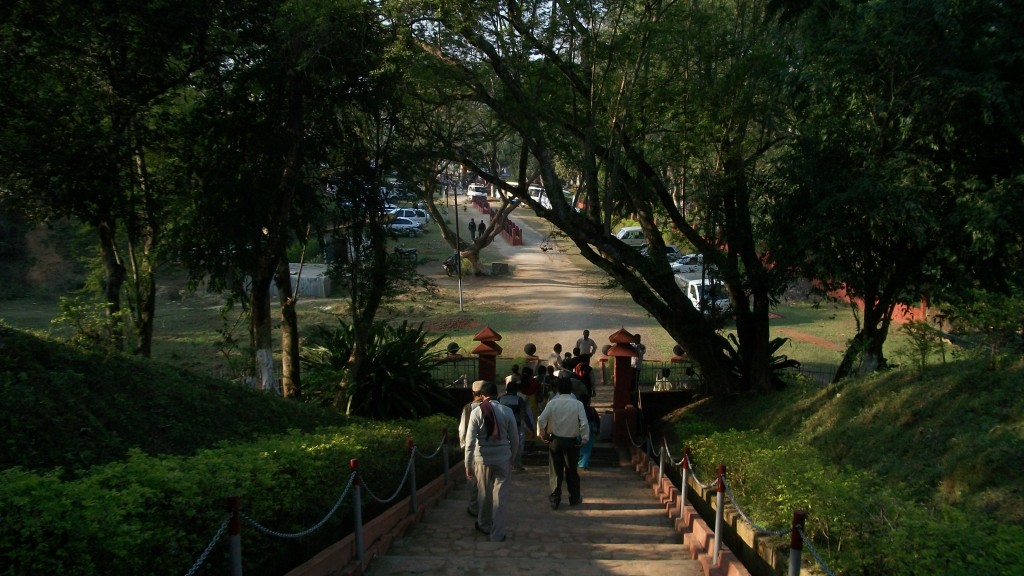
- The Group of Four Maidams — The four most significant and best-preserved moidams at the site, protected as Ancient Monuments of National Importance under ASI. These are the primary visitor focus.
- The Sa-dhua-pukhuri — The sacred pond used for ritualistic bathing of royal bodies before burial; still present at the site; one of the most atmospheric elements of the landscape.
- The Sa-nia-ali — The designated path through which royal bodies were carried for burial; its route is preserved as a heritage element of the site.
- The broader Charaideo Archaeological Site — The remaining moidams, managed by the Assam Government DOA; the landscape of the full necropolis — 90 moidams across the hilltop terrain — is best understood from the site boundary viewpoints.
How to Reach Charaideo
- From Sivasagar (Sibsagar): 25 km; approximately 45 minutes by road. Sivasagar is the cultural hub of Ahom heritage in Assam — the Sivasagar Sivadol, Rang Ghar, and Kareng Ghar are all here. Charaideo is the most significant add-on to any Sivasagar visit.
- From Jorhat: Approximately 60 km; 1.5 hours by road.
- From Guwahati: Over 400 km; 10–11 hours. The region is best reached by flying to Jorhat Airport (connected to Guwahati and Kolkata) and driving from there.
Best Time to Visit Charaideo
- October to March: Best weather; comfortable for exploration of the outdoor site; January 31 for Me-Dam-Me-Phi festival
- January 31 (Me-Dam-Me-Phi): The most culturally intense occasion at Charaideo — the living Tai-Ahom community in full ritual
- June to September: Monsoon; the hilltop site remains accessible but can be muddy; the landscape is intensely green
