




Northeast India is home to four UNESCO World Heritage Sites — eight sites on the UNESCO Tentative List — spanning natural wonders, living cultures, and a royal necropolis that rivals the pyramids of Egypt in ambition. Together, they represent the most compelling argument for why this region deserves a place on every serious traveller’s map.
Here is everything you need to know before you visit each one, including what makes it exceptional, the best time to go, and how to get there.
List of UNESCO World Heritage Sites in Northeast India
1. Kaziranga National Park, Assam
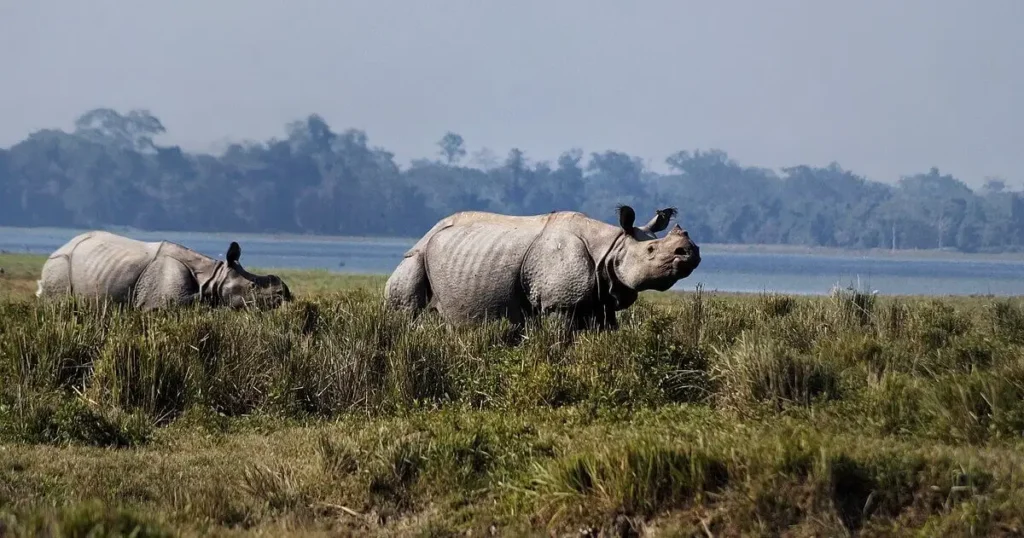
UNESCO Status: Natural World Heritage Site, inscribed 1985
Location: Golaghat and Nagaon districts, Assam — approximately 220 km from Guwahati
Kaziranga National Park is where Northeast India makes its most dramatic first impression. Spread across the flood plains of the Brahmaputra River’s southern bank in Assam, this park holds the world’s largest population of the great Indian one-horned rhinoceros — a conservation success story that is nothing short of extraordinary. In the early 20th century, the rhino population in Assam had been hunted to near extinction. Today, Kaziranga is home to more than 2,600 of them, representing approximately two-thirds of the global population.
The park does not stop at rhinos. Kaziranga is also home to the highest density of tigers of any protected area in the world, though you are far more likely to see an elephant on a dawn safari than a big cat. Wild water buffalo, swamp deer (barasingha), Hoolock gibbons, and Gangetic river dolphins inhabit the landscape. Over 480 species of birds have been recorded here, making Kaziranga one of the subcontinent’s most important avian habitats.
What to Do
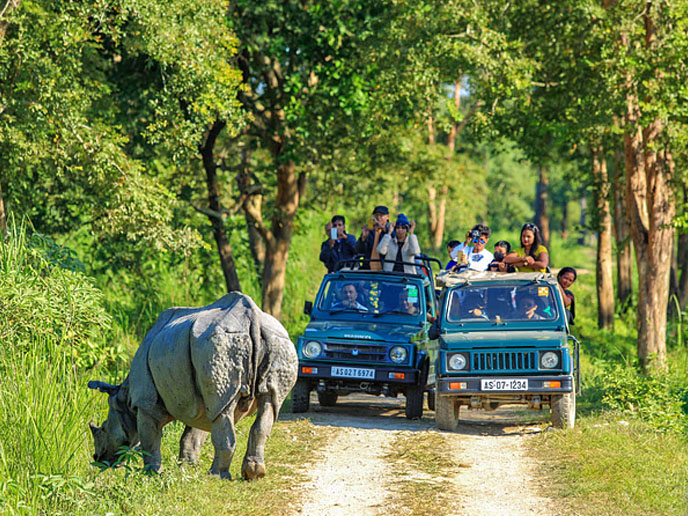
- Take a jeep or elephant safari at dawn — the golden morning light over the grasslands and the near-certainty of rhino sightings make it one of the great wildlife experiences in Asia.
- Visit the Western Range (Bagori) and the Central Range (Kohora) for the best rhino density.
- Attend the park’s interpretation centre at Kohora for context on the conservation history.
Best Time to Visit
October to April. The park closes during the monsoon season (roughly May to September) when the Brahmaputra floods the grasslands.
How to Get There
Fly to Guwahati (Lokpriya Gopinath Bordoloi International Airport), then drive approximately 4–5 hours east. Jorhat Airport is closer at roughly 97 km. Trains from Guwahati also run to Furkating (for the Central Range) and Jakhalabandha (for the Western Range).
2. Manas Wildlife Sanctuary, Assam
UNESCO Status: Natural World Heritage Site, inscribed 1985; removed from Danger List 2011
Location: Chirang and Baksa districts, Assam — approximately 175 km from Guwahati
Manas Wildlife Sanctuary has one of the most remarkable conservation stories in modern India. Inscribed as a World Heritage Site in 1985, the sanctuary was placed on UNESCO’s List of World Heritage in Danger in 1992 after years of civil conflict led to severe poaching and habitat destruction. By 2011, sustained conservation efforts by the Bodo community, the state government, and NGOs had turned the situation around sufficiently for UNESCO to remove it from the Danger List — a rare achievement globally.
Covering 39,100 hectares in the foothills of the Bhutan Himalayas, Manas is a trans-boundary sanctuary: the contiguous Royal Manas National Park in Bhutan forms a single ecological unit with it. The sanctuary harbours more than 20 endangered species, including the tiger, pygmy hog (one of the world’s rarest mammals), Indian rhinoceros, Indian elephant, wild water buffalo, clouded leopard, golden langur, and Bengal florican. The Manas River, fed by Himalayan glaciers and flanked by forests, is the defining landscape feature.
What to Do
- Jeep safaris into the core zone — tiger and elephant sightings are relatively common by Northeast India standards.
- River rafting on the Manas River during the appropriate season.
- Golden langur spotting — this rare primate, found only in this region of Assam and Bhutan, was first recorded at Manas in the mid-20th century.
Best Time to Visit
November to April. The park closes during monsoon season, typically from June to October.
How to Get There
Fly or take a train to Guwahati, then travel approximately 4 hours by road to the main entry point at Barpeta Road. Local taxis and buses run from Barpeta Road to the park gates.
3. Khangchendzonga National Park, Sikkim
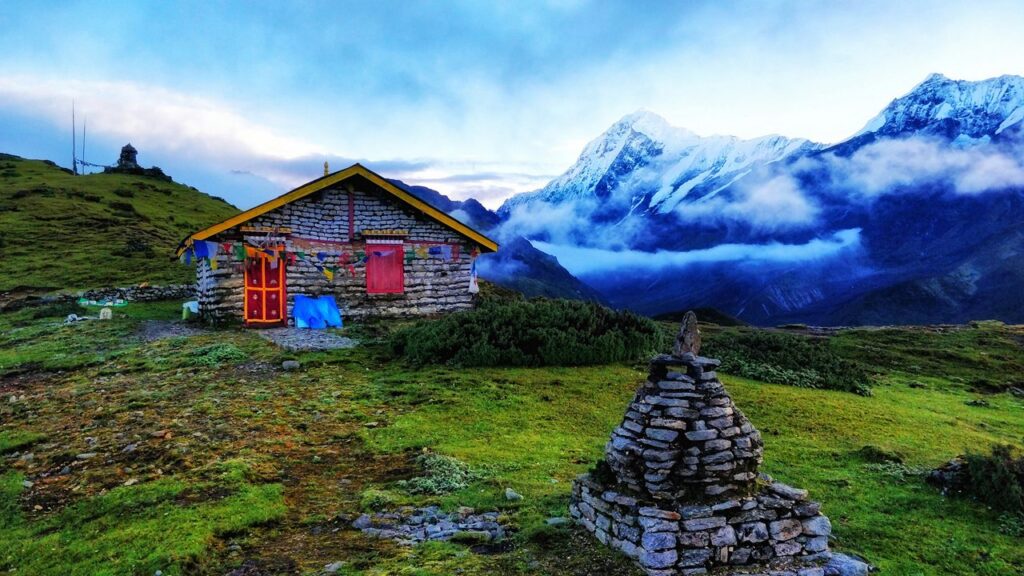
UNESCO Status: Mixed World Heritage Site (Natural + Cultural), inscribed 2016 — India’s only mixed heritage site
Location: Western and northern Sikkim — accessible from Gangtok
Khangchendzonga National Park is unique in the UNESCO World Heritage system: it is India’s only Mixed Heritage Site, recognized for both its outstanding natural value and its deep cultural and spiritual significance to the indigenous peoples of Sikkim. At its centre stands Mount Khangchendzonga — at 8,586 metres, the third-highest peak on Earth — which the Lepcha, Bhutia, and other communities of Sikkim regard as the guardian deity of their homeland.
Spread across 1,784 square kilometres, the park encompasses the full range of Himalayan ecosystems, from subtropical forests to alpine meadows, glaciers, and permanent snow. The Zemu Glacier — the largest in the Eastern Himalayas at approximately 26 km in length — is one of the park’s most dramatic features. Rare and endangered animals, including the snow leopard, red panda, Himalayan black bear, musk deer, and Tibetan antelope inhabit the higher elevations. The park has been a Biosphere Reserve since 1977.
The cultural dimension is equally compelling. Natural features throughout the park — caves, rivers, lakes, and peaks — are regarded as sacred by indigenous communities. Festivals, rituals, and traditional land management practices remain active, making this a living cultural landscape as much as a protected wilderness.
What to Do
- Trek the Kanchenjunga base camp trail from Yuksom (a 9–12 day trek for experienced hikers) — permits required from the Wildlife Education and Interpretation Centre at Yuksom.
- Visit Yumthang Valley (Valley of Flowers) in spring, when rhododendrons bloom across the hillsides.
- Explore Gurudongmar Lake — one of the highest lakes in the world at 5,183 metres, sacred to both Buddhists and Sikhs.
Best Time to Visit
March to late May (spring, rhododendrons in bloom) and September to mid-December (clear post-monsoon skies, best for high-altitude trekking).
How to Get There
Fly to Bagdogra Airport (West Bengal), then take a shared taxi or bus to Gangtok (approximately 4 hours). Alternatively, take a train to New Jalpaiguri (NJP) and proceed by road. Note: Protected Area Permits (PAP) are required for most areas of the park — arrange in advance through the Sikkim Tourism office.
4. Moidams — The Mound-Burial System of the Ahom Dynasty, Assam
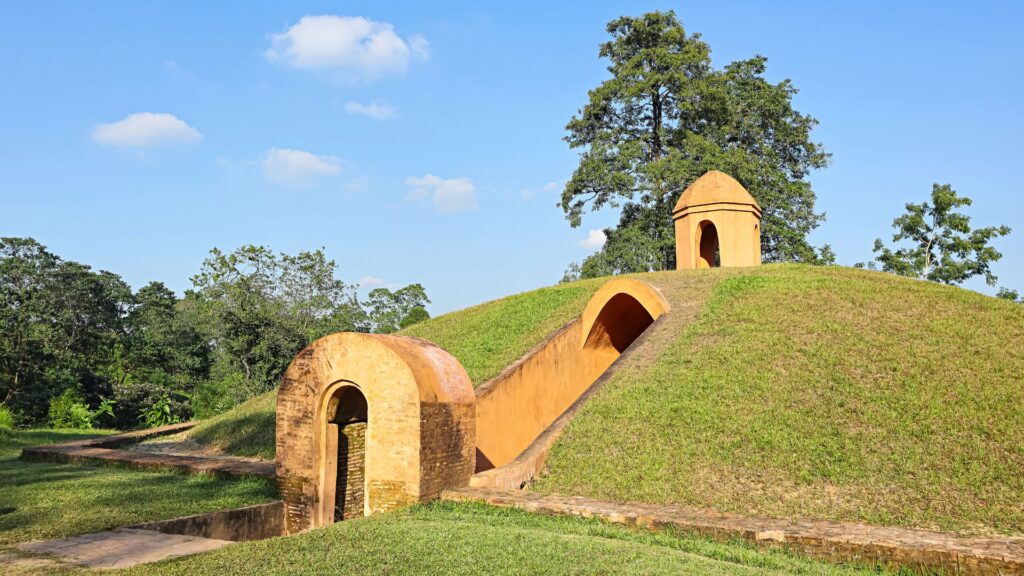
UNESCO Status: Cultural World Heritage Site, inscribed July 26, 2024 — India’s 43rd UNESCO World Heritage Site and the first cultural heritage site from Northeast India
Location: Charaideo, Sivasagar district, Assam — approximately 370 km from Guwahati
In July 2024, during the 46th session of the World Heritage Committee — held, fittingly, in India for the first time — the Moidams of Charaideo were inscribed on the UNESCO World Heritage List. This was a landmark moment: not only was it India’s 43rd inscription, it was the first cultural World Heritage Site to be recognised from the entire Northeast.
A Moidam is a burial mound, and what the Tai-Ahom people built at Charaideo over six centuries is nothing short of extraordinary. The property contains 90 moidams — hollow vaults of brick, stone, or earth, each topped by a shrine and enclosed within an octagonal wall — where the kings and royals of the Ahom dynasty were interred along with grave goods including food, horses, elephants, and sometimes queens and servants.
The Tai-Ahom people migrated to present-day Assam from Southeast Asia (present-day Yunnan, China) in the 13th century under Prince Siu-kha-pha. They established their first capital at Charaideo, and it became their sacred necropolis — a royal burial ground maintained continuously for 600 years, from the 13th to the 19th centuries CE. The word Moidam derives from the Tai script ‘Phrang Mai’ (to bury) and ‘Dam’ (spirit of the dead). The Tai-Ahom believed the soul lives on after death; these mounds were ‘homes for the spirit’. The site has been compared to the pyramids of Egypt and royal tombs of ancient China in its architectural ambition and cultural significance.
Living rituals keep the site active. The Tai-Ahom practice of Me-Dam-Me-Phi — an ancestor worship ceremony held annually on January 31 — and the Tarpan libation ritual continue to be performed at Charaideo, linking the present community to this 700-year-old tradition.
What to Do
- Walk among the 90 moidams and examine the architectural detail of the brick and stone vaults.
- Visit the Charaideo Museum for artefacts and context on the Ahom Kingdom and the excavation history of the moidams.
- Plan a visit around January 31 to witness the Me-Dam-Me-Phi ancestor worship ceremony.
- Combine with a visit to nearby Sivasagar, the later Ahom capital, which has several important Ahom-era monuments.
Best Time to Visit
October to March offers the most comfortable weather for exploring this outdoor site. The January 31 Me-Dam-Me-Phi ceremony is the most culturally immersive time to visit.
How to Get There
Fly to Jorhat Airport (approximately 70 km from Charaideo) or Dibrugarh Airport (approximately 90 km). Shared taxis run from Jorhat and Sivasagar to Charaideo. Sivasagar town, 25 km from Charaideo, is the most convenient base.
5. The Tentative List: What May Come Next
UNESCO’s Tentative List for India includes several Northeast sites currently under consideration for future World Heritage inscription. These places showcase the region’s extraordinary blend of biodiversity, indigenous traditions, spiritual heritage, and cultural landscapes.
Majuli Island, Assam
On UNESCO’s Tentative List since 2004 under the Cultural category, Majuli is recognized as the world’s largest freshwater river island. It is the spiritual heartland of Assamese Neo-Vaishnavism and home to the centuries-old satras — living monastic institutions that continue to preserve Assamese dance, music, theatre, mask-making, and literature.
Living Root Bridges of Meghalaya
The remarkable Living Root Bridges represent one of the world’s most fascinating examples of indigenous bio-engineering. Built by the Khasi and Jaintia communities, these bridges are formed by guiding the aerial roots of rubber fig trees across rivers over decades, creating resilient living structures deeply connected to the region’s ecological knowledge systems.
Apatani Cultural Landscape, Arunachal Pradesh
The Apatani Cultural Landscape is celebrated for its highly sustainable wet rice cultivation and forest management practices developed by the Apatani tribe over centuries. Located in the scenic Ziro Valley, the landscape reflects a rare balance between human settlement and environmental conservation.
Thembang Fortified Village, Arunachal Pradesh
Nestled in the Eastern Himalayas, Thembang Fortified Village is a historic settlement of the Monpa community known for its traditional stone fortifications, unique architecture, and preserved cultural heritage.
Namdapha National Park, Arunachal Pradesh
Namdapha National Park is one of India’s richest biodiversity hotspots. Spread across diverse altitudinal zones, the park is famous for its dense rainforests and rare wildlife, including clouded leopards, red pandas, and several big cat species.
Keibul Lamjao National Park, Manipur
Located on Loktak Lake, Keibul Lamjao National Park is the world’s only floating national park. It is globally significant as the last natural habitat of the endangered Sangai deer, often called the “dancing deer of Manipur.”
Garo Hills Conservation Area, Meghalaya
The proposed Garo Hills Conservation Area includes ecologically sensitive forests such as the Nokrek Biosphere Reserve, known for rich wildlife, endemic citrus species, and critical conservation value within the Eastern Himalayan biodiversity region.
Unakoti Rock-Cut Sculptures, Tripura
Unakoti Rock-Cut Sculptures is an extraordinary archaeological and spiritual site featuring massive rock carvings, Shaivite sculptures, and ancient reliefs carved into forested hillsides, unlike any other rock-cut heritage site in India.
These sites represent the ongoing story of Northeast India’s heritage recognition on the world stage. Visiting them now means experiencing places at the cusp of global acknowledgement — while they are still relatively uncrowded.
Practical Notes for UNESCO Site Visits
- Kaziranga and Manas are both Tiger Reserves in addition to UNESCO sites. Book safaris in advance, especially for peak season (November to February).
- Khangchendzonga requires Protected Area Permits for most trekking routes. Apply through the Sikkim Tourism office in Gangtok.
- Charaideo / Moidams is managed by the Archaeological Survey of India. Entrance fees apply; check current rates at the site or with ASI.
- Photography is generally permitted at all four sites, but specific restrictions may apply inside museum buildings and near active ritual areas. Always check local guidance.
