




Right across the road from one of Meghalaya’s most revered sacred forests sits a village built entirely to answer one question: what did Khasi life actually look like before it changed? The Khasi Heritage Village at Mawphlang isn’t an ancient ruin or ceremonial ground — it’s a deliberately reconstructed model village, built by the Khasi Hills Autonomous District Council to preserve architecture, tools, and customs that were quietly disappearing from everyday Khasi life. If you’ve been exploring our Meghalaya travel coverage and wondering where to actually understand Khasi culture rather than just glimpse its landscapes, this is that place.
Quick Facts About Khasi Heritage Village
| Location | Mawphlang, East Khasi Hills district, Meghalaya |
|---|---|
| Distance from Shillong | ~25-27 km (45 minutes to 1 hour by road) |
| Built By | Khasi Hills Autonomous District Council (KHADC) |
| Area | Approximately 8 acres |
| Opposite | Mawphlang Sacred Grove (Law Kyntang) |
| Timings | 8 AM – 6 PM, all days |
| Entry Fee | ₹20-30 per person; camera fee ₹20 |
| Parking | Charged separately; can run high during peak hours |
| Annual Event | Monolith Festival (dates vary by year) |
| Nearest Airport | Shillong Airport, ~50 km |
What Is the Khasi Heritage Village, Exactly?
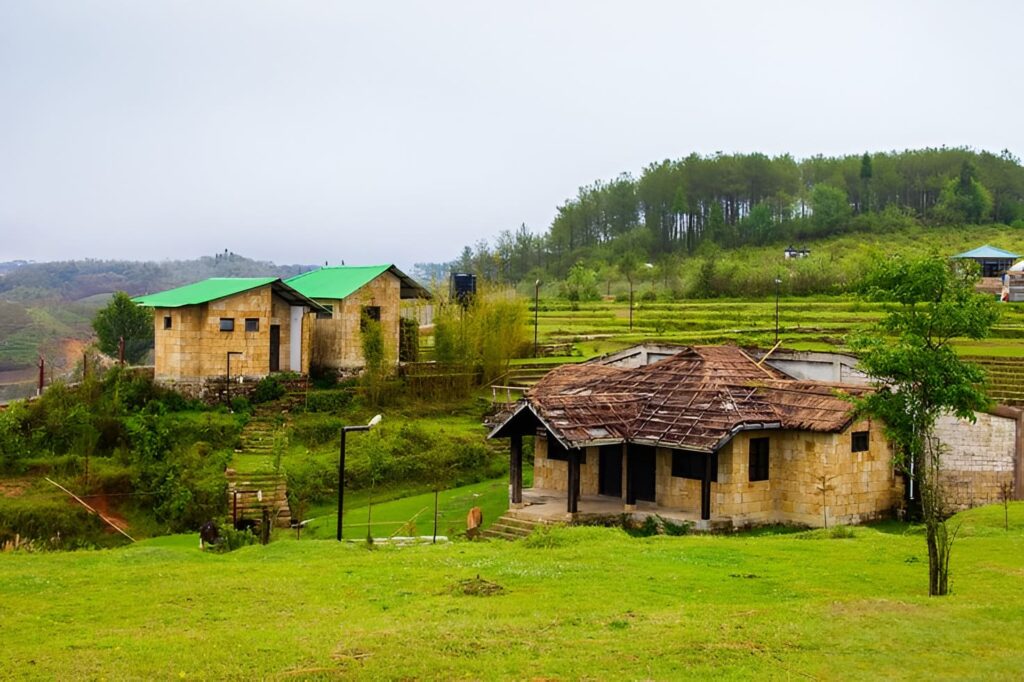
Spread across roughly 8 acres, the Khasi Heritage Village recreates an entire cross-section of traditional Khasi settlement life. Unlike a museum with objects behind glass, this is a walk-through village of full-sized huts, each built from bamboo, timber, and thatch in the authentic architectural style of different Khasi sub-regions, and each carrying a small description explaining its original purpose.
Wander through and you’ll come across a Dorbar Hall, the traditional community meeting space where local governance and disputes were historically settled, alongside reconstructed kitchen huts fitted with period cooking tools, storehouses, and family dwellings. A dedicated museum section displays artefacts, weapons, and daily-use items that once defined Khasi domestic life, while a separate archery section showcases the traditional bows and arrows still used in Khasi sporting culture today. The site also has a long suspension bridge and an amphitheatre used for screenings and stage performances during festival season.
The Matrilineal Khasi: Why This Heritage Matters
The Khasi are one of the few genuinely matrilineal societies left in the world, tracing lineage, property, and clan identity through the mother’s line rather than the father’s — a structure shared with Meghalaya’s other major communities, the Garo and Jaintia. It’s this distinct social fabric, along with a language of Mon-Khmer origin unlike most of Northeast India‘s Tibeto-Burman tongues, that the Heritage Village was built to protect and explain to a wider audience.
As KHADC’s own leadership has put it, Khasi culture has been openly practised for roughly two centuries in its current form since Christian missionaries arrived in the hills, but its older customs, oral traditions, and traditional systems of governance risk fading if nobody actively documents and displays them. The Heritage Village is the Council’s answer to that concern — a physical, walkable record rather than a written one.
The Monolith Festival: Khasi Heritage Village’s Signature Event
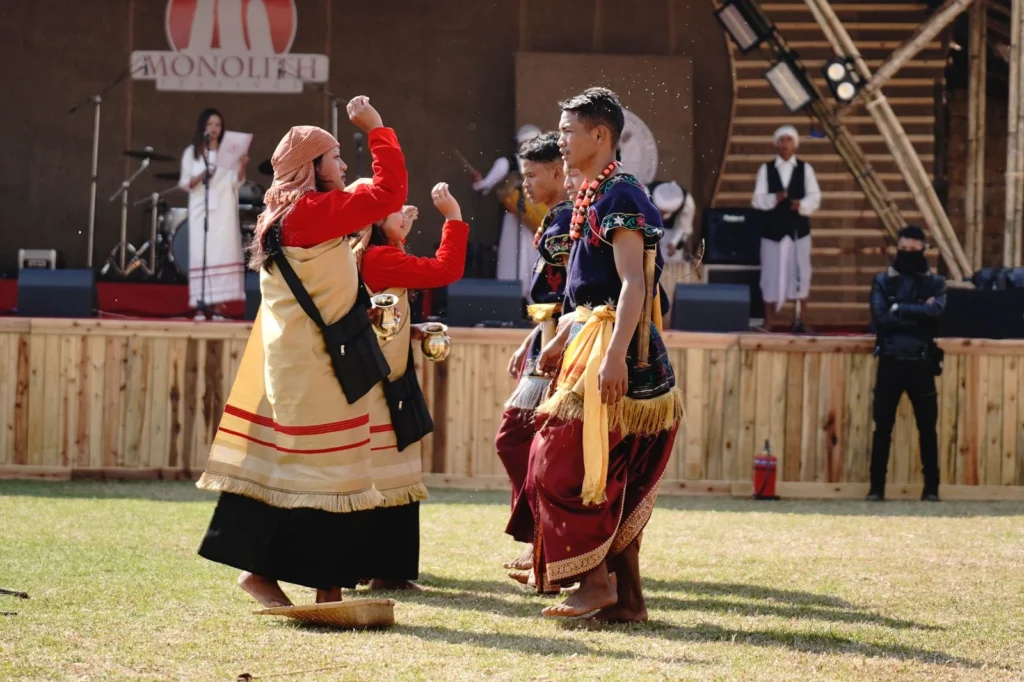
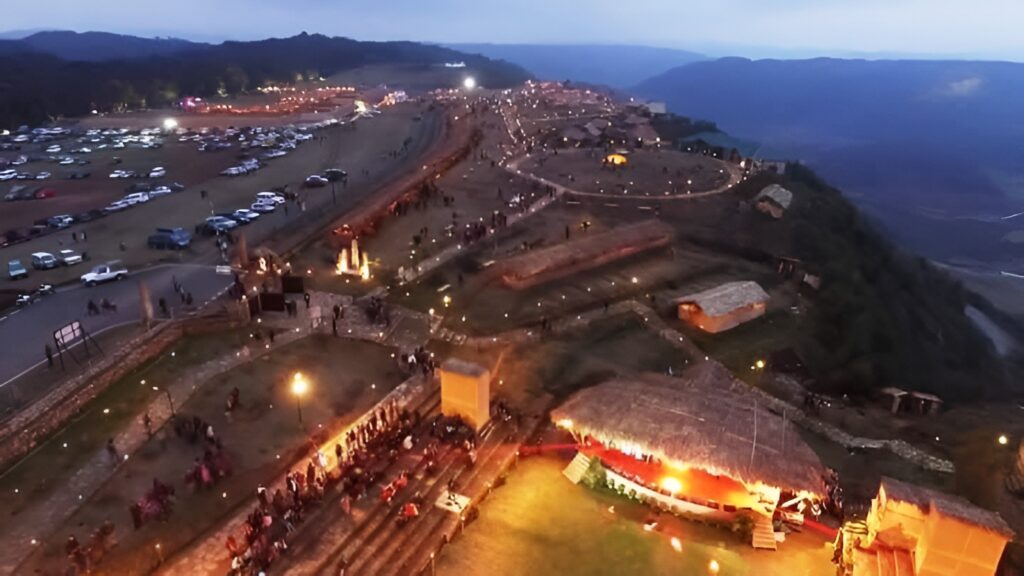
If there’s a single reason to time your Mawphlang trip precisely, it’s this. The Monolith Festival, organised by the Khasi Hills Autonomous District Council, is held annually at the Heritage Village grounds, drawing chiefs, cultural troupes, and visitors from across all of Meghalaya’s traditional Khasi Himas (kingdoms).
The festival’s exact dates shift year to year — past editions have run in October, December, January, and March, depending on scheduling and state events — so it’s worth checking Meghalaya Tourism’s official listings closer to your travel dates. What stays consistent is the scale: recent editions have commemorated all 53-54 traditional Khasi chieftainships in one place, with three full days of folk dances like Shad Suk Mynsiem and Shad Kruh Ram, theatrical skits recounting Khasi legends, live performances on traditional instruments, a traditional-attire fashion show, and food stalls serving Khasi staples like jadoh (rice cooked in pork fat), doh khlieh (a minced pork salad), and tungrymbai (fermented soybean curry).
Not everyone in Meghalaya sees the festival the same way. Some cultural commentators have pointed out that, unlike older religious festivals rooted in Khasi tradition like Shad Suk Mynsiem itself, the Monolith Festival is a comparatively new, tourism-driven event — a modern platform rather than an ancestral one. That’s a fair distinction to know before you go: this is Khasi culture curated for a wide audience, not a centuries-old ritual you’re observing firsthand. Either way, it remains one of the most accessible ways for an outside visitor to experience Khasi performing arts and cuisine in a single sitting.
Khasi Heritage Village vs Mawphlang Sacred Grove: How Do They Compare?
These two sites sit directly opposite each other, and most visitors do both in a single stop — but they serve very different purposes.
| Site | What It Shows | Time Needed | Vibe |
|---|---|---|---|
| Khasi Heritage Village | Reconstructed architecture, tools, festival culture | 30-45 minutes | Curated, walkable, family-friendly |
| Mawphlang Sacred Grove | A living, centuries-old protected forest tied to local deity worship | 1-1.5 hours (guided) | Reverent, ecological, mildly restrictive |
The Sacred Grove, a genuine UNESCO-recognised community conservation site, requires a local guide and strict rules — nothing may be removed from the forest, following a belief that doing so invites misfortune. The Heritage Village, by contrast, is built specifically for visitors to walk freely, photograph, and engage with displays at their own pace. Pairing the two gives you both the anthropological and the spiritual sides of Khasi Hills culture in one short trip.
Best Time to Visit Khasi Heritage Village
The site is pleasant nearly year-round, given Meghalaya’s mild climate, but October through May offers the clearest skies and driest paths for walking the grounds. If you specifically want to catch the Monolith Festival, check current-year dates in advance, since the event has shifted between winter and spring scheduling in recent editions. Outside festival dates, weekday mornings offer a quieter, more contemplative visit — weekends and festival days bring noticeably larger crowds.
How to Reach Khasi Heritage Village
The village sits at Mawphlang, roughly 25-27 km from Shillong, and is typically visited as a half-day trip combined with the Sacred Grove next door.
- Hire a taxi or private car from Shillong — the most common approach, taking 45 minutes to an hour depending on traffic.
- Take a shared taxi or bus to Mawphlang town, then a short local transfer or walk to the Heritage Village, if travelling on a tighter budget.
- Combine it with a wider East Khasi Hills loop — Mawphlang sits conveniently along routes toward Laitlum Canyons and other Shillong-area attractions, making it easy to fold into a longer day out.
No special permits are required for Indian or foreign tourists visiting Shillong and its surrounding East Khasi Hills attractions, unlike several ILP-restricted states elsewhere in the region — see our Northeast India travel permits guide if you’re planning a wider multi-state itinerary.
Visitor Tips and a Few Honest Notes
- Carry small denomination cash. Entry fees are modest, but card payments aren’t reliably available on-site.
- Watch the parking charges. Several recent visitors have flagged that parking fees can run surprisingly high relative to the low entry ticket — worth budgeting for.
- Wear comfortable walking shoes. The grounds are spread out and mostly grass or dirt paths.
- Don’t expect polished infrastructure. Some huts have shown wear between festival cycles, since maintenance tends to intensify ahead of the Monolith Festival specifically rather than running continuously.
- Combine with the Sacred Grove same-day, since the two sites are directly across from each other and logically pair into one visit.
- Food is available just outside the village rather than inside the grounds themselves.
Nearby Attractions Around Mawphlang
Beyond the Sacred Grove directly opposite, the wider Mawphlang area rewards a slightly longer stay. The village itself is one of many in the Khasi Hills named after monoliths — “maw” means stone, and “phlang” means grassy, giving Mawphlang its literal meaning of “grassy stone.” A short drive further brings you toward Laitlum Canyons, one of the most dramatic viewpoints in the East Khasi Hills, and onward toward Shillong’s cluster of waterfalls and lakes if you have a full day to spend in the district.
Frequently Asked Questions About Khasi Heritage Village
Is one visit enough to see everything? Yes — most visitors comfortably cover the entire village, including the museum section and archery display, in 30 to 45 minutes.
Can I visit without a guide? Yes, unlike the Sacred Grove next door, the Heritage Village is self-guided, with descriptive plaques at each hut.
Is it worth visiting outside the Monolith Festival? Absolutely — the huts, museum, and archery section are open year-round, and many visitors actually prefer the quieter, uncrowded experience outside festival dates.
Is the Khasi Heritage Village suitable for children and older visitors? Yes, the grounds are flat and walkable, though there’s no dedicated transport within the village itself for those with mobility concerns.
Final Thoughts
The Khasi Heritage Village won’t overwhelm you with scale, and that’s rather the point — it’s a compact, honest attempt to keep Khasi architecture, tools, and customs visible to a generation that might otherwise only encounter them in old photographs. Pair it with the sacred forest next door, time your visit around the Monolith Festival if you can, and you’ll leave Mawphlang with a genuinely rounded picture of Khasi Hills life, past and present.
For more from this part of Meghalaya, browse our Meghalaya travel coverage or check out our Northeast India tourism guide for a longer regional itinerary.
