




The earthy smell of incense reaches you before the monastery does. Walking up the final approach to Rumtek Monastery from the road, past the whitewashed chorten that marks the complex boundary, the scent arrives on the thin mountain air along with the distant sound of a gong, the low resonance of chanted prayers, and the sharp jingle of a prayer wheel caught by the wind. By the time you step through the main gate into the courtyard, something has already changed — the specific quality of the silence here, even in the presence of chanting and movement, tells you that this is a place that holds something large.
Rumtek Monastery, approximately 24 kilometres from Gangtok in the South Sikkim district, is the largest monastery in Sikkim and the principal seat outside Tibet of the Karma Kagyu — the Black Hat lineage of Tibetan Buddhism. It was designed and built in the 1960s by the 16th Karmapa, Rangjung Rigpe Dorje, who fled Tibet after the Chinese occupation destroyed the original Tsurphu Monastery — the Karma Kagyu’s 900-year-old Tibetan home.
Rumtek Monastery was built from memory: the Karmapa recreated the Tsurphu layout, the ritual arrangements, the iconographic programme, and the monastic organisation from his recollection of the original, creating a living heir to a tradition that China had attempted to erase. It remains one of the most extraordinary acts of cultural reconstruction in the history of Himalayan Buddhism.
Quick Facts About Rumtek Monastery
| State | Sikkim |
| District | East Sikkim (Rumtek village) |
| Distance from Gangtok | 24 km; approximately 1.5 hours by road |
| Altitude | 1,550 metres (5,085 feet) |
| Founded | 1960s; rebuilt by the 16th Karmapa, Rangjung Rigpe Dorje |
| Modelled On | Tsurphu Monastery, Tibet — original Karma Kagyu headquarters, destroyed by China in 1966 |
| Lineage | Karma Kagyu — the Black Hat sect of Nyingma school Tibetan Buddhism |
| Key Institution | Karma Shri Nalanda Institute of Buddhist Studies — 9-year Mahayana curriculum |
| Opening Hours | 6 AM to 6 PM daily |
| Entry Fee | Nominal; camera restrictions apply — take permission before photographing |
The Karma Kagyu — The Black Hat Lineage
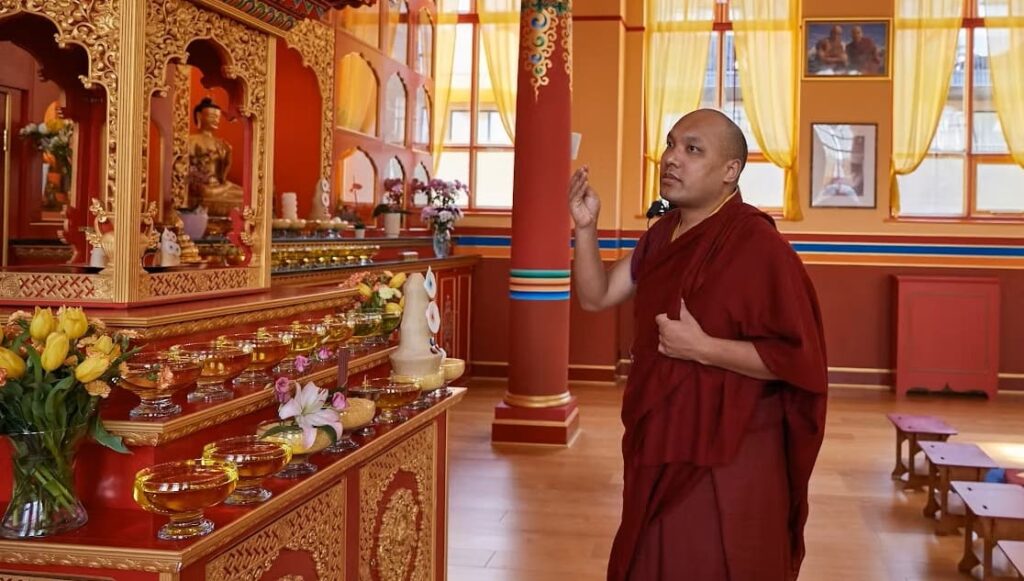
The Karma Kagyu sect — one of the most important lineages in Tibetan Buddhism — takes its common name from the Black Crown (black hat) that is the central symbol of the Karmapa’s authority. The lineage was founded in the 12th century by Düsum Khyenpa, the 1st Karmapa, and has maintained an unbroken succession of 17 Karmapas since then — each one identified as a reincarnation of the last through a tradition of discovery that predates the better-known identification process used for the Dalai Lamas.
The Black Hat legend: According to the tradition, the Karmapa — upon attaining a particular form of enlightenment — was presented with a hat woven from the hair of one hundred thousand dakinis (female deities). This hat, containing the power of flight and the accumulated spiritual force of all those beings, is encased in a box because its power is too great to be displayed openly. The ceremonial Black Crown worn by the Karmapa during the Black Crown Ceremony (Vajra Mukut) is a physical representation of this invisible crown. Many devotees believe the original magical hat is preserved at Rumtek.
The 16th Karmapa at Rumtek Monastery: Rangjung Rigpe Dorje, the 16th Karmapa, arrived in Sikkim in 1959 following the Chinese occupation of Tibet. The Chogyal of Sikkim offered him land at Rumtek Monastery, where a small monastery already stood. Between 1961 and 1966, the Karmapa oversaw the construction of the new monastery — a complex designed to precisely replicate the scale, orientation, and sacred geography of the destroyed Tsurphu. He died in 1981 in the United States; his ashes are preserved in a gilded stupa within the Nalanda Institute.
The Architecture — A Replication from Memory
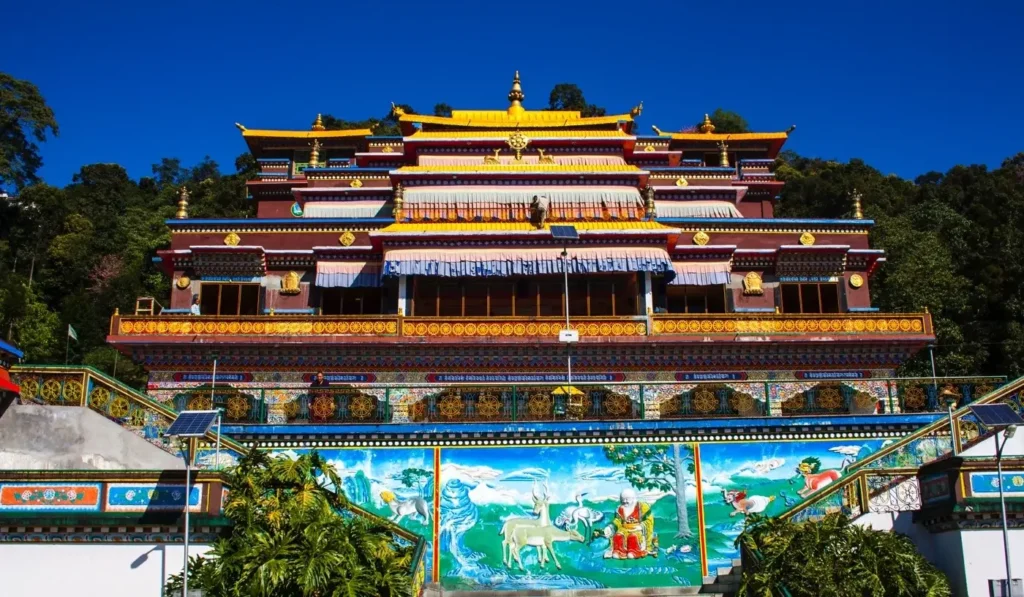
The main temple at Rumtek Monastery is an immediate statement of artistic ambition. The facade — wood latticework painted in the vibrant reds, golds, and blues of traditional Tibetan religious art — overlooks a wide stone courtyard that serves as the gathering space for festivals, ceremonial dances, and the daily movement of monks between the various structures of the complex.
The Main Prayer Hall
The interior of the main hall is one of the finest examples of classical Tibetan Buddhist decorative art in India. The walls are covered in intricate murals depicting Buddhist masters, dharmapalas (protector deities), dakinis, and narrative cycles from Buddhist cosmology. Thangka paintings — large-format devotional paintings on fabric — are hung from the ceiling beams between the columns. A large gilded Buddha sits at the altar, flanked by the images of previous Karmapas. The prayer hall is used for daily rituals beginning at 7 AM; respectful visitors may observe from the back during non-restricted periods.
- The murals are executed in the classical Tibetan style — the best preserved examples of this tradition in Sikkim
- The central Buddha figure is flanked by Guru Rinpoche (Padmasambhava) and Chenrezig (Avalokiteshvara)
- Morning prayers (7 AM): the most atmospheric time to visit — the hall fills with the low resonance of chanting, drums, and the occasional punctuation of a conch shell
The Karma Shri Nalanda Institute
Behind the main temple, the Karma Shri Nalanda Institute of Buddhist Studies is the intellectual heart of the Rumtek Monastery complex — and one of the most significant centres of Mahayana Buddhist scholarship outside Tibet. Monks spend nine years studying the complete Mahayana Buddhist curriculum here: logic, philosophy, meditation, ritual, and the interpretation of the major Kagyu and Nyingma texts. The institute’s scale and ambition reflect the Karmapa’s determination to reconstitute in Sikkim the full scholarly tradition of the Tibetan monasteries.
- 9-year full Mahayana curriculum in the Karma Kagyu tradition
- The ashes of the 16th Karmapa are preserved in a gilded reliquary stupa within the institute
- The building also functions as the monks’ living quarters, kitchen, and dining hall
- The institute is not open to casual visitors but the building and grounds are visible from the courtyard
| Cultural note: Rumtek is a working monastery, not a museum. The monks who live here, study here, and maintain the rituals of the Karma Kagyu lineage are doing so with complete seriousness. Visitors are welcome to observe but the monastery’s primary function is not tourism. Arrive with genuine curiosity and respect; follow the instructions of monastery staff at all times; do not enter the inner sanctum during rituals unless specifically invited; and treat the spaces of daily monastic life with the same consideration you would give any working community. |
The Festivals of Rumtek Monastery— When to Visit
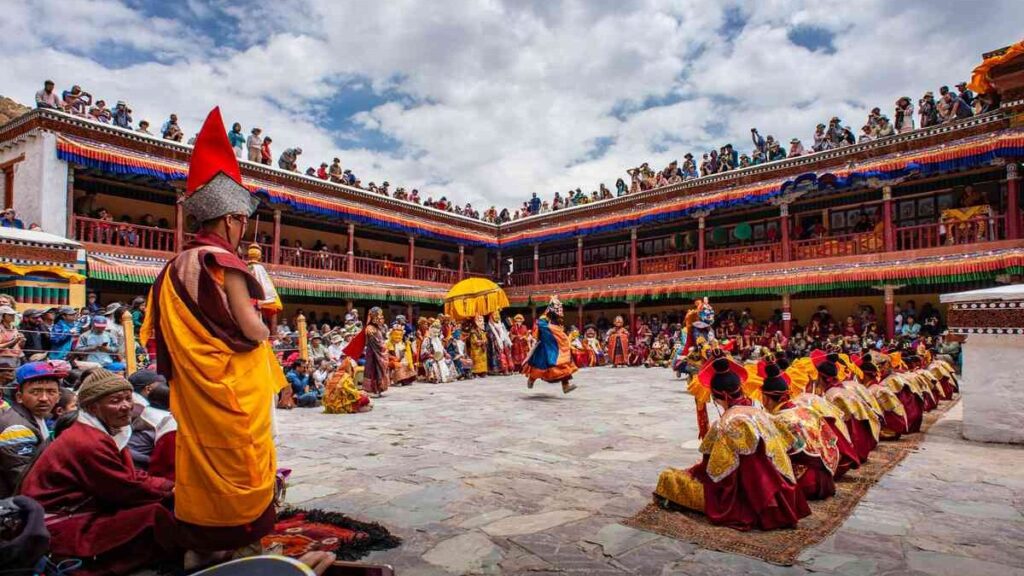
Losar (Tibetan New Year — February): The most important annual celebration at Rumtek Monastery. Celebrated for three consecutive days with communal prayers, traditional music, masked dances, and the gathering of monks and lay devotees from across Sikkim and the Himalayan region. The courtyard at Losar is filled with colour and movement.
Mahakal Puja (two days before Lhosar): A week-long series of rituals culminating in Cham — the masked dance performance using elaborate costumes representing Mahakal, Mahakali, and Dorje Drugpa. The Cham at Rumtek Monastery is among the most theatrically powerful religious performances in Sikkim.
Dungdrub Puja (Saga Dawa — May/June): Celebrating the anniversary of Buddha’s enlightenment, the monks of Rumtek Monastery join devotees in chanting one million mantras — the Dungdrub — as a prayer for world peace. The marathon chanting session continues throughout the day.
Vajrakilaya Festival (alternate years): Celebrating Guru Padmasambhava, founder of the Nyingma sect; includes performances of Lhamo — Tibetan folk theatre with songs and masked dances. Held in alternate years; verify current year schedule before planning.
17th Karmapa’s Birthday (June 26): Sacred dances and cultural programmes mark the birthday of the current Karmapa; a quieter but significant celebration.
| Festival planning: Losar is the finest single occasion to visit Rumtek but requires advance planning — the exact date follows the Tibetan lunar calendar and shifts each year. Verify dates through the Rumtek Monastery website or through a Gangtok tour operator. Accommodation in Gangtok should be booked 4–6 weeks ahead for the Lhosar period. |
The View from Rumtek Monastery
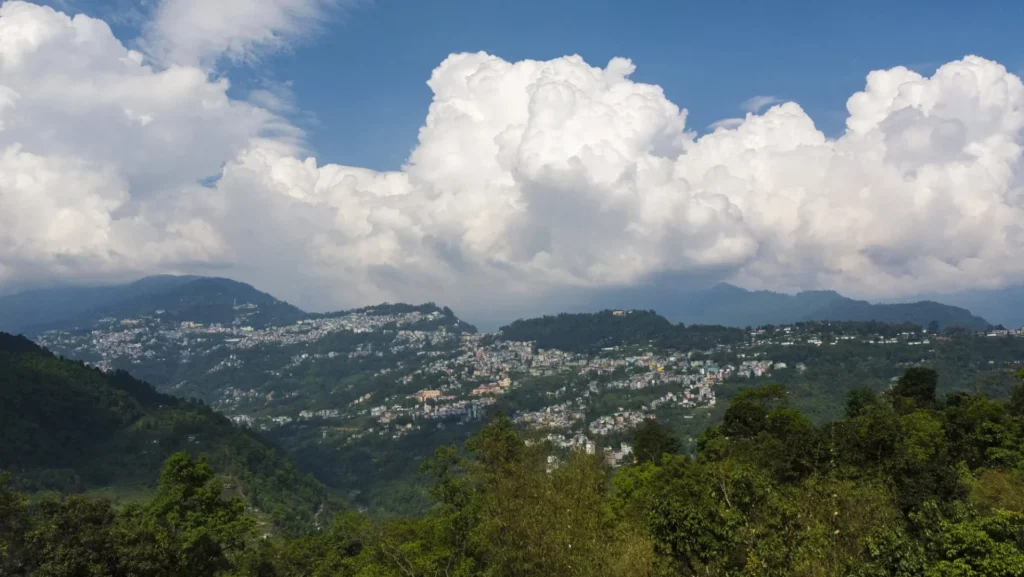
Rumtek Monastery sits on a hill directly facing Gangtok across a wide valley — the capital is visible as a ridge of buildings on the opposite hillside, catching the morning sun. The view from the monastery courtyard, looking back toward Gangtok with the terraced valley below and the snow peaks occasionally visible beyond the city, is one of the finest urban-mountain panoramas in Sikkim. The afternoon light — when the sun moves behind Rumtek’s hill and throws Gangtok into golden relief — is particularly fine.
How to Reach Rumtek Monastery
- From Gangtok: 24 km; approximately 1.5 hours by road. Taxis available from Deorali Taxi Stand in Gangtok (shared or private). The road descends dramatically from Gangtok into the Rani Khola valley and climbs again to Rumtek on the opposite ridge.
- By shared taxi: Shared taxis operate from Deorali in the morning; return shared taxis available throughout the afternoon.
- Walk from the road: The taxi drops you approximately 800 metres from the monastery gate; a gentle uphill walk through the village to the entrance.
Travel Essentials
- Remove footwear before entering the prayer hall and inner sanctum areas
- Photography: take permission before photographing; certain sections (inner sanctum, the reliquary stupa) are photography-prohibited
- Dress: cover shoulders and knees; avoid shorts and sleeveless clothing
- Arrive during morning prayers (7 AM) for the most atmospheric experience
- The monastery shop sells genuine Karma Kagyu ritual objects, thangkas, and books; the quality is reliable and purchasing here directly supports the institution
Best Time to Visit Rumtek Monastery
- February (Lhosar): The single finest festival occasion; three days of celebration, Cham dances, and communal devotion
- October to March: Clear mountain air; Kangchenjunga sometimes visible from the monastery ridge; comfortable temperatures
- March to May: Spring; rhododendrons on the approach road; pleasant weather; manageable crowds
- June to September: Monsoon; the approach road can be misty; the monastery grounds are lush green but views are obscured
