




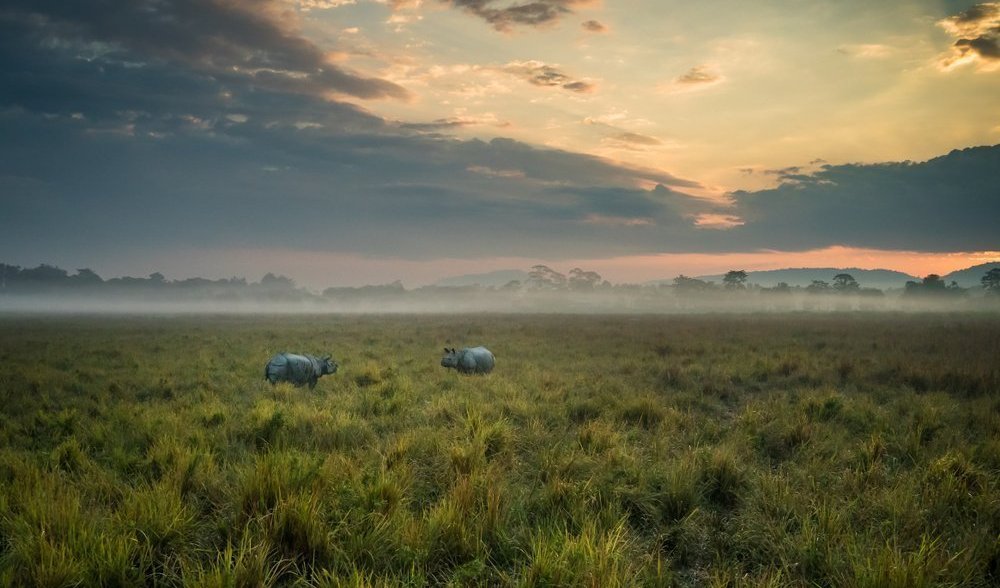
There are national parks, and then there is Kaziranga. Spread across 430 square kilometres of floodplain grassland, wetland, and semi-evergreen forest along the southern bank of the Brahmaputra in central Assam, Kaziranga National Park contains the single largest population of the Indian one-horned rhinoceros on Earth — over 2,600 individuals, representing approximately two-thirds of the entire global wild population. That number alone would make it one of the world’s most important wildlife destinations. But Kaziranga is also a UNESCO World Heritage Site with the highest density of tigers in any protected area in India, a major stronghold for the Asian elephant, and a globally significant wetland for migratory birds. By any measure, this is the Northeast India‘s most extraordinary wildlife destination.
The park sprawls across the Golaghat and Nagaon districts and is divided into four administrative ranges — Central (Kohora), Eastern (Agoratoli), Western (Bagori), and Burapahar — each offering different landscapes and different wildlife concentrations. Most visitors base themselves at Kohora on the NH37 highway and explore the Central and Eastern ranges. Those with more time discover that the Western and Burapahar ranges offer equally compelling wildlife with significantly fewer other jeeps.
Quick Facts About Kaziranga National Park
| State | Assam |
| District | Golaghat and Nagaon |
| Area | 430 sq km (core) + 1,307 sq km (buffer zones) |
| UNESCO Status | World Heritage Site (1985) |
| Altitude | 40–80 metres |
| Nearest Town | Kohora (on NH37, also called NH715) |
| Nearest Airport | Jorhat Airport — 97 km; Guwahati Airport — 217 km |
| Nearest Rail | Furkating — 75 km; Jorhat Town — 97 km |
| Permit Required | No ILP; park entry fees apply; jeep and elephant safari booking required |
| Park Season | Open November to April; closed May to October (monsoon flooding) |
| Best Time | November to February (peak wildlife; dry season) |
The Wildlife of Kaziranga
The Indian One-Horned Rhinoceros
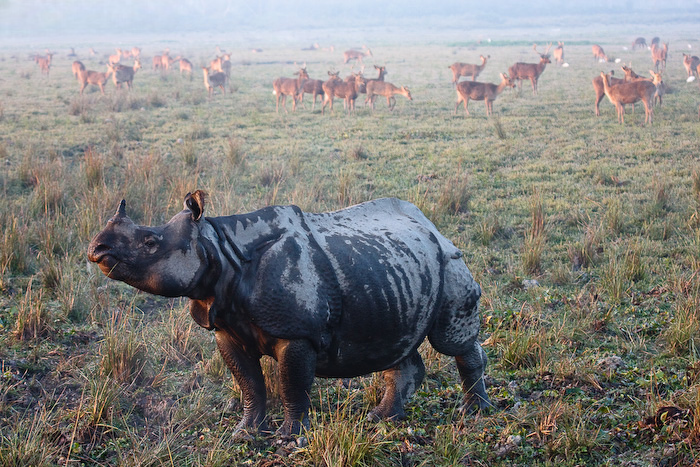
The Indian one-horned rhinoceros (Rhinoceros unicornis) is Kaziranga’s defining resident and the reason the park was created in 1905, when Viceroy Lord Curzon’s wife reportedly lamented that she had not seen a single rhino during her visit and pressed for the area’s protection. At that time, the population had dwindled to fewer than a dozen individuals from uncontrolled hunting. Today, over 2,600 rhinoceroses roam the park’s grasslands — one of the most remarkable conservation recovery stories in the history of wildlife management.
- Physical characteristics: The Indian one-horned rhino is the world’s fourth-largest land animal — males can weigh up to 2,700 kg. Despite their immense size, they can run at up to 55 km/h over short distances. The single horn (as opposed to the two horns of African species) can grow to 90 cm. Their skin, which folds into what appears to be armour plating, is deeply distinctive.
- Behaviour: Rhinos are generally solitary except for mothers with calves. They are most active at dawn and dusk, spending the hot midday hours in water or wallowing in mud. Their eyesight is poor but their sense of smell is exceptional — staying downwind of rhinos during jeep safari is important for prolonged observation.
- Sighting likelihood: Kaziranga offers the highest probability of rhino sighting of any wildlife destination in the world outside Africa. On a standard morning jeep safari in the Central Range, a sighting of 5–15 rhinos is routine. Seeing 20 or more individuals in a single morning is not uncommon.
Tiger
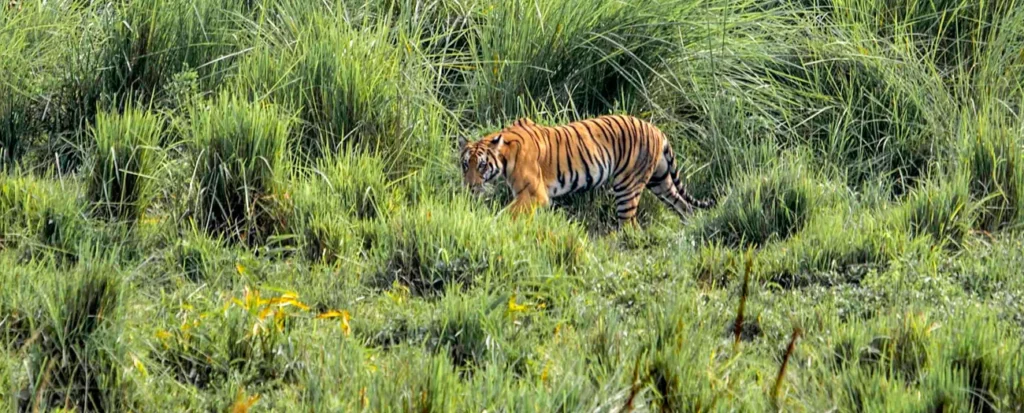
Kaziranga has the highest recorded tiger density of any protected area in India — approximately 120 tigers in the core zone, giving a density of roughly one tiger per 3.5 square kilometres. Despite this extraordinary density, tiger sightings are less common than rhino sightings because tigers use the tall elephant grass extensively and are adept at concealment. The best chance of a tiger sighting is in the early morning on the park’s jeep tracks, particularly in the Central and Eastern ranges.
- Approximately 120 tigers in the core zone — highest density in India
- Best sightings: early morning on open grassland sections, particularly in dry season (February–April)
- The Eastern range (Agoratoli) is considered the best for tiger probability among experienced guides
Asian Elephant
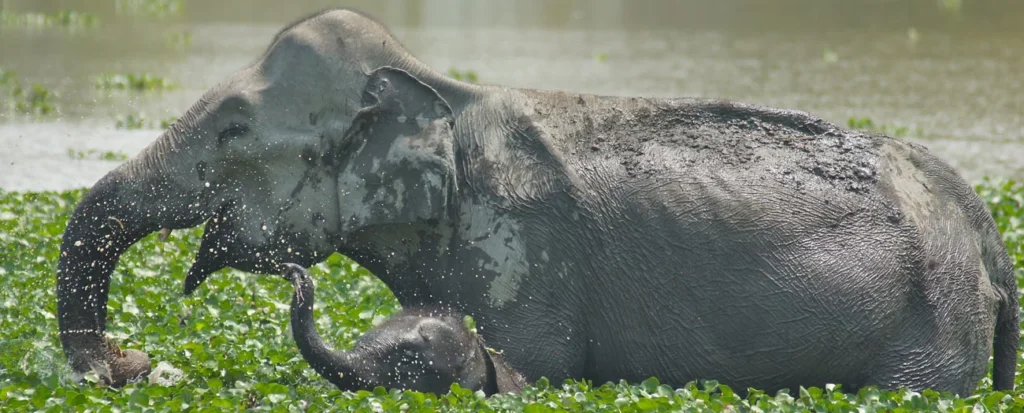
Kaziranga’s elephant population numbers approximately 1,300 individuals — one of the largest concentrations of wild Asian elephants in India. Unlike in many other reserves where elephants are reclusive, Kaziranga’s open grasslands mean elephant encounters are frequent and often dramatic — large herds moving through the grass, mothers with young calves at the water’s edge, bull elephants in musth crossing the road.
Other Key Species
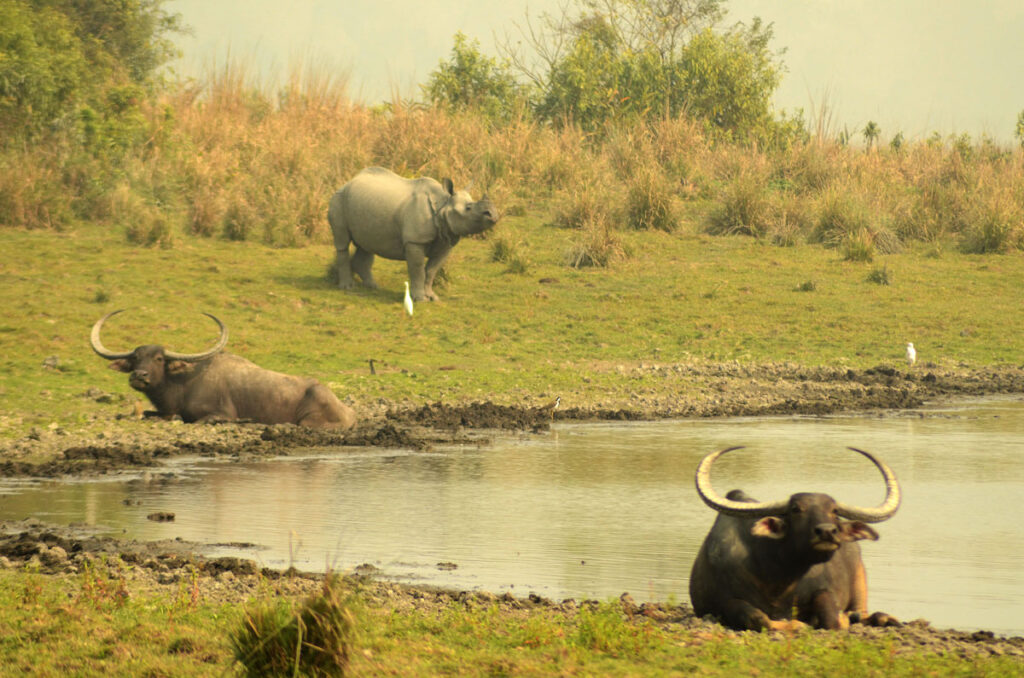
- Wild Water Buffalo (Bubalus arnee) — Kaziranga has the world’s largest population of this critically endangered species; the massive dark-horned animals are frequently seen at the grassland edges
- Swamp Deer (Barasingha) — A globally vulnerable species whose Kaziranga population is one of the most significant in India
- Hoolock Gibbon — Asia’s only ape; heard (and occasionally seen) in the semi-evergreen forest sections of Burapahar Range
- Smooth-coated Otter — Common at the park’s wetlands and jheel (oxbow lake) edges
- Gangetic River Dolphin — Present in the Brahmaputra adjacent to the park
Birdlife
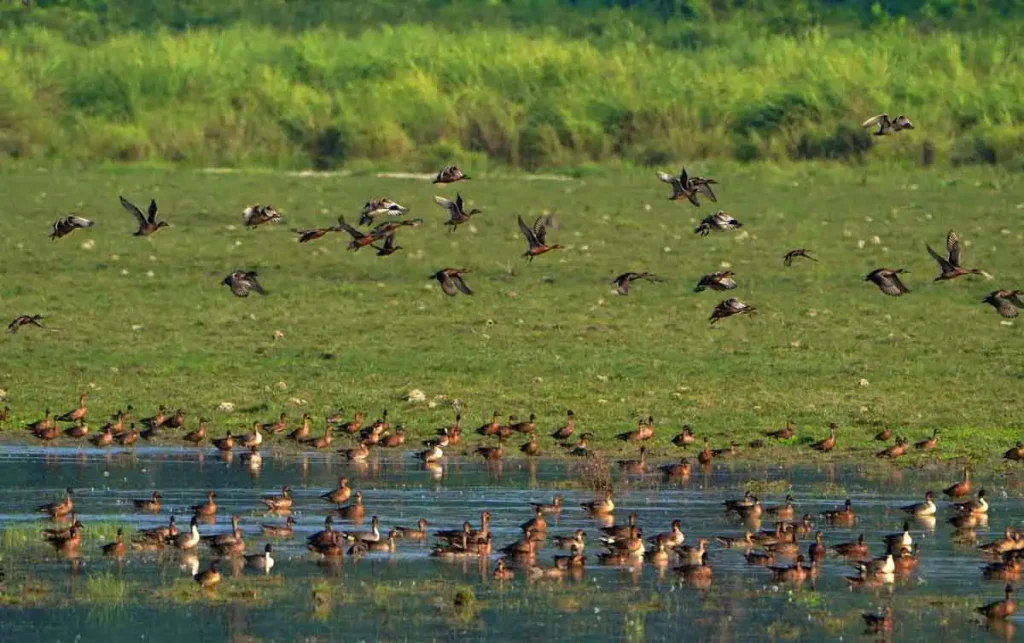
Kaziranga has recorded over 480 bird species — the park’s wetlands, grasslands, and forest edges create an extraordinary diversity of habitats. Key species include:
- Greater Adjutant Stork — critically endangered; Kaziranga has the world’s largest remaining breeding population
- Bengal Florican — critically endangered grassland bustard
- Bar-headed Goose, Lesser White-fronted Goose — winter migrants from Central Asia
- Pallas’s Fish Eagle, Grey-headed Fish Eagle, White-tailed Eagle
- Baer’s Pochard, Ferruginous Duck — globally threatened waterfowl
Safari Options at Kaziranga
1. Jeep Safari (Most Popular)
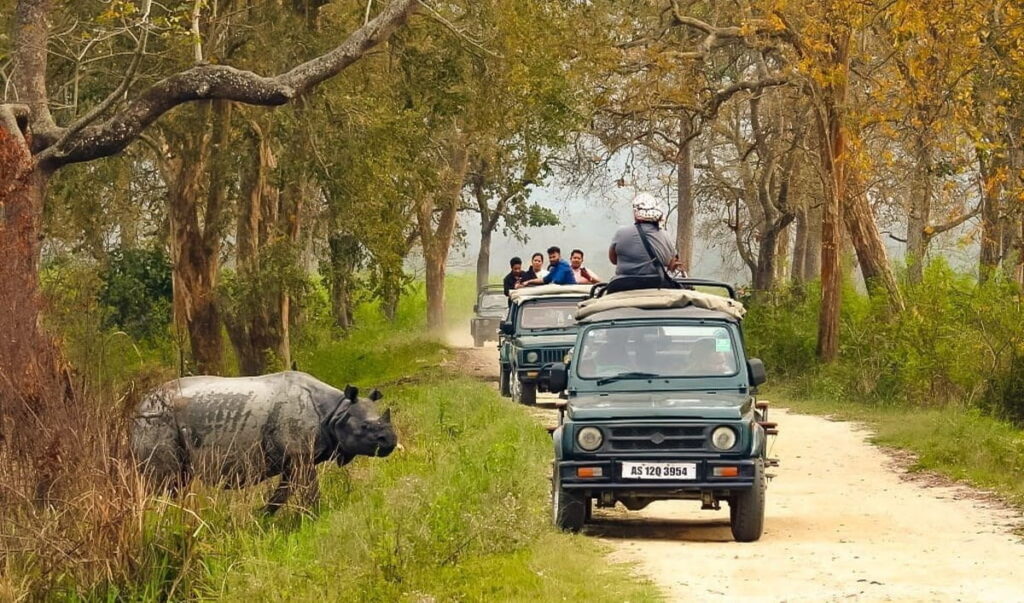
Jeep safaris are the primary way to experience Kaziranga and offer the most flexible, comprehensive wildlife viewing. Gypsys (open-top jeeps) carry 4–6 passengers and are driven by a driver with a forest guard. Each range has its own jeep tracks and safari timings.
- Central Range (Kohora) — Most popular; best rhino density; multiple jheels; good for all major species
- Eastern Range (Agoratoli) — Less crowded; best for tiger probability; beautiful open grasslands
- Western Range (Bagori) — Good elephant concentrations; scenic wetlands; fewer tourists
- Burapahar Range — Most forested; best for Hoolock Gibbon, leopard, and forest birds; fewest other vehicles
- Timing — Morning safari (5:30–8 AM) and afternoon safari (1:30–4 PM); morning is significantly better for wildlife
- Booking — Book online through the Kaziranga National Park website or through accredited Kohora operators; advance booking strongly recommended October–February
| Morning safari strategy: Book the Central Range for your first morning (guaranteed rhino sightings, good wetland scenery), and the Eastern Range for your second morning (best tiger probability). If you have a third day, the Western Range offers a quieter, more contemplative experience with excellent elephant and bird watching. |
Check out our portal for resorts and homestays.
2. Elephant Safari
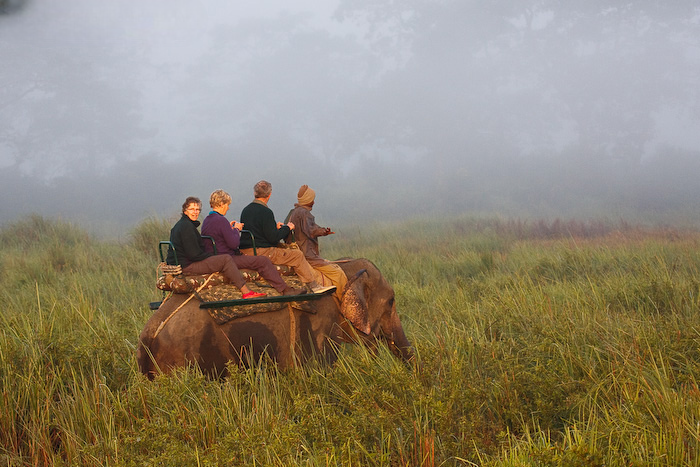
The elephant back safari at Kaziranga is one of the most iconic wildlife experiences in India — riding on a trained elephant into the tall elephant grass at dawn, approaching rhinos from a height and at a pace that does not disturb them, experiencing the park from the level at which its animals live. Elephant safaris depart from specific ranges (primarily Mihimukh in the Central Range) and must be booked in advance.
- Dawn departure (approximately 5:00 AM) — the most atmospheric wildlife experience in Assam
- Elephants move silently through the grass — allows much closer rhino approach than jeeps
- Limited capacity — book weeks in advance for November to February
- Approximately 45–60 minutes per ride; groups of 2–4 per elephant
3. Watch Tower Viewing
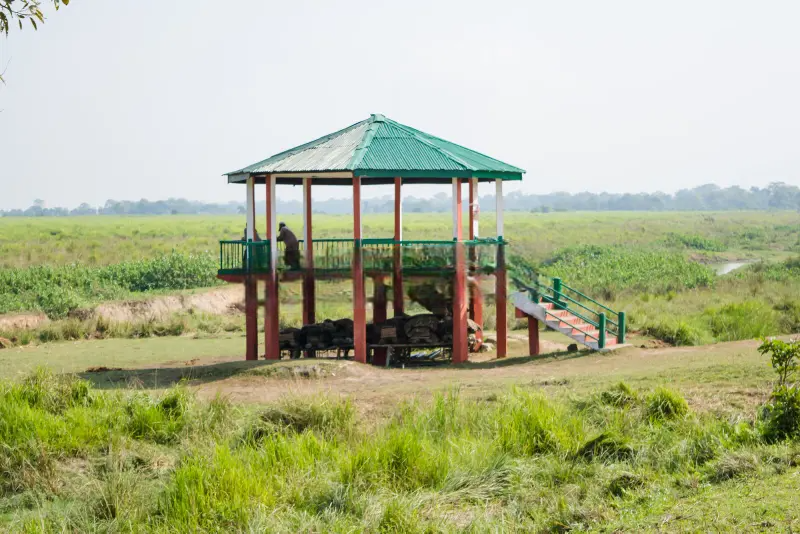
Four raised watchtowers are distributed across the Central and Western ranges — Sohola, Mihimukh, Kathpara, and Foliamari. These offer a different perspective from the jeep safari — a stationary, elevated viewpoint over grassland and wetland where wildlife comes and goes throughout the day. Particularly useful for photography and extended observation of specific animals.
Beyond the Safari — Other Activities at Kaziranga
- Orchid Conservation Centre — The park maintains a remarkable collection of Assam’s orchid species; a short visit adds botanical context to the wildlife experience
- Village walks in buffer zone — The communities surrounding Kaziranga have developed community tourism initiatives; walking through the buffer zone tea gardens and villages with a local guide provides ecological and human context
- Birdwatching from park periphery — The bheel (wetland) edges visible from NH37 and the forest roads offer excellent dawn birdwatching without requiring a paid safari
- Tea estate visits — The Kaziranga area is tea country; several estates along NH37 welcome visitors for tours and tastings of single-estate Assam CTC and orthodox teas
The Bihu Connection
The Rongali Bihu festival (April) — Assam’s most important cultural celebration — coincides with the closing weeks of the park season. Several resorts near Kaziranga host Bihu cultural evenings during this period, offering an opportunity to experience Assamese traditional music, dance, and cuisine alongside the wildlife experience.
Where to Stay at Kaziranga
- Iora — The Retreat — One of the finest eco-lodges in Northeast India; thatched cottages in the forest; excellent wildlife positioning; ₹8,000–₹15,000 per night
- Wild Grass Resort — Long-established and widely respected property at Kohora; good wildlife access; ₹5,000–₹9,000
- Diphlu River Lodge — River-edge property with excellent birding; beautiful setting; ₹7,000–₹12,000
- Mid-range hotels at Kohora — Several clean, reliable options along NH37; ₹2,000–₹4,500
- Budget guesthouses — Available throughout Kohora village; ₹800–₹2,000; best for self-sufficient travelers
| Staying inside or immediately adjacent to the park buffer zone (rather than in Kohora town itself) significantly enhances the experience — you can hear the jungle at night, encounter wildlife on the resort grounds, and be at the safari gate within minutes of the morning departure. |
Where to Eat at Kaziranga
- Resort dining — Most properties at Kaziranga offer full board including Assamese meals; the best quality food in the area
- Assamese thali — Rice, masor tenga (sour fish curry), dal, and seasonal vegetables; available at local restaurants along NH37
- Pork preparations — Many local restaurants serve excellent Assamese pork dishes; ask for the local speciality
- Tea — The immediate area produces some of Assam’s finest CTC tea; drink it the Assamese way — strong, with milk and sugar, before the morning safari
How to Reach Kaziranga
From Guwahati (Most Common Route)
- 217 km on NH37; approximately 4.5–5 hours by road
- Regular bus services from Guwahati’s ISBT to Kohora (Kaziranga junction)
- Private taxi from Guwahati: approximately ₹3,500–₹5,000
By Air
- Jorhat Airport — 97 km; connections from Guwahati, Kolkata, Delhi; taxi to Kaziranga approximately 2.5 hours
- Guwahati Airport — 217 km; the better-connected hub for long-distance flights
By Train
- Furkating Railway Station — 75 km from Kohora; on the Guwahati–Dibrugarh main line
- Jorhat Town — 97 km; accessible from the Furkating station direction
- The Saraighat Express and Brahmaputra Mail from Guwahati serve this route well
Travel Essentials for Kaziranga
- No permits required — park entry fees apply on arrival (approximately ₹50 for Indian nationals, ₹500 for foreign nationals)
- Jeep safari fees: approximately ₹3,000–₹4,000 per jeep per session; book online in advance
- Elephant safari: book directly through the Forest Department online; limited capacity
- Clothing: neutral colours (khaki, olive, grey) for safaris; avoid bright whites and reds
- Binoculars: essential for birding and distant wildlife viewing
- ATMs available at Kohora; carry sufficient cash for tips and small purchases
Best Time to Visit Kaziranga
- November to February: Peak season; dry grasslands; rhinos at water’s edge; migratory birds present; comfortable temperatures
- March to April: Pre-monsoon; grass begins to grow; still excellent wildlife; fewer tourists
- October: Park just reopened post-monsoon; grass still tall; exciting but sightings more difficult
- May to October: Park closed; Brahmaputra floods the grasslands annually — a natural process that maintains the ecosystem
