




Vanghmun does not announce itself the way hill stations usually do. There is no cable car, no promenade lined with hotels, no queue of tourist buses on a famous road. What it offers instead is rarer: the accumulated character of a century-old Mizo village perched at the highest inhabited ridge in Tripura, so clean you feel something shift the moment you arrive, and so far from the usual Northeast India circuit that reaching it still feels like a minor act of discovery.
The village sits in the Jampui Hills of North Tripura, pressed against the Mizoram border at around 1,000 metres. The hills are cool when the plains below bake. In October and November, terraced slopes turn amber with ripening Jampui oranges. In March, orchids appear on the forest floor. In the rainy season, clouds move through the village at eye level.
Quick Facts About Vanghmun
| District | North Tripura |
| Altitude | ~1,000 m; Betlingchhip Peak 930 m (state’s highest) |
| Language | Mizo; Bengali, English |
| Religion | Christianity (majority); tribal faiths |
| Founded | 5 February 1919 |
| Nearest Town | Kanchanpur (~25–30 km) |
| Airport | Agartala (~200 km) |
| No ILP Required | Open to all Indian nationals |
| Best Time | October to March |
The People of Vanghmun: Mizo Heritage & the Dokhuma Sailo Legacy
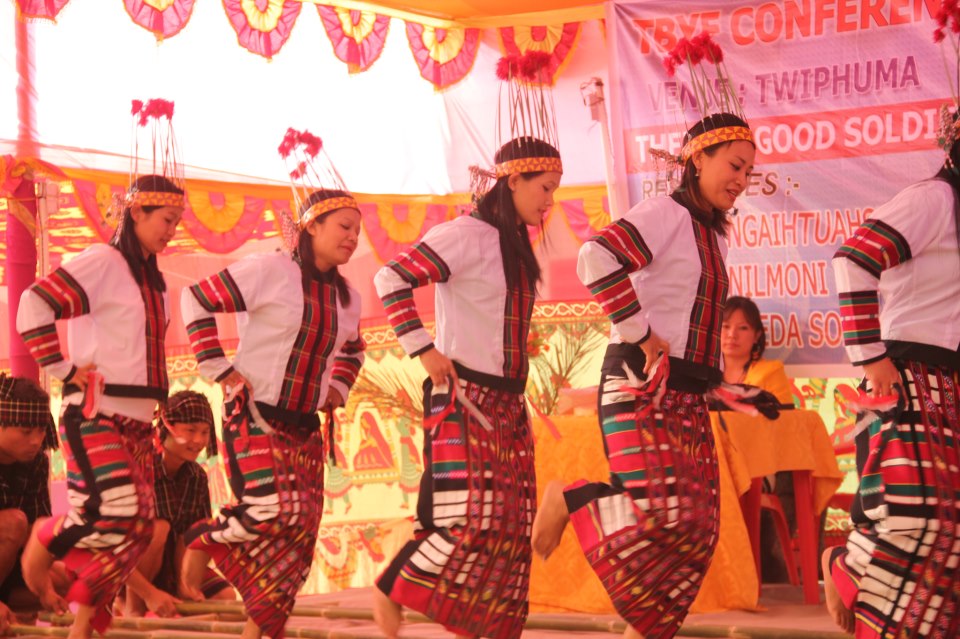
Vanghmun was founded on 5 February 1919 by a Mizo chief named Dokhuma Sailo, who established a settlement of twenty houses on the Jampui ridge. He ruled with enough skill and diplomatic grace that Maharaja Birendra Kishore Manikya conferred on him the title Raja Bahadur in 1922 — a recognition preserved in the village’s old informal name, Raja Bahadur Dokhuma Sailo village.
The Mizo people who settled these hills are part of the broader Tibeto-Burman tribal family, and they brought with them a culture centred on collective responsibility, Christian faith, and a standard of cleanliness that has earned Vanghmun national recognition. Members of the Young Mizo Association (YMA) began organised cleanliness drives well before any government programme existed. Every household keeps a dustbin at the entrance. Villagers from age eight to eighty gather every weekend for community cleaning. In 2019, the village banned plastics entirely, with women preparing handmade paper bags as alternatives. Visitors who litter are corrected — firmly but gently — by children who have grown up understanding cleanliness as a form of community pride.
The Reang tribal community inhabits parts of the wider Jampui Hills range alongside the Mizo majority, adding a second cultural thread to a region where identity runs deeper than its remoteness suggests.
| Tripura requires no Inner Line Permit. All Indian nationals can travel freely. The challenge is the road, not the paperwork. |
Top Attractions
1. Betlingchhip Peak — Tripura’s Highest Point
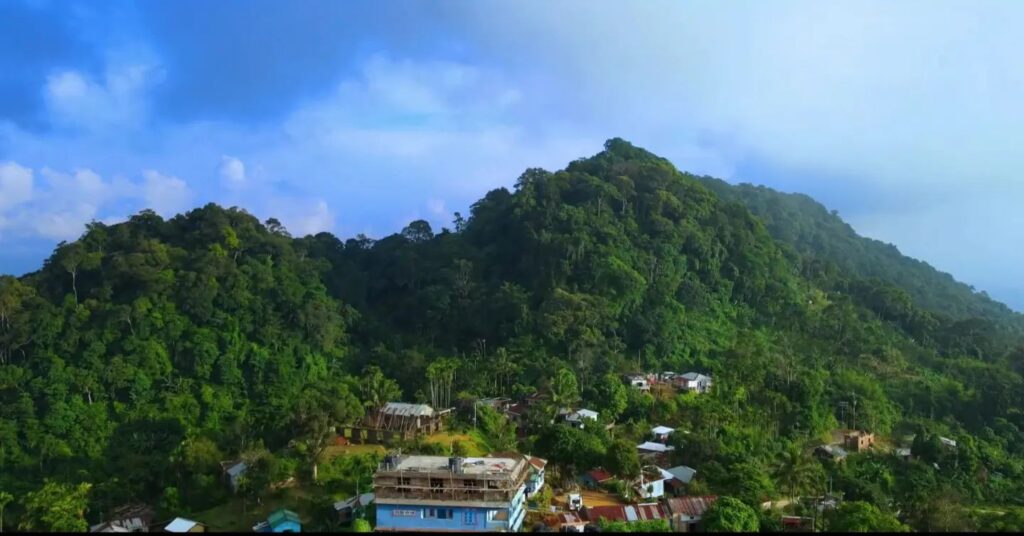
At approximately 930 metres, Betlingchhip is the highest point in Tripura. On clear days, the Chittagong Hill Tracts of Bangladesh are visible to the west and Mizoram’s ranges stretch east. The trek from Vanghmun through the bamboo forest takes 3–4 hours return and requires a local guide for the final section. Go early — clouds close in rapidly by mid-morning.
2. Sunrise Viewpoint & Helipad Ridge
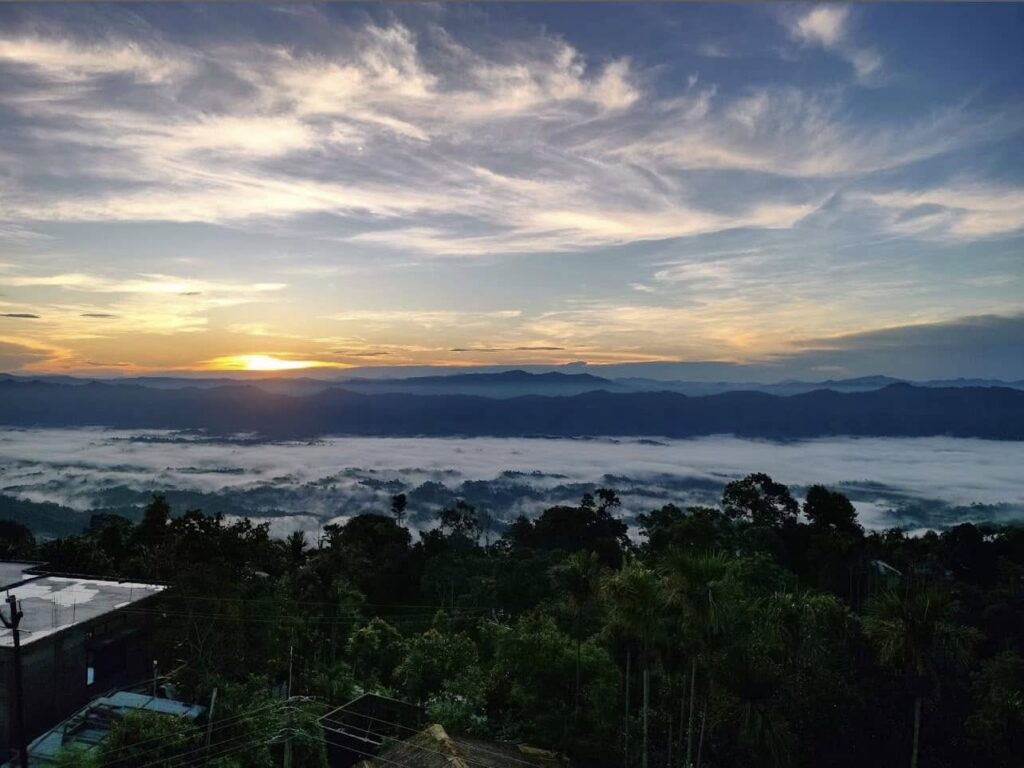
The ridge above the village, minutes on foot from the Eden Tourist Lodge, is one of the finest sunrise positions in North Tripura. The valley fills with cloud before dawn; at first light the sun rises over Mizoram into a sky that turns through orange and rose. At sunset, the same ridge frames Bangladesh’s plains in the fading light. No entry fee; accessible all year.
3. Vanghmun Orange Valley
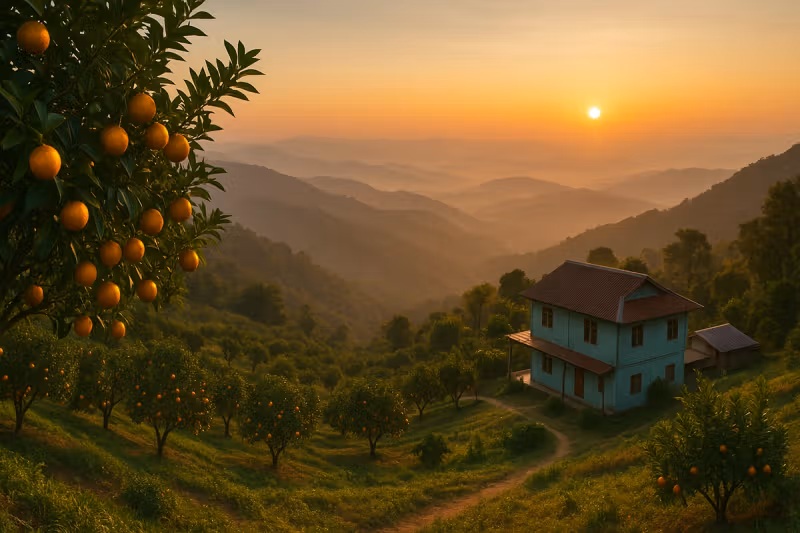
Jampui oranges — an exceptionally sweet mandarin variety — have been grown on these terraced slopes since the 1960s. From October through December, the hillsides turn amber with ripening fruit. The November Orange & Tourism Festival celebrates the harvest with cultural performances, local food stalls, and Cheraw bamboo dancing. Note that a fungal disease has reduced yields in recent years and some farmers have switched to areca nut; the orchards are thinner than their peak, but the November festival atmosphere remains one of the most distinctive cultural experiences in Northeast India.
4. Paragliding
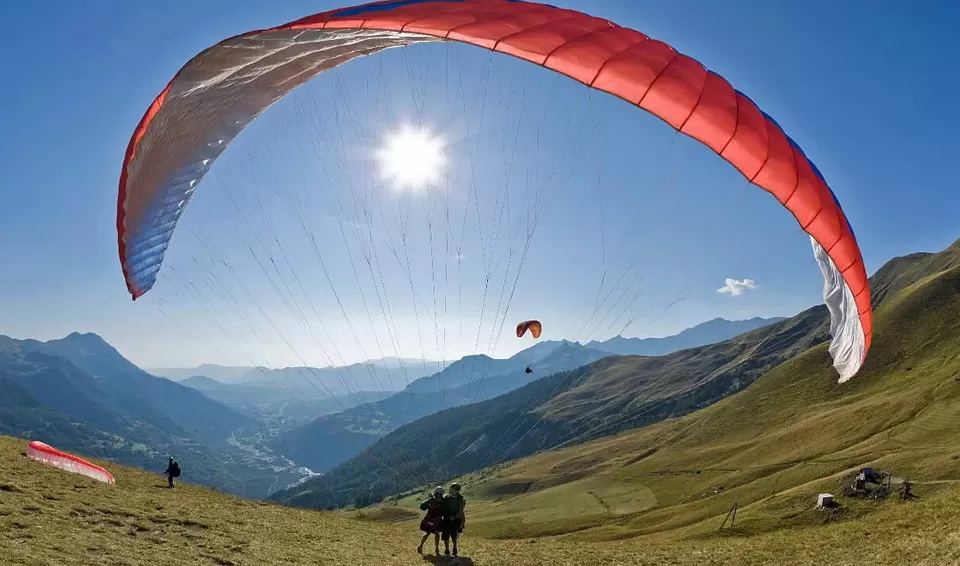
Tripura’s first paragliding centre was inaugurated in Vanghmun in 2022. The launch site gives tandem flights over the terraced valley with the Mizoram ranges as a backdrop. Best in the October–February dry season. Confirm availability with Tripura Tourism before planning around it.
5. Village Walks: Sabual & Phuldungsai
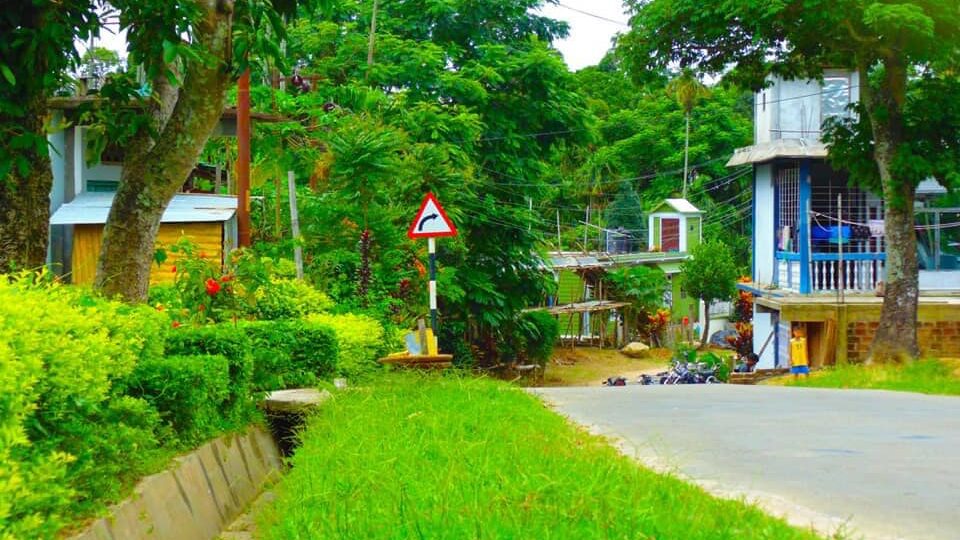
A few kilometres from Vanghmun, the smaller Mizo settlements of Sabual and Phuldungsai retain traditional wooden architecture — stilted homes of bamboo and timber surrounded by kitchen gardens. Walking between villages through forest paths is one of those Jampui experiences that resists the word “attraction” but stays with visitors longest. A local guide is recommended for navigation and cultural context.
Festival Calendar
- Orange & Tourism Festival (November): The signature annual event — organised by Tripura Tourism Development Corporation — combines the orange harvest with Cheraw bamboo dancing, tribal food stalls, and Mizo hospitality at its most generous. Book accommodation weeks in advance.
- Chapchar Kut (March): The oldest Mizo festival, celebrating the completion of communal land-clearing work. Five days of feasting, traditional games, and the Cheraw dance. The most important community event of the year.
- Chavang Kut (October/November): Post-harvest Mizo thanksgiving — quieter than Chapchar Kut, marked by communal feasting and traditional songs. Its overlap with the orange season gives it a particular abundance.
Mizo Cuisine in Vanghmun
The food here is rice-based, lightly spiced, and built around local herbs, bamboo shoots, and pork. It differs sharply from Bengali cooking and from the Tripuri tribal food of the plains.
- Bai — Boiled vegetables with pork, bamboo shoots, and herbs; the defining dish of Mizo cuisine
- Sawhchiar — Thick rice porridge cooked with pork or chicken; a one-pot festival staple
- Vawksa Rep — Smoked pork with herbs; the most requested dish at homestay tables
- Jampui oranges — Not a dish, but an experience; eaten fresh from roadside sellers in November, they are among the sweetest mandarins produced in India
Where to eat: The Eden Tourist Lodge dining room is the reliable option. MJ Homestay offers home-cooked Mizo meals at the family table — the most authentic way to eat in Vanghmun. During the Orange Festival, temporary food stalls around the festival grounds serve the full range of tribal food.
Where to Stay
- Eden Tourist Lodge — Government-run flagship property in Vanghmun; solar-heated water, valley views from the rooftop, helpful staff who can arrange guides. ₹1,500–₹3,000 approx.
- MJ Homestay — Well-regarded Mizo family homestay; home cooking and cultural immersion
- S.S. Homestay — Budget-friendly option popular with backpackers
- Local Mizo families (Paying Guest) — Informal accommodation across the hills; ask at Kanchanpur or contact the North Tripura district tourism office
How to Reach Vanghmun
By Air: Fly to Agartala (Maharaja Bir Bikram Airport), then hire a private vehicle — 6–7 hours via Dharmanagar and Kanchanpur.
By Train: Alight at Pecharthal (56 km), then arrange a vehicle. Kanchanpur (30 km from Vanghmun) is the most convenient staging town.
By Road: From Silchar: 5–6 hours via the Barak Valley and Dharmanagar. From Dharmanagar: approximately 75 km; the final 25 km from Kanchanpur is a single-lane jungle road — allow 1.5 hours. No reliable public transport operates on this stretch. A hired car or shared jeep to Mizoram is the only realistic option.
Best Time to Visit
- October to March: Best weather; oranges in season; festivals; clear skies for sunrise and Betlingchhip views
- March to May: Chapchar Kut; orchid season; warm, pre-monsoon green
- June to September: Heavy rain, possible landslides on the hill road; not recommended for first visits
- November is the single best month — the festival, the oranges, and the clearest skies of the year, all at once
Sample 3-Day Itinerary
Day 1 — Arrival & the Ridge: Reach Vanghmun by late afternoon; walk to the helipad ridge for sunset; dinner of Bai and Sawhchiar at the lodge.
Day 2 — Betlingchhip & the Orchards: Pre-dawn sunrise at the viewpoint; guided trek to Betlingchhip (3–4 hours return); afternoon orchard walk through the orange groves; evening stroll through Vanghmun’s immaculate lanes.
Day 3 — Village Walks & Departure: Morning walk to Sabual or Phuldungsai for traditional Mizo village life; return by midday and begin the descent to Kanchanpur.
