




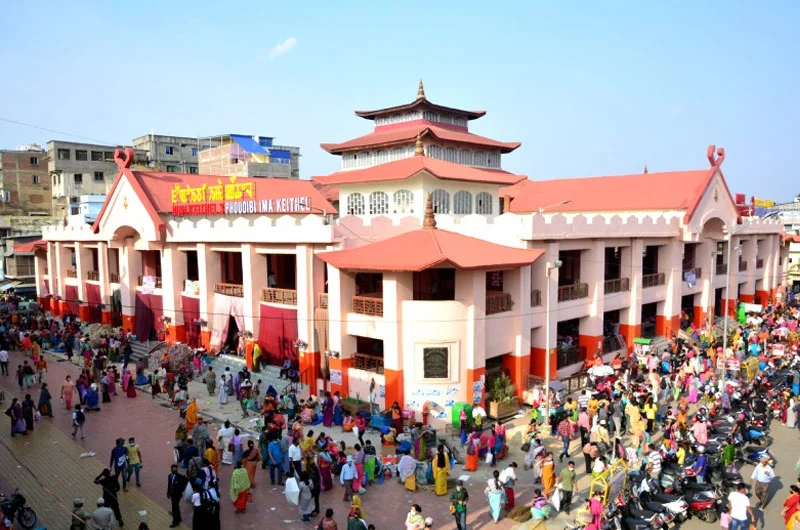
There is no market quite like Ima Keithel anywhere else in the world. Not because of its scale — though its scale is extraordinary, with over 5,000 women vendors across three market buildings in the heart of Imphal. Not because of the products — though the range, from handwoven Moirang Phee shawls and Phanek skirts to fresh Yongchak beans, ghost peppers, Ngari fermented fish, and traditional Meitei brass, is remarkable in its breadth and cultural specificity. What makes Ima Keithel singular is its governance: every single vendor here is a woman. Men may enter as customers, porters, guards, or to serve tea. They may not sell anything. This is not a modern feminist policy. It has been this way since 1533 CE.
Ima Keithel, meaning “Mothers’ Market” in Meitei, was established in the 16th century during the Kangleipak Kingdom. Its origins are linked to the Lallup-Kaba system, which often sent men away for military service and public works, leaving women to manage agriculture and trade. Over generations, they built one of India’s most distinctive marketplaces. The market later became a centre of political resistance and community finance through its long-running, interest-free micro-credit network. Its economic importance was underscored during the COVID-19 pandemic, when a ten-month closure reportedly caused losses exceeding ₹3,800 crore.
| Why Men Cannot Sell at Ima Keithel The prohibition on male vendors at Ima Keithel is a centuries-old tradition rooted in the Lallup-Kaba labour system, which often sent men away from their villages for long periods. Women established and sustained the market in their absence. Today, the tradition is upheld by the Ima Keithel Union and reinforced by a Government of Manipur directive that prohibits men from selling within the market premises. |
Quick Facts About Ima Keithel
| QUICK FACTS | IMA KEITHEL, IMPHAL, MANIPUR |
| State | Manipur |
| Location | Khwairamband Bazar, central Imphal |
| Established | 1533 CE — under the Kangleipak Kingdom; Lallup-Kaba origin |
| Vendors | Approximately 5,000–6,000 women vendors across three market buildings |
| Status | Asia’s largest all-women market; only all-women market of this scale in the world |
| Vendor Rules | Only married women may operate stalls; retiring vendors nominate a female successor |
| Male Entry | Permitted as customers, porters, guards, and tea servers only; male selling prohibited |
| Union | Ima Keithel Union — market governance, stall allocation, Marup credit system |
| Stall Fee | Approximately ₹40 per month per stall |
| ILP Required | Yes — Inner Line Permit required for all non-Manipur Indian residents |
The Origin — Lallup-Kaba and the Women Who Stayed
The Lallup-Kaba was a comprehensive corvée labour system imposed by the Meitei royal administration — one of the most institutionalised forms of state-directed forced labour in pre-modern Northeast India. Every male household head owed the king a fixed number of days of labour each year: fighting wars, building roads, constructing palaces, maintaining royal infrastructure. The system continued in various forms until 1892, meaning Meitei men were frequently absent from their villages for months or years at a stretch.
The women who remained were not passive in the face of this absence. They managed the agricultural cycle, maintained the community’s economic life, and created the market system that came to define commercial Imphal. Ima Keithel was not designed by a government planner or a social reformer. It grew from the daily necessity of women who needed to sell their surplus paddy and vegetables, and who built, across generations, the most distinctive marketplace in India.
The succession system that emerged is still intact today. When a vendor retires, she nominates a female successor — almost always a daughter or niece — to inherit her stall position. The ₹40 monthly fee has remained nominally unchanged for decades. Families maintain the same physical location across multiple generations, creating a direct material thread between the market’s present and its 16th-century origins.
The Three Market Buildings — What’s Where
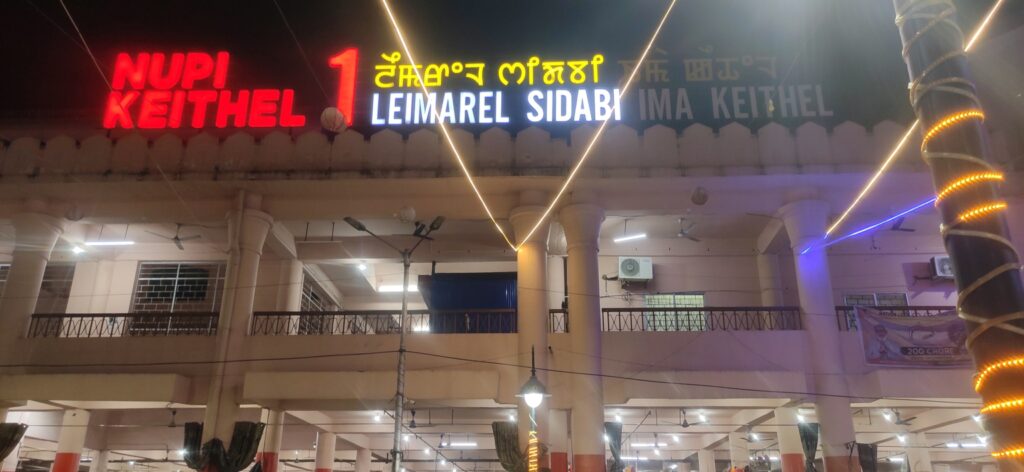
The Khwairamband Bazar complex is home to three distinct multi-storey market buildings, each with its own commercial identity. The buildings — commonly referred to as Nupi Keithel I, II, and III or informally as Market Block 1, 2, and 3 — were rebuilt and reopened in 2018 following damage from the 2016 Imphal earthquake, under the Municipal Administration, Housing and Urban Development (MAHUD) department.
Block 1 — Handlooms, Attire & Ceremonial Goods
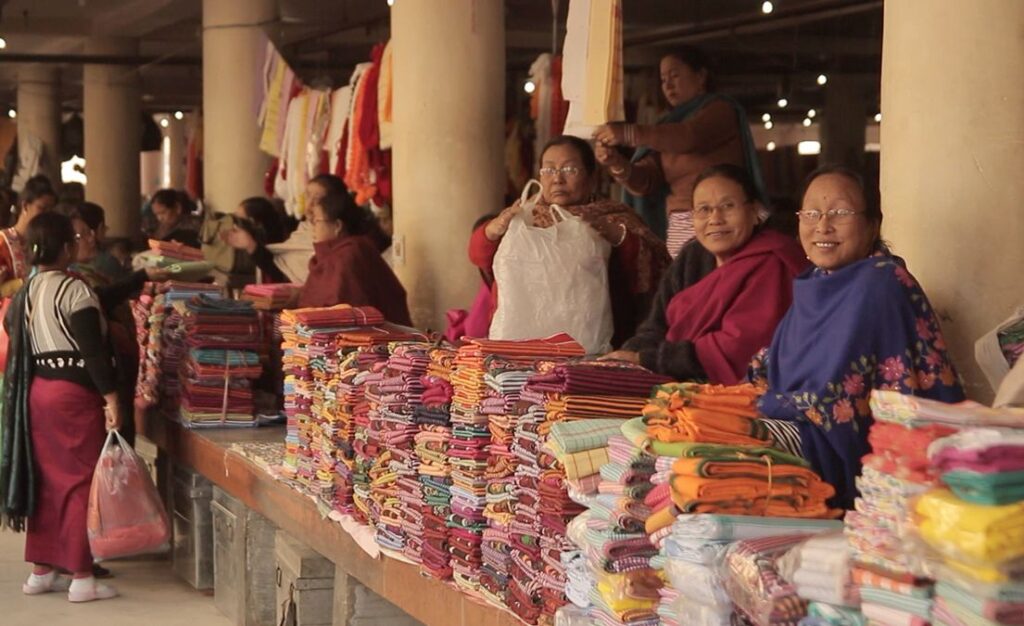
The first building is the textile heart of Ima Keithel. Here the weavers and cloth vendors are concentrated: Phanek (the traditional Meitei wrap-around skirt), Innaphi (the delicate sheer shawl), Mayek Naibi (Meitei script-patterned cloth), and the celebrated Moirang Phee — the geometric dark-red-and-black pattern that is the cultural signature textile of Manipur. This is also the block for ritual and ceremonial goods: items used in Meitei religious practice (Sanamahism), traditional jewellery, and handmade Meitei dolls. For serious textile buyers, Block 1 is the reason to come to Ima Keithel.
Block 2 — Produce, Herbs & the Ghost Pepper
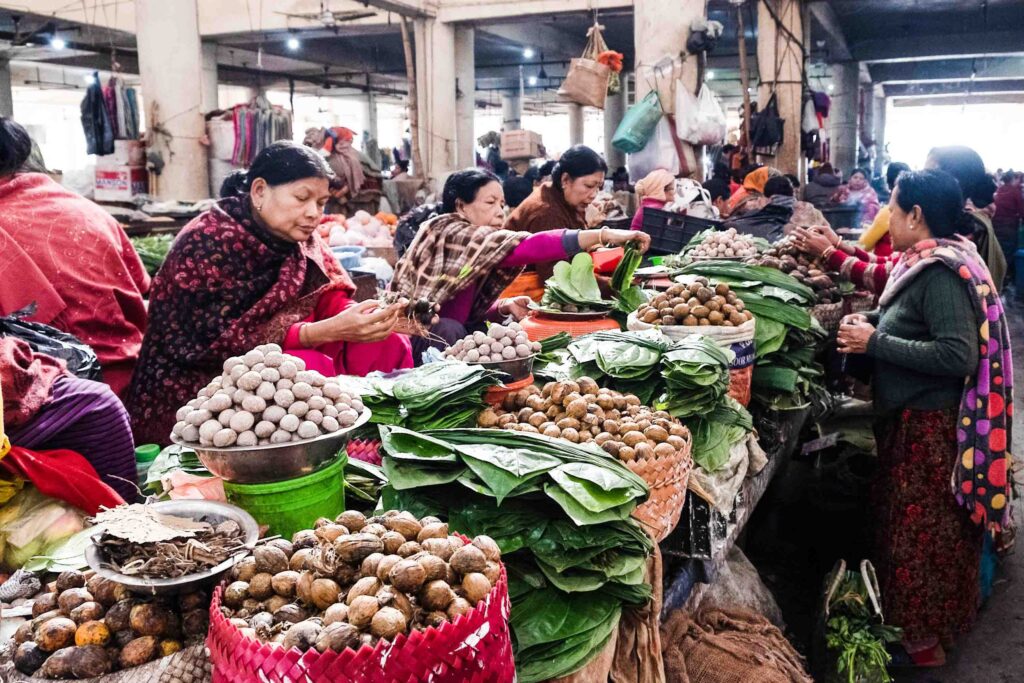
Block 2 is the produce and fresh goods building — Imphal’s kitchen in physical form. The stalls carry fresh local vegetables (including Yongchak tree beans, water hyacinth flower, and varieties of greens specific to the Manipur valley), indigenous herbs used in both Meitei cooking and traditional medicine, bamboo shoot preparations in fresh, fermented and dried forms, pure local honey, and — most famously — Raja Mircha, the Bhoot Jolokia or ghost pepper, sold fresh, dried, or pickled. This is one of the hottest chillies in the world by Scoville measurement and one of the most searched food products associated with the market.
Block 3 — Brass, Ngari & Wicker
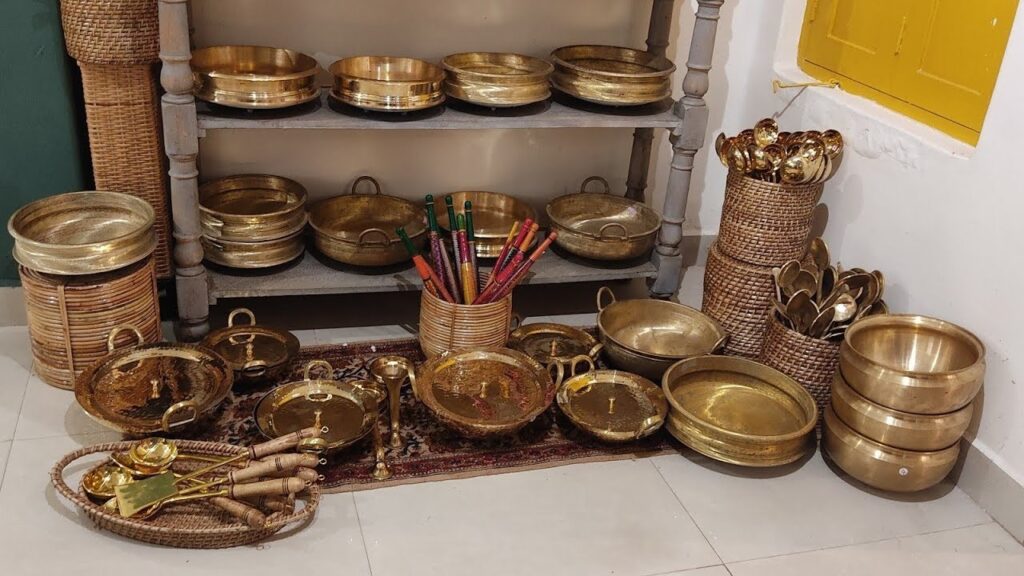
Block 3 houses dry goods, crafts, and the market’s most pungent commodity: Ngari. The traditional Meitei brass items — bowls, ritual vessels, decorative pieces — are made in forms that have not fundamentally changed for centuries. The dry fish section carries multiple varieties, of which Ngari (semi-dried fermented fish) is the most culturally significant: it is the foundational flavouring of Meitei cuisine, added to eromba, kanghou, and singju in quantities that a non-Manipuri cook might find alarming and that any serious cook of local food will understand as essential. Local wicker basketry in traditional weave patterns completes the block — functional craft at its most direct.
The Marup — The Ima Keithel Credit Union
Beyond its commercial role, Ima Keithel operates an informal financial institution that has served its vendors for generations: the Marup. A Marup is a traditional rotating savings and credit association — a system where members contribute a fixed sum at regular intervals and each member in turn receives the pooled amount. It is, in financial terminology, a Rotating Savings and Credit Association (ROSCA), but the Ima Keithel version carries social and trust dimensions that purely formal financial products cannot replicate.
Managed through the Ima Keithel Union, the Marup provides vendors with access to capital for business investment, family emergencies, and ceremonial expenses — all without interest charges and without the documentation requirements that exclude most informal market vendors from formal banking. A woman who has run the same stall for 30 years has a credit history and a trust network within the Marup that no bank statement can easily capture. The system is the financial backbone of thousands of households across Imphal, operating invisibly to the city’s visitors but fundamental to the economic reality of the women who make the market function.
| The Marup at Ima Keithel is one of the most durable examples of indigenous women-run financial infrastructure in India — a functioning micro-credit system that predates microfinance as a formal development concept by several centuries. Its operation on a foundation of community trust rather than collateral is not a limitation of the system. It is the system’s defining strength. |
The Nupi Lal — The Women’s Wars
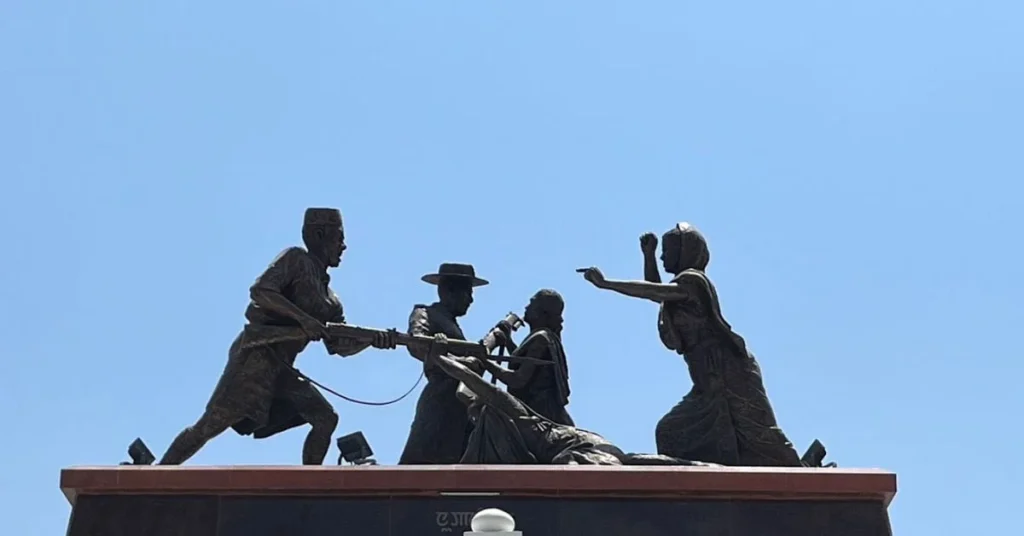
Nupi Lal of 1904
The first Nupi Lal was a protest against British administration construction projects that diverted Meitei male labour away from the paddy fields at a critical agricultural moment. Over 5,000 women, coordinating from the Ima Keithel, rallied successfully against the policy and halted the project. The protest established, for the first time in the historical record, that the market was not merely a place of commerce but a platform for organised collective political action.
Nupi Lal of 1939
The second Nupi Lal remains one of the most effective women-led political movements in India’s colonial history. In 1939, the British administration began exporting Manipur’s locally grown rice to feed military battalions, creating food shortages for the local population. When administrators subsequently proposed selling the Ima Keithel buildings to outside traders — partly to neutralise the vendors’ political power — the market women refused absolutely. The market was not merely a building. It was their identity, their livelihood, and 400 years of their community’s economic independence.
The resulting protests, marches, and blockades lasted months and drew women from across the state. The British eventually conceded on the rice export — a significant retreat from an administration accustomed to dismissing indigenous demands. The Nupi Lal of 1939 is taught in Manipuri schools as a foundational event in the state’s resistance to colonial rule.
| The COVID Closure: ₹3,879 Crore Lost Ima Keithel remained closed for ten months during the COVID-19 pandemic. Media reports citing independent estimates put the economic loss at ₹3,879 crore, underscoring the market’s importance to Imphal’s economy. When it reopened in 2021, many long-time vendors described the shutdown as the most severe disruption they had ever experienced. |
What to Buy — Local Produce & Goods Glossary
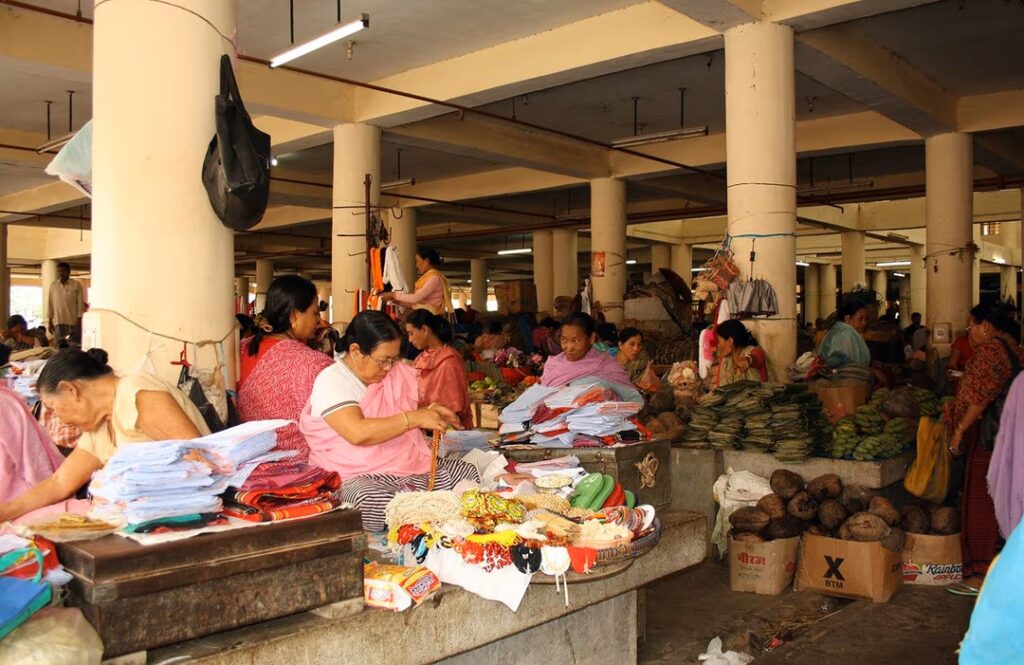
The items below are among the most searched and most distinctive goods available at Ima Keithel. Many are specific to Manipur’s valley and are difficult or impossible to find outside the state in authentic form.
| Local Item | Type / Category | What It Is & Why It Is Distinctive |
| Phanek & Innaphi | Handloom Textile | Traditional Meitei wrap-around skirt (Phanek) and sheer shawl (Innaphi). The Imas wear these daily — they are the living model for the market’s own product. |
| Moirang Phee | Handloom Textile | Manipur’s most distinctive weave: geometric patterns in dark red, black, and white. Considered the cultural signature textile of the state. Made on traditional handlooms by Meitei weavers. |
| Mayek Naibi cloth | Handloom Textile | Fabric incorporating Meitei script characters into the weave pattern — a textile and a written language simultaneously. |
| Ngari | Local Delicacy / Spice | Semi-dried fermented fish; the cornerstone flavouring ingredient of Meitei cuisine. Added to eromba, singju, and kanghou. The smell is powerful; the culinary effect is irreplaceable. |
| Yongchak | Fresh Produce | Tree bean (Parkia speciosa), also called stink bean; highly prized in Manipuri winter salads and stir-fries. Strong, distinctive flavour; unavailable in most Indian markets outside the Northeast. |
| Raja Mircha | Spice / Chilli | Bhoot Jolokia (Ghost Pepper) — one of the world’s hottest chillies by Scoville measure. Sold fresh, dried, or pickled. Handle with respect; do not rub your eyes. |
| Traditional brass items | Craft / Kitchenware | Meitei brass vessels and bowls in forms unchanged for centuries. Used in daily cooking and religious ritual. Block 3. |
| Longpi pottery | Craft | Black stone pottery from Ukhrul district; made without a wheel using a unique clay-and-serpentinite paste. The only pottery tradition of its kind in India. |
| Local honey | Food | Pure unfiltered honey from Manipur valley producers. Block 2 produce stalls. |
| Handmade Meitei dolls | Craft / Souvenir | Traditional cloth dolls in Phanek and Innaphi attire — one of the most culturally specific souvenirs available in Manipur. |
Bargaining Culture & Visitor Etiquette
Ima Keithel is an active commercial space run by working women, not a tourist attraction managed for visitor experience. Understanding how to engage respectfully makes the visit better for everyone — and ensures the market’s social fabric remains intact for the next visitor and the next generation of vendors.
Friendly bargaining is a normal part of the market culture, but aggressive haggling is discouraged. Many vendors come from families that have traded here for generations, and their prices often reflect the time and skill involved in producing their goods. If you photograph a stall, it is courteous to make a small purchase. Supporting vendors helps sustain this 500-year-old market and the community that depends on it.
- Arrive between 7 AM and 11 AM for peak activity, freshest produce, and best natural light
- Ask before photographing individual vendors — most will agree readily, but the courtesy matters
- The Imas often speak limited English; gestures, smiles, and a willingness to browse patiently go further than language
- Bring cash — card payments are not standard across most stalls
- Dress modestly; the market is also a community and religious gathering space for many vendors
Inner Line Permit (ILP) — Essential Information
An Inner Line Permit is required for all Indian nationals visiting the state. Foreign nationals require a Protected Area Permit (PAP).
How to Apply
- Online at Manipur Inner Line Permit (ILP)
- At Manipur House offices in Delhi, Kolkata, and Guwahati
- At border entry points (Jiribam and Mao Gate) — though advance application is strongly recommended
For full permit details, visit the Travel Permits guide on NorthEast India Connect.
How to Reach & Best Time to Visit
Getting There
- From Kangla Fort: walking distance — Kangla Fort, Ima Keithel, and Govindajee Temple form the cultural heart of central Imphal within a 10-minute walk
- From anywhere in Imphal: any auto-rickshaw driver will know Ima Keithel immediately; it is the city’s most recognisable landmark
- From Imphal Airport: approximately 8–10 km by auto or taxi; 20–25 minutes
Best Time
- October to March: best weather; market at full activity; festival season (Ras Leela, Yaoshang)
- 7 AM to 11 AM: peak market energy; freshest produce; best photography light
- Avoid Sundays and Mondays (reduced activity); and peak festival days when some vendors close
%20Imphal:%20Asia’s%20Largest%20All-Women%20Market)