




Picture drifting down a narrow river in a small motorboat, dense forest closing in from both banks, with barely another soul in sight — and then looking up to find a twenty-foot goddess carved directly into a sheer rock cliff, staring back at you from five centuries ago. That’s Chabimura, tucked into the Gomati district of South Tripura, and it remains one of the most genuinely under-the-radar heritage sites anywhere in Northeast India. If you’ve been exploring our coverage of Sikkim, Nagaland, and Meghalaya and wondering what Tripura has to offer that isn’t a palace or a temple queue, this is it.
Quick Facts About Chabimura
| Location | Gomati district, near Amarpur, South Tripura |
|---|---|
| Also Known As | Chabimura, Chobimura, Chakwrakma, or Devtamura |
| River | Gomati (Gumti) River |
| Distance from Agartala | ~80-82 km (3-4 hours by road) |
| Distance from Udaipur | ~30 km |
| Distance from Amarpur | ~7.5-12 km |
| Carvings Date | 15th-16th century |
| Number of Panels | 4 major panels; up to 37 individual carved images documented |
| Largest Carving | Mahishasurmardini Durga, approximately 10.7 m high, 7.7 m wide |
| Boat Charge | Approx. ₹100-200 per person, or ₹1,000-1,500 for a private boat |
| Best Time to Visit | October to March (winter) |
What Is Chabimura, Exactly?
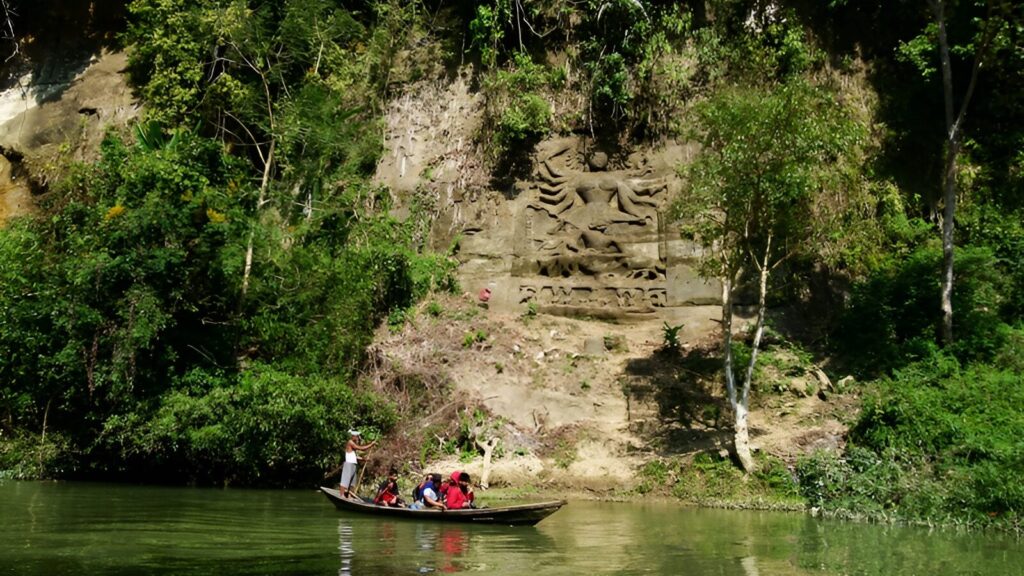
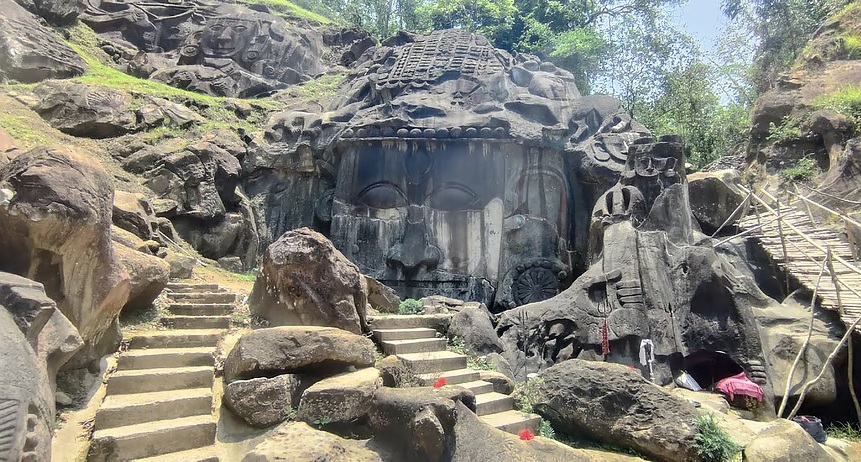
Chabimura, whose name literally translates to “mountain of pictures,” is a series of rock-cut panels carved into the near-vertical cliff face of the Devtamura Hills, directly above the Gomati River. According to Wikipedia’s entry on the site, the carvings depict Shiva, Vishnu, Kartikeya, and a monumental image of Mahishasurmardini Durga, and are dated to the 15th and 16th centuries.
The single most striking image here is the enormous Durga carving, worshipped locally as Chakrak-ma. Tripura’s own tourism department describes her as roughly 10.7 metres tall and 7.7 metres wide, ten-armed, with dishevelled hair rendered in a distinctive round-faced style, carved at a height of about 10 metres above the riverbed. Weathering and floral growth have blurred some of the detail on her weapons over the centuries, but the scale of the work is still striking from the water.
The River Journey: Why You Can Only Reach Chabimura by Boat
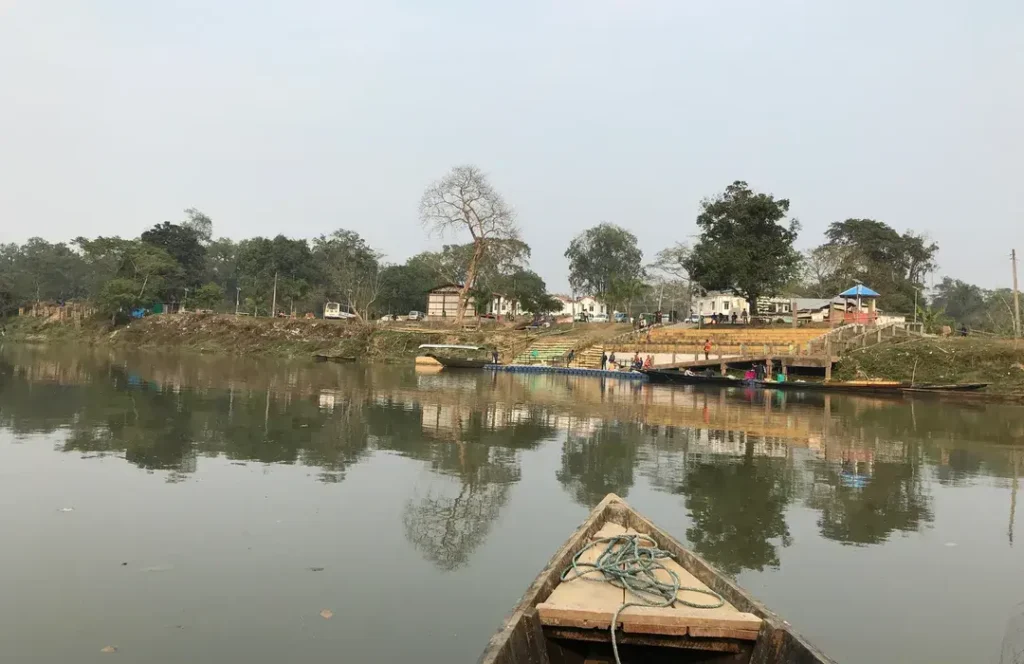
This is what makes Chabimura genuinely unlike most heritage sites in India: there’s no road, no footpath, and no viewing platform. The cliff faces drop almost straight into the river, and the surrounding hills are thick with forest, so the only way to actually see the carvings is by boat.
Visitors typically set off from a boarding point locally known as Rangamati, near Amarpur, and drift downstream through a narrow gorge with steep, forested hills rising on both sides. Multiple independent travel accounts consistently compare the ride to navigating the Amazon rainforest — not for its scale, but for the sensation of gliding through dense, closed-in jungle with almost no other tourists in sight. The boat typically takes 40 minutes to over an hour, depending on the route and number of stops, and often pauses partway at a set of caves locally called “Swarger Daar,” or the Path to Heaven, tied to local legends about a historical ruler and his treasure.
Boat charges vary depending on group size and whether you book a shared or private boat — expect somewhere between ₹100 and ₹200 per person for a shared motorboat, or ₹1,000 to ₹1,500 to hire one privately, which is worth it if you’d rather not wait for a boat to fill up. A local guide, generally available at the boarding point, adds real value here, since the site has no signage explaining what you’re looking at.
The Legend Behind the Carvings
Chabimura doesn’t come with one single origin story, but the most repeated local legend ties the carvings to a tribal ruler, said to be the grandfather of the celebrated Maharaja Chichingfa, who reigned over the Burtiari area in the 15th or 16th century. After a string of military defeats, he is said to have turned to worship of Mahishasurmardini, commissioning her image as Chakrak-ma directly into the cliff face in gratitude or supplication. It’s a legend rather than documented history, and locals themselves will tell you as much — Chabimura’s real draw isn’t a tidy historical record, it’s the sheer improbability of finding carvings this scale in a place this remote.
Chabimura vs Unakoti: Tripura’s Two Rock-Carving Sites
Tripura actually has two major rock-carving destinations, and they couldn’t be more different in how you experience them.
| Site | Age | How You View It | Setting |
|---|---|---|---|
| Chabimura | 15th-16th century | By boat only, along the Gomati River | Remote river gorge, dense forest |
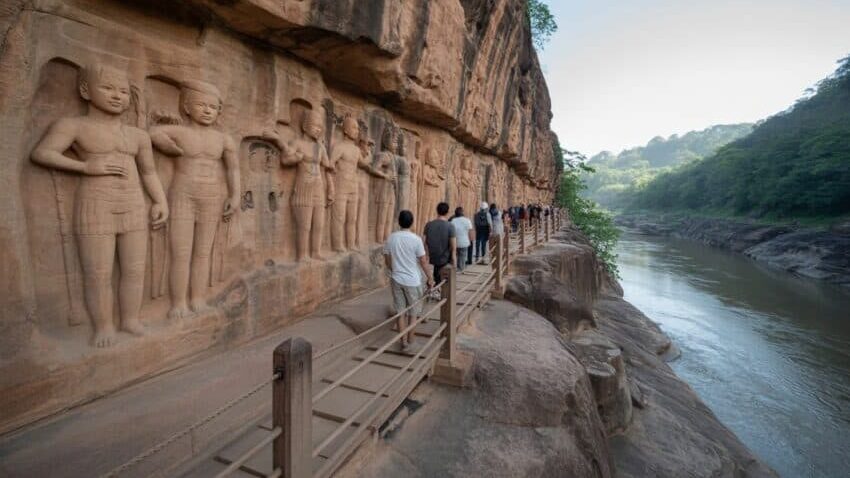
| Unakoti | 7th-9th century | On foot, walking trail through hillside | Accessible hillside site near Kailashahar |
Unakoti is older, better documented, and easier to reach on foot; Chabimura is younger but arguably more atmospheric, precisely because reaching it requires the boat journey through the gorge. If your itinerary allows for both, they make for a genuinely comprehensive picture of Tripura’s rock-art heritage — but Chabimura is the one you can’t casually stumble into without proper planning.
Wildlife and Natural Surroundings
Beyond the carvings themselves, Chabimura’s forested gorge is a legitimate draw for nature enthusiasts. The Devtamura hills support a healthy population of birdlife, making the area genuinely interesting for ornithologists, and multiple visitors have reported sightings of spectacled monkeys along the riverbanks during the boat ride. The dense, largely undisturbed forest cover on both sides of the Gomati gives the whole excursion an ecotourism character as much as a heritage one.
Best Time to Visit Chabimura
Winter, from October through March, is unambiguously the best window. Water levels are manageable, the boat ride is calmer, and daytime temperatures are comfortable for the return road trip. Summer months from March to May can push temperatures past 32°C, though the river breeze offers some relief during the boat ride itself. The monsoon season, June through September, turns the Gomati’s current considerably stronger and can make both the river crossing and the approach roads more difficult — best avoided unless you’re specifically chasing the lush post-monsoon greenery and are travelling with an experienced local guide.
How to Reach Chabimura
- Drive from Agartala to Udaipur, Tripura’s former capital and now Gomati district’s biggest town, a journey most travellers combine with a stop at the revered Tripura Sundari Temple at Matabari, which sits conveniently on the route.
- Continue from Udaipur to Amarpur, roughly 26-30 km further along the state highway.
- Take the village road from Amarpur to Deb Bari, about 7.5-12 km, where the Rangamati boat point marks the actual start of the Chabimura experience.
- Hire a boat at the boarding point. There’s no advance online booking — arrangements are made on arrival with local boat operators, ideally with a guide who knows the panels and the safe stopping points.
The full one-way drive from Agartala takes roughly 3 to 4 hours depending on road conditions, so most visitors treat Chabimura as a full-day excursion from Agartala or a half-day trip if based in Udaipur or Amarpur overnight. No Inner Line Permit is required to visit Tripura, unlike several neighbouring states — see our Northeast India travel permits guide if you’re planning a wider regional trip.
Where to Stay and What to Know Before You Go
Chabimura itself has no overnight accommodation — a scattering of Tripura Tourism-run cottages near the boat point can be rented by the hour for changing or resting, but nobody stays there after dark. Amarpur has a couple of basic hotels, including the Sagarika Parjatan Niwas run by Tripura Tourism, while Agartala offers the widest range of comfortable accommodation if you’d rather do Chabimura as a long day trip.
A few honest practicalities worth knowing:
- Carry your own food and water. Facilities at the site are minimal, and the few local eateries operate inconsistently.
- Mobile network is unreliable once you’re past Amarpur, so download offline maps and inform someone of your plan beforehand.
- Cash is essential — card and digital payments are not dependable this far out.
- Wear shoes you don’t mind removing. Some boatmen ask visitors to leave footwear behind before the short, slippery walk to the caves.
- Avoid touching or climbing the carvings, both out of respect and because the rock faces are genuinely fragile after centuries of erosion.
- Sundays draw the largest crowds, so a weekday visit gets you a quieter, more private boat ride.
Frequently Asked Questions About Chabimura
Can I visit Chabimura without a guide? Technically yes, but it’s not advisable — the site has no signage, boat operators know exactly where each panel is visible from the water, and getting lost in the surrounding forest is a genuine risk without local knowledge.
Is Chabimura suitable for a day trip from Agartala? Yes, it’s the most common way to visit, though it makes for a long day — budget 7-8 hours round trip including the boat ride itself.
Are the rock carvings still actively worshipped? Yes, particularly the large Durga panel, known locally as Chakrak-ma, which continues to hold religious significance for communities in the area.
Final Thoughts
Chabimura rewards exactly the kind of traveller who doesn’t need polished infrastructure to be impressed — a five-century-old goddess carved into a cliff, reachable only by a slow boat through genuinely wild forest, with almost nobody else around to share the moment with. Go before the “massive tourist transformation” that Tripura’s tourism department has been hinting at for years actually arrives.
For more on this part of Northeast India, browse our Northeast India tourism guide or check our Northeast India travel permits guide before planning a longer regional itinerary.
