




Every June, something extraordinary unfolds on Nilachal Hill in Guwahati. Sadhus who have wandered the forests for months descend to the city. Pilgrims board trains from across India, some travelling for two or three days. The air fills with incense, chanting, and the kind of charged atmosphere you only feel when millions of people believe they are standing on sacred ground. This is the Ambubachi Mela — one of the most spiritually significant festivals in all of India, and the beating heart of Northeast India’s sacred calendar.
Often called the “Mahakumbh of the East,” the Ambubachi Mela runs from the night of June 22 to sunrise on June 26 at the Kamakhya Temple, Guwahati. What sets it apart from every other religious gathering in the country is its central act: venerating the annual menstrual cycle of the goddess as a cosmic, divine event — turning what is treated as taboo in much of India into a public celebration of womanhood and creative power.
⚠️ Critical 2026 Booking Update: Do not rely on older travel guides that say you can buy Special Darshan passes at the hill. Effective June 15, 2026, all offline counter bookings for Special Darshan Tickets have been completely discontinued by temple authorities. If you do not secure a slot on mkdonline.co.in before arriving, you will stand in the general queue — which on reopening day routinely stretches to 6–10 hours of waiting.
Quick Facts: Ambubachi Mela
| Detail | Information |
|---|---|
| Event | Ambubachi Mela |
| Location | Kamakhya Temple, Nilachal Hill, Guwahati, Assam |
| Assamese Month | 7th day of Ahaar |
| Expected Footfall | 25+ lakh devotees |
| Also Known As | “Mahakumbh of the East”; locally as “Ameti” or “Amoti” |
| Special Darshan Booking | Online only via mkdonline.co.in (from June 15, 2026) |
Understanding the Kamakhya Temple: Why There Is No Idol Inside
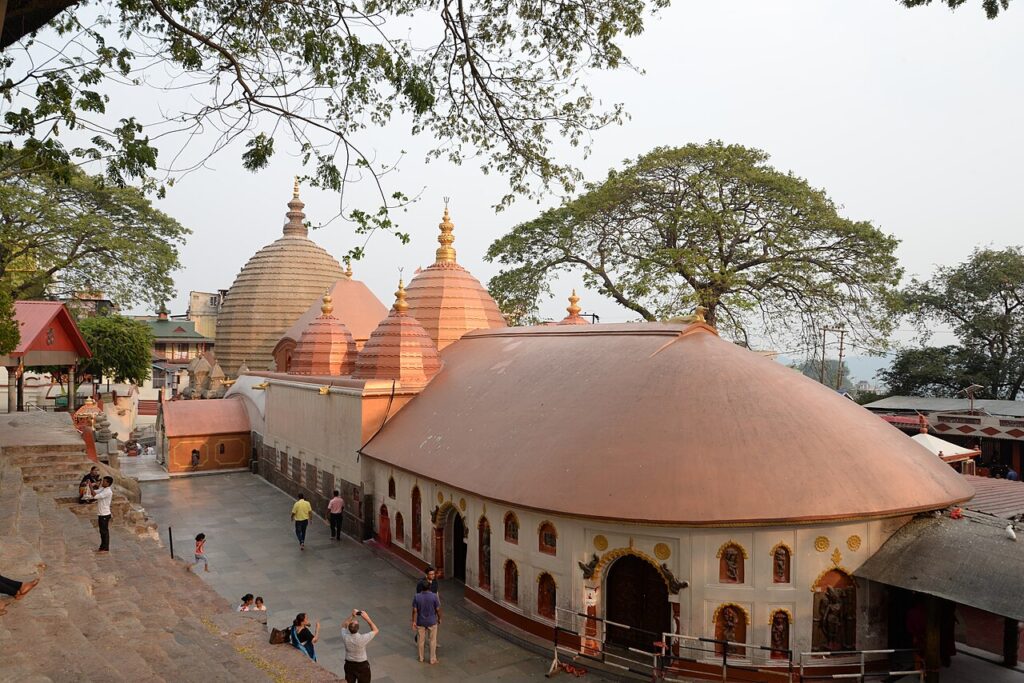
Before understanding the Ambubachi Mela, you need to understand the temple at its centre — because Kamakhya is unlike any other temple you have visited.
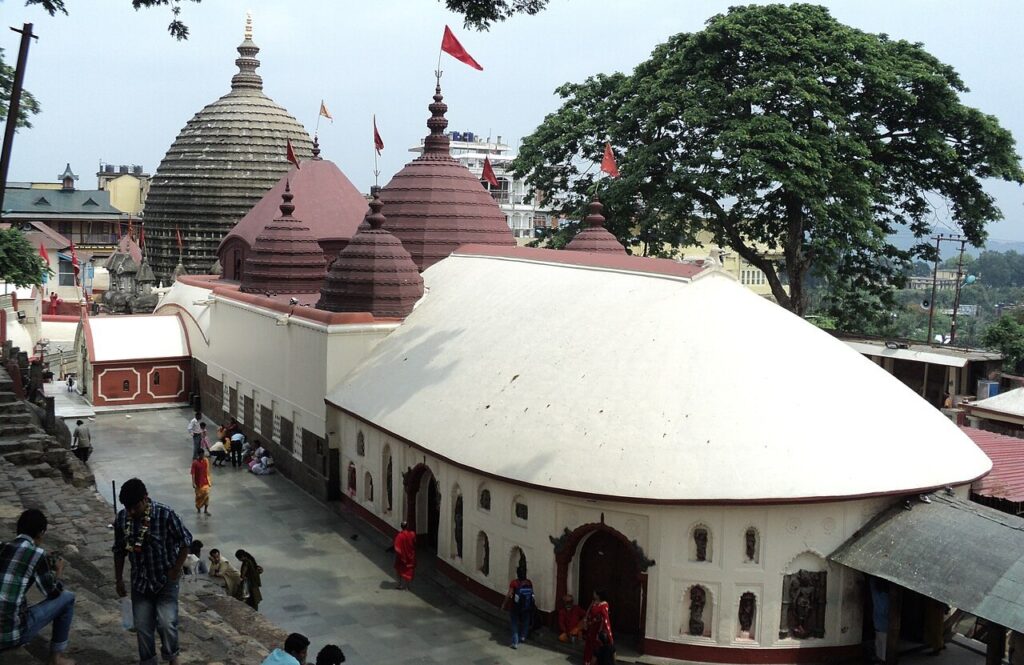
The Kamakhya Temple sits atop Nilachal Hill, approximately 8 kilometres west of Guwahati city, overlooking the Brahmaputra River. It is one of the 51 Shakti Peethas — the most sacred sites in the Shakta tradition of Hinduism — and it holds a distinction found nowhere else: there is no idol inside the sanctum. Devotees descend into a cave-like garbhagriha (inner chamber) to worship a natural yoni-shaped rock formation perpetually fed by an underground spring. This is the Yoni Peetha of Maa Sati, the spot where the yoni of Goddess Sati is believed to have fallen to earth according to the legend of Daksha’s yagna and Shiva’s grief.
The present structure was rebuilt in the 16th century by Koch King Nara Narayana and later expanded by the Ahom rulers. The temple complex also houses shrines to the ten Mahavidyas — the ten tantric forms of the divine feminine — making Kamakhya one of the most theologically layered Shakta centres anywhere in Asia. This tantric lineage is precisely why the Ambubachi Mela carries the spiritual intensity it does. The entire year’s worth of tantric sadhana on Nilachal Hill builds toward this one convergence point.
Ambubachi Mela: Dates and the Ritual Calendar
The word “Ambubachi” comes from “Ambu” (water) and “Bachi” (flowing) — a reference both to the monsoon timing and to the underground spring inside the sanctum that symbolically flows during the festival. Ambubachi Mela marks the moment Goddess Kamakhya is believed to enter her annual menstrual phase, corresponding to the 7th day of the Assamese month of Ahaar.
Understanding the festival’s two-phase structure is essential before you book anything.
Pravritti: What Happens When the Temple Gates Close?
The Pravritti — the sacred closure — begins on the evening of June 22. The temple gates are shut to devotees. The garbhagriha is sealed. No public worship, no darshan, no ritual offerings. The Garbhagriha is believed to flood naturally with spring water during these three days, symbolising the goddess’s menstrual flow. In a gesture of spiritual solidarity, many devotees also observe a pause in everyday activities — farming, cooking, trading — during this period.
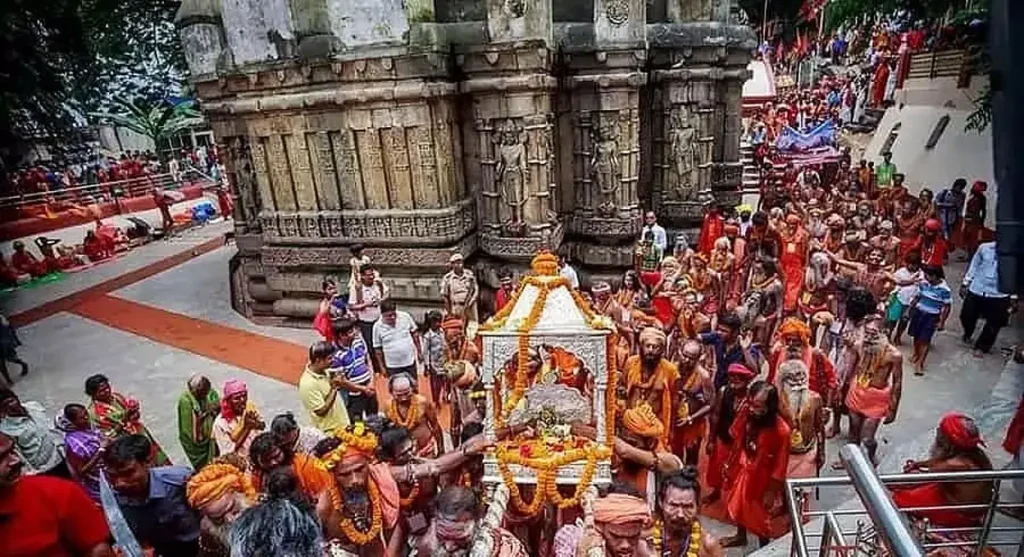
What happens on the hill during the closure is, in many ways, the most remarkable part of Ambubachi Mela. Tantric practitioners and sadhus who have spent months in solitary practice in remote forests and hills emerge and converge on Nilachal. Aghoris, Naga sadhus, and practitioners of various tantric lineages conduct rituals and sadhanas that are rarely visible anywhere else in the world. For many spiritual seekers — and curious travellers — arriving during Pravritti rather than on reopening day offers a more concentrated, authentic experience, precisely because the crowds are thinner and the atmosphere is wholly devotional.
Nivritti: The Reopening Rituals and Rakta Bastra Prasad
On June 26 at sunrise, the temple reopens with the Nivritti ceremony. After a ceremonial bathing of the sanctum, Vedic chants, and aarti, the doors open and the first darshan of the new cycle begins. This is the moment the entire mela builds toward, and the crowds reflect it — reopening day draws the heaviest footfall, with lakhs of devotees waiting overnight for the first glimpse of the goddess.
The prasad distributed on this day is unique and intensely sought after. The Angodak — water from inside the sanctum during the closed period — is believed to carry concentrated divine blessing. The Angavastra or Rakta Bastra, a red cloth that has rested inside the garbhagriha throughout the closure, is considered even more precious. Because demand vastly exceeds supply, the Rakta Bastra is not available at standard stalls. It is distributed through designated queues managed by the Kamakhya Bordeuri Samaj, the priestly coalition that oversees temple rituals — which means you cannot simply purchase it or obtain it informally. Being patient, joining the designated queue early, and following the directions of Bordeuri Samaj members is the only way.
What Makes Ambubachi Mela Spiritually Singular
In a country where menstruation continues to be surrounded by stigma — where women are regularly excluded from religious spaces during their cycle — Kamakhya Temple stands as a counterpoint that is centuries old. The three-day closure of the temple is not an act of exclusion but of reverence. The goddess herself is menstruating, and the entire community’s response is collective stillness and devotion, not taboo.
Ambubachi Mela draws not just general pilgrims but also some of the most revered Tantric masters in India, for whom this period is when the Shakti energy of the site is at its annual peak. The atmosphere during the convergence of 25+ lakh devotees, ascetics, and sadhus on Nilachal Hill is something that resists description — it has to be experienced. As one consistent observation from past visitors puts it, the air itself feels different on that hill during those four days.
Mandatory Online Booking: How to Secure Your Kamakhya Special Darshan Ticket
This is the section that could save you from a genuinely miserable experience on reopening day.
From June 15, 2026, the temple authorities — the Doloi of Maa Kamakhya Devalaya — have completely discontinued offline counter booking for Special Darshan Tickets. Every pass must now be booked through the official portal at mkdonline.co.in. This change was announced by public notice on June 10, 2026, citing the increasing daily rush at the temple.
Here is what you need to know:
- Special Darshan passes cost ₹501 per person and typically reduce your wait from 6–10 hours (general queue) to around 30–60 minutes
- Slots during Ambubachi peak days, especially June 26, fill within hours of opening — check the portal early in the morning for newly released slots due to cancellations
- Carry your e-ticket and a valid government photo ID; temple security will verify both
- Note that Special Darshan booking is not available during the three closed days (June 22–25) and resumes from June 26
To avoid scams: the official booking portal is mkdonline.co.in. The temple has also issued a public warning about third-party websites and apps offering online pujas in the name of Maa Kamakhya Devalaya and soliciting large sums. Use only the official channel.
Foothill to Peak: Navigating the New Pandu Access Route
Getting to the temple during Ambubachi Mela is a journey in itself, and understanding Guwahati’s geography makes it far less stressful.
Historically, virtually all 25+ lakh pilgrims funnelled up a single narrow corridor — the Maligaon/Nursery route — creating the kind of bottleneck that turns a 2-kilometre walk into a 3-hour ordeal. In 2026, authorities opened a second access route from the Pandu side, utilising the northern cliff face of Nilachal Hill. This disperses the massive footfall more evenly across the hill geography and is particularly useful for pilgrims arriving from the Kamakhya Railway Station and transit camps at Old Pandu Railway Station and Pandu Port.
Key ground logistics:
- Vehicles cannot proceed beyond Bongshi Bagan toward the temple on peak mela days — all devotees walk the final stretch (typically 20–40 minutes depending on crowd density)
- Parking is available at Adabari Bus Stand, Boripara Field, ASTC Machkhowa, and Sonaram High School Field — plan to use these designated zones, not roadside spots (strictly prohibited)
- City buses from Jalukbari drop passengers at Biswakarma Mandir; those from Bharalumukh drop at Boripara Field
- The Nilachal Flyover and its surroundings are declared no-parking zones throughout the Ambubachi Mela period
On footwear: This is a detail most guides skip, but it matters enormously on peak days. The queue to deposit footwear at official counters alone can take over an hour. The asphalt path up the hill, wet from monsoon rain and blazing from morning sun in alternation, is punishing barefoot. Carry a small, waterproof drawstring bag to keep your footwear with you if security checkpoints permit it on arrival — confirm this on the day, as policy can vary.
The Shanti Shibir Transit Camps
The Assam Government and the Kamrup Metro district administration set up several large transit camps (Shanti Shibirs) to support the enormous influx of pilgrims. Based on arrangements from recent editions, these have been located at:
- Kamakhya Railway Station premises
- Old Pandu Railway Station
- Sonaram Field
- Nahorbari Camp
- Bangshi Bagan Camp
Each camp includes free drinking water stations, basic medical units staffed by government health teams, and food distribution through bhandaras (community kitchens). ASTC buses operate dedicated services ferrying pilgrims between these camps and the temple foothills throughout the day and into the night. For senior citizens, women, and physically challenged devotees, these shuttle services are the most reliable and least exhausting way to reach the hill.
How to Reach Guwahati for Ambubachi Mela
By Air: Lokpriya Gopinath Bordoloi International Airport (LGBI) is approximately 20 km from Nilachal Hill. During Ambubachi Mela, traffic around Guwahati intensifies significantly — factor in 60–90 minutes for the airport-to-temple journey. Prepaid taxis are available at the airport; book accommodation before you land.
By Train: Guwahati Railway Station is well connected to major cities across India. Kamakhya Railway Station is the closer option for the temple and connects directly to the transit camps. Book train tickets months in advance — berths sell out entirely for the June 22–26 window.
By Road: Guwahati is accessible via NH27. During peak mela days, traffic restrictions are enforced on DG Road, MG Road, and AT Road. Check the Kamrup Metro district administration’s traffic advisory — typically released 3–4 days before Ambubachi Mela begins — for the most current diversion details.
Where to Stay in Guwahati During Ambubachi
Accommodation in Guwahati during Ambubachi Mela needs to be booked 2–3 months in advance at minimum. Every budget category fills up, from dharamshalas near Kamakhya Railway Station to mid-range hotels in the city centre. Options to consider:
- Near Kamakhya Railway Station: Best proximity to the temple, though basic in most cases
- Paltan Bazaar / GS Road (city centre): Wider range of options; 8–15 km from the temple
- Fancy Bazaar and Pan Bazaar: Mid-range options, well-connected by city buses
June in Guwahati is monsoon season — humid, warm, and intermittently rainy. Pack light, breathable clothing, a compact rain jacket, and a reusable water bottle. The queues during Ambubachi Mela are long, and the sun is unforgiving in the breaks between rain.
Assam Monsoon Spiritual Circuit: Beyond Nilachal Hill
Attending the Ambubachi Mela in late June places you in Assam at one of its most beautiful moments — the hills lush and green from the early monsoon, the Brahmaputra swollen and dramatic, the air washed clean. It would be a waste to leave immediately after Ambubachi Mela. Consider extending your trip into a broader Assam spiritual and heritage circuit:
Sivasagar (2 hrs east of Guwahati): The cultural heart of Ahom Assam. The Sivadol, Rang Ghar, and Kareng Ghar together form one of the most impressive concentrations of historical monuments in Northeast India — and just 25 km further lies Charaideo, home to the Moidams, Assam’s UNESCO World Heritage Site. The rolling hills of upper Assam in monsoon light are as striking as any landscape in the country.
Majuli (3 hrs from Guwahati via Jorhat): The world’s largest river island, home to the Vaishnavite Sattra monasteries that represent a completely different spiritual current in Assamese culture — meditative, artistic, and deeply connected to the land. After the intensity of Ambubachi, Majuli’s quietness has a particular restorative quality.
Kaziranga National Park (4 hrs from Guwahati): Monsoon is technically the park’s closed season for safaris, but the landscape around Kaziranga in June — flooded grasslands, animals on the highland strips — is one of Assam’s great visual spectacles, best viewed from the highway or the Kanchanjuri viewpoint.
Use the NE India Trip Planner to build a personalised post-mela itinerary across the region.
- Dates: June 22 (night, temple closes) to June 26 (sunrise, reopening darshan)
- Temple closed for darshan: June 22 evening through June 25
- Reopening day: June 26 — plan for very large crowds; arrive by 5 AM if possible
- Special Darshan: ₹501/person, online only at mkdonline.co.in — book early, slots fill within hours on festival days
- Offline counter booking: discontinued from June 15, 2026
- Footwear: carry a waterproof drawstring bag; depositing shoes at counters can take over an hour on peak days
- Transit camps (Shanti Shibirs): Kamakhya Railway Station, Old Pandu, Sonaram Field, Nahorbari, Bangshi Bagan — all with free water and medical facilities
- ASTC shuttle buses operate from transit camps to the temple foothills throughout the day
- Accommodation: book 2–3 months in advance; every tier fills up
- Photography: prohibited inside the garbhagriha
Whether you are a devotee seeking the goddess’s blessings on reopening day, a practitioner drawn to one of the world’s most significant gatherings of Tantric sadhana, or a curious traveller who wants to witness something genuinely found nowhere else — the Ambubachi Mela earns the journey. The Nilachal Hills in June, in the first rush of monsoon, with the Brahmaputra below and the hill filled with chanting, smoke, and devotion: there are very few experiences in Northeast India quite like it.
